| Piú viste |
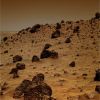
SOL914-1.jpgVolcanic Landscape - Sol 914 (possible True Colors; credits: Dr G. Barca & Lunexit)56 visitenessun commentoMareKromium
|
|
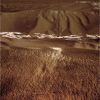
OPP-SOL644-1P185353757EFF6444P2567L3M1.jpgThe incredible "Dunes" around Erebus Crater (possible True Colors) - Sol 64456 visitenessun commentoMareKromium
|
|
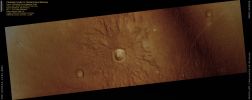
Psp_009654_2245_red.jpgPedestal Crater in Deuteronilus Mensae (natural colors; credits: Lunexit)56 visiteThis crater with spectacular ejecta is located in the Northern Mid-Latitudes in the Deuteronilus Mensae, located near the dichotomy boundary, where the Southern Highlands transition into the Northern Lowlands.
The crater has raised, fluidized ejecta. Scientists think that fluidized ejecta forms when an impact occurs into ice-rich material. The interior of the crater shows some material, particularly on the West wall, that has detached and is flowing into the crater center. This suggests the presence of ground ice.MareKromium
|
|
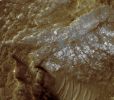
PSP_010012_2225_RED_abrowse-01.jpgDeep Rocks Unveiled at Bonestell Crater (edm; natural colors; credits: Lunexit)56 visiteThis edm (437x500 mt or 479x547 yards) of the HiRISE image shows a portion of Bonestell's Central Peak. HiRISE reveals details in the structure and color of these deep rocks that will help scientists decipher the origin and history of the Northern Lowlands.MareKromium
|
|
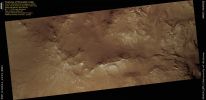
PSP_010012_2225_RED_abrowse-00.jpgDeep Rocks Unveiled at Bonestell Crater (ctx frame; natural colors; credits: Lunexit)56 visiteImpact craters are sometimes nicknamed “Mother Nature's drill holes” because, thanks to them, deep rock formations are exposed at the surface. Bonestell Crater is a good example.
This image depicts part of the floor of this relatively young impact crater located in the Northern Lowlands. The Northern Lowlands occupy most of the northern half of Mars. They are younger than the Southern Highlands, as shown by the lower number of impact craters, and well below the Planet’s Average Elevation. Their origin is still a mystery.
Bonestell is about 42 Km (approx. 26 miles) in diameter and about 1250 meters (4100 feet) deep. The rocky hills on the floor of this crater constitute its “Central Peak”.
Central peaks form due to elastic rebound of subsurface materials immediately after impact. The rocks in Bonestell's Central Peak may have been 4-to-8 Km below the surface before impact.MareKromium
|
|
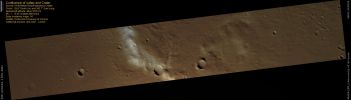
Psp_009669_1500_red.jpgConfluence of Valley and Crater (natural colors; credits: Lunexit)56 visiteThis image shows the South-Eastern Rim of a large degraded Impact Crater where a Valley breaches the Crater Rim. The Valley itself, no longer pristine, is difficult to locate in the image.
However, it appears to be in the center, near the right of the Crater Rim. It is possible that this Valley transported water into the Crater, forming a lake in the ancient past.
The scene is peppered with craters of various sizes and states of degradation, indicating that the surface is not young.
A few craters are young enough to still have raised rims. One of these, located on the floor of the larger crater, has distinct raised ejecta radiating out from it.
The crater also has dunes on its floor, indicating that aeolian processes have modified it since it formed.MareKromium
|
|
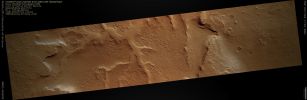
PSP_007394_1750_RED_abrowse~0.jpgInverted Fluvial Channels and Craters with Ejecta Rays (natural colors; credits: Lunexit)56 visiteThe lower part of this image shows well-defined overlapping channels, which have inverted topography (i.e.: they were once low spots that have been filled in with sediments and now eroded in a such a way that they appear as topographically high regions).
The channels have a winding and intersecting geometry indicating the shifting of the channels over time, a feature consistent with the flow of water in rivers. The channels have small craters that have excavated the channel materials and ejected them to form well-defined rays. There are dark slope streaks (toward the top of the image) showing transport of fine dust down the slope of an eroded bedrock terrain.MareKromium
|
|
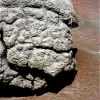
OPP-SOL251-04.jpgThe "Sleeping Bear" (a.k.a.: "Wopmay") - Sol 251 (possible True Colors; credits: Dr G. Barca)56 visitenessun commentoMareKromium
|
|

ZZ-Mercury-Craters-Unnamed_Southern_Rayed_Crater-PIA11371.jpgSpectacular "Rayed-Crater" (Enhanced Natural Colors; credits for the additional process. and color.: Dr Paolo C. Fienga - Lunexit Team)56 visiteThis NAC image shows a bright crater with an extensive system of impact ejecta rays; the crater is also clearly visible on the Southern portion of Mercury near the Limb of the Planet in the departure full-planet image (see PIA11245).
This impact crater and its associated system of rays were originally detected in 1969 as a “bright feature” in radar images at 12,5-centimeter wavelength obtained by the Goldstone Observatory in California. Subsequently, about a decade ago, radar images acquired by the Arecibo Observatory in Puerto Rico clearly revealed this feature to be a crater with a fresh system of rays of rough material radiating outward from it. This feature has been referred to simply as Feature “A”.
MESSENGER’s recent Mercury flyby provided the first Spacecraft images of Feature “A”, enabling this relatively young crater with its impressive set of rays to be seen here in close-up detail.
Date Acquired: October 6, 2008
Image Mission Elapsed Time (MET): 131773947
Instrument: Narrow Angle Camera (NAC) of the Mercury Dual Imaging System (MDIS)
Resolution: 530 meters/pixel (0,33 miles/pixel)
Scale: The bright rayed crater is approx. 80 Km (about 50 miles) in diameter
Spacecraft Altitude: approx. 20.600 Km (about 12.800 miles)MareKromium
|
|
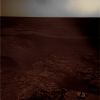
OPP-SOL1702-1N279292342EFF93LGP0723L0M1.jpgMeridiani Twilights - Sol 1702 (natural colors; credits: Lunexit)56 visitenessun commentoMareKromium
|
|
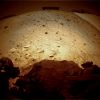
SOL1723-2R279326208EFFAZ13P1312R0M1.jpgSlow Movements... - Sol 1723 (natural colors; credits: Lunexit)56 visitenessun commentoMareKromium
|
|
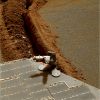
OPP-SOL487-1.jpgSolar Panels and Surface - Sol 487 (possible True Colors; credits: Dr G. Barca)56 visitenessun commentoMareKromium
|
|
| 25353 immagini su 2113 pagina(e) |
 |
|
|
|
|
1687 | |
|
|
|
|





