| Piú viste |
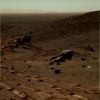
SOL510-GB.jpgRover Tracks and the "foggy" distant Rim of Gusev Crater - Sol 510 (Enhanced and Darkened Natural Colors; credits: Dr G. Barca & Lunar Explorer Italia)56 visitenessun commentoMareKromium
|
|

SOL545-GB.jpgSkyline - Sol 545 (Natural Colors; credits: Dr G. Barca & Lunar Explorer Italia)56 visitenessun commentoMareKromium
|
|
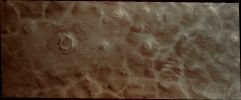
Vastitas_Borealis-NP-MO-20090219a.jpgVastitas' Texture (Natural Colors; credits for the additional process. and color.: Dr Paolo C. Finega - Lunar Explorer Italia)56 visiteCaption NASA:"The Northern Plains of Mars contain an abundance of different textures and appearances. This Region contains mounds separated by channels with an unusual floor pattern. Just how this texture formed is unknown".
Coord.: 70,0° North Lat. and 55,9° East Long.MareKromium
|
|

South_Polar_Feartures-Layers-20090223a-PCF-LXTT.jpgSouth Polar Spring (Darkened Absolute Natural Colors; credits for the additional process. and color.: Dr Paolo C. Fienga - Lunar Explorer Italia)56 visiteCoord. 84,4° South Lat. and 313,9° East Long.MareKromium
|
|
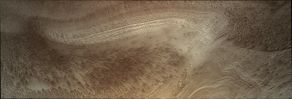
South_Polar_features-Fans-SP-MO-20090224a.jpgSouth Polar Spring: Fans (Natural Colors; credits for the additional process. and color.: Dr Paolo C. Fienga - Lunar Explorer Italia)56 visiteCaption NASA:"As the Sun continues to warm the South Polar Region, spots appear on the ice. The dark material of the spots is apparently mobile, with the wind able to lengthen the spots into streaks".
Coord.: 86,6° South Lat. and 99,1° East Long.MareKromium
|
|

Saturn-PIA10585.jpgSaturnian Terminator (Natural Colors; credits: Lunar Explorer Italia)56 visiteCaption NASA:"The Terminator nearly covers the South Pole of Saturn and its stormy vortex in darkness.
As the Southern Hemisphere moves toward Winter in the Planet's 29-year orbit, darkness eventually will consume the vortex. But this seasonal change also will bring the North Pole into the light.
This view looks toward the sunlit side of the Rings from about 69° below the Ring-Plane.
The image was taken with the Cassini Spacecraft wide-angle camera on Jan. 6, 2009 using a spectral filter sensitive to wavelengths of near-InfraRed Light centered at 752 nanometers. The view was acquired at a distance of approx. 761.000 Km (about 473.000 miles) from Saturn and at a Phase Angle of 96°.
Image scale is roughly 42 Km (approx. 26 miles) per pixel.MareKromium
|
|
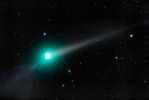
Comets-Comet_Lulin03-Richins.jpgThe Two Tails of Comet Lulin56 visiteCaption NASA:"Go outside tonight and see Comet Lulin. From a dark location, you should need only a good star map and admirable perseverance -- although wide-field binoculars might help. Yesterday, Comet Lulin passed its closest to Earth, so that the comet will remain near its brightest over the next few days. The comet is currently almost 180° around from the Sun and so visible nearly all night long, but will appear to move on the sky about 10 full moons a night. Pictured above, Comet Lulin was captured in spectacular form two nights ago from New Mexico, USA.
The central coma of the comet is appearing quite green, a color likely indicating glowing cyanogen and molecular carbon gasses. Bright stars and a distant spiral galaxy are clearly visible in the image background. The yellow dust tail, reflecting sunlight, is visible sprawling to the coma's left trailing behind the comet, while the textured bluish-glowing ion tail is visible to the coma's right, pointing away from the Sun. Over the past few weeks, from the current vantage point of Earth, these two tails appeared to point in opposite directions. Comet Lulin is expected to slowly fade over the next few weeks".MareKromium
|
|

Titan-Dunes-PIA11802.jpgAt the Edge of Titan's Dunes56 visiteThis is a portion of a Cassini Radar Mapper image obtained by the Cassini Spacecraft on its Dec. 21, 2008, flyby of Saturn's moon Titan.
The area shown covers the southern boundary of an equatorial band where longitudinal dunes (dunes that form along the wind direction) are pervasive.
Here the dunes are apparently created by winds locally coming from the West and North-West, and generally blowing toward the East. The dunes are interspersed with radar-bright features that are inferred to rise above the surrounding terrain.
In the lower part of the image there are no dunes at all, and the texture is more typical of featureless plains observed in many other areas of Titan that lack dunes.
In this Transition Zone, the sand-sized particles that make up the dunes might not be so plentiful. In this case, insufficient sand to replenish the dunes makes them gradually disappear.
To compare the nature of these dunes to those seen at the Northern Boundary of the dune fields observed in radar images obtained during the T3 flyby on Feb. 15, 2005 see PIA07009.
The image is centered near 19,2° South Lat. and 257,4° West Long.
It covers an area of about 220 Km (approx. 137 miles) by about 170 Km (approx. 106 miles). North is approximately toward the top of the image, the radar illumination is from the right, and the Solar Incidence Angle is about 25° (meaning that the Sun was 65° above the Local Horizon).
The vertical stripe across the image at its center is an artifact in this preliminary version.MareKromium
|
|

Rhea-PIA10586.jpgRhea (Natural Colors; credits: Lunar Explorer Italia)56 visiteCaption NASA:"A wide crater dominates the lower right of this image while part of Rhea's brightly lit, wispy terrain can still be seen near the limb of the moon.
Smaller craters are overprinted upon this crater, telling the story of an extremely old feature that has collected impacts over the eons. Younger craters also have been collected on another of Rhea's large basins — Tirawa (see also PIA08976).
North on Rhea (approx. 1528 Km, or about 949 miles across) is up. This view looks toward the Saturn facing-Side of Rhea. The image was taken in visible light with the Cassini Spacecraft narrow-angle camera on Aug. 27, 2008. The view was acquired at a distance of approx. 1,1 MKM (such as about 680,000 miles) from Rhea and at a Sun-Rhea-Spacecraft, or Phase, Angle of 56°.
Image scale is roughly 6 Km (about 4 miles) per pixel".MareKromium
|
|
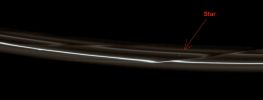
PIA10587.jpgThe "Fragile" F-Ring56 visiteCaption NASA:"Set starkly against the blackness of space are the F-Ring's delicate strands which are periodically gored by its shepherding moon, Prometheus.
Prometheus (approx. 86 Km, or about 53 miles across) and Pandora (approx. 81 Km, or about 50 miles across) both interact with the F-Ring but neither is visible here. Prometheus has the larger effect (see, for instance, PIA08397 for a movie of Prometheus creating a Streamer-Channel in the ring).
A star can be seen through the ring on the right side (Dx) of the image.
This view looks toward the unilluminated side of the Rings from about 33° above the Ring-Plane. The image was taken in visible light with the Cassini Spacecraft narrow-angle camera on Jan. 11, 2009.
The view was acquired at a distance of approx. 1 MKM (such as about 620,000 miles) from Saturn and at a Sun-Saturn-Spacecraft, or Phase, Angle of 37°.
Image scale is roughly 6 Km (about 4 miles) per pixel".MareKromium
|
|

Titan-Map-PIA11149.jpgTitan's Global Digital Map (credits: NASA/JPL/Space Science Institute)56 visiteThis Global Digital Map of Saturn's moon Titan was created using images taken by the Cassini Spacecraft's Imaging Science Subsystem.
The images were taken using a filter centered at 938 nanometers, allowing researchers to examine variations in albedo (or inherent brightness) across the Surface of Titan. Because of the scattering of light by Titan's dense Atmosphere, no topographic shading is visible in these images.
The map is an equidistant projection and has a scale of 4 Km (about 2,5 miles) per pixel. Actual resolution varies greatly across the map, with the best coverage (close to the map scale) near the center and edges of the map and the worst coverage on the Leading Hemisphere (centered around 120° West Long.).
Imaging coverage in the Northern Polar Region continues to improve as Titan approaches northern vernal equinox in August 2009 and the North Pole comes out of shadow. Large dark areas, strongly suspected to be liquid-hydrocarbon-filled lakes, have been documented at high at high latitudes (see PIA11146).
The mean radius of Titan used for projection of this map is 2,575 kilometers (1,600 miles). Until a control network is created for Titan, the satellite is assumed to be spherical.
MareKromium
|
|
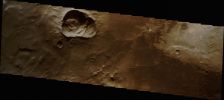
Craters-Herschel_Crater-Dunefield-20090303a-PCF-LXTT.jpgDunefield inside Herschel Crater (Extremely Enhanced Natural Colors; credits for the additional process. and color.: Dr Paolo C. Fienga - Lunexit Team)56 visiteCoord.: 15,5° South Lat. and 131,7° East Long.MareKromium
|
|
| 25353 immagini su 2113 pagina(e) |
 |
|
|
|
|
1684 | |
|
|
|
|





