| Piú viste |

T-CerberusFossae-05.JPGThe Fissures of Cerberus Fossae (Hi-Def3-D - credits and Copyright: Dr G. Barca and Lunar Explorer Italia)56 visitenessun commentoMareKromium
|
|
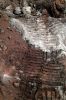
SOL429-GB.jpgRover Tracks - Sol 429 (possible True Colors; credits: Dr G. Barca)56 visitenessun commentoMareKromium
|
|
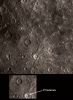
ZZ-Mercury-Craters-Enwonwu_Crater-PIA11784-1.jpgEnwonwu: a young Mercurian Crater (Natural Colors; credits: Lunar Explorer Italia)56 visiteThe feature indicated by the white arrow in this NAC image is the newly named crater Enwonwu (see also PIA11762). It is named in honor of Benedict (Ben) Chukwukadibia Enwonwu, the 20th Century modernist Nigerian sculptor and painter.
Enwonwu Crater displays a Central Peak and a set of bright rays emanating from the Crater Rim. The rays cross the surrounding surface and neighboring craters, indicating that Enwonwu Crater was formed comparatively recently in Mercury’s history. The brightness of the rays also suggests relative youth, as over time rays darken and disappear on Mercury's Surface.
These relationships provide useful indicators for determining the relative ages of features and the sequence of events that have shaped the Surface of Mercury.
Date Acquired: January 14, 2008
Image Mission Elapsed Time (MET): 108829024
Instrument: Narrow Angle Camera (NAC) of the Mercury Dual Imaging System (MDIS)
Resolution: 590 meters/pixel (0,37 miles/pixel)
Scale: Enwonwu Crater is about 38 Km (approx. 24 miles) in diameter
Spacecraft Altitude: about 23.000 Km (approx. 14.300 miles)MareKromium
|
|

ZZ-Mercury-Global_View_of_the_Surface-PIA11795_fig1.jpgVarious Mercurian Surface Features (natural colors; credits: Lunar Explorer Italia)56 visiteThis NAC image displays a number of interesting geologic features characteristic of Mercury’s Surface.
The Crater indicated by the yellow arrow has unusual bright material on its floor, likely due to rocks of a different chemical composition. Bright material also has been seen in the craters Sander and Kertész.
The pink arrows point to a pair of larger and older craters that have been flooded with now solidified volcanic lava, similar to flooding seen at the impact basin Raphael. In the lower right-hand corner of the image is a large peak-ring Basin, about 210 Km (approx. 130 miles) in diameter, which also appears to have been flooded with lava. There is also a small Scarp (or "Cliff") within that Basin that cuts through a smaller crater at the edge of the Basin's inner ring, at the point indicated by the blue arrow.
Scarps on Mercury are often seen intersecting Impact Craters, such as this dramatic, previously released image from the mission's second Mercury flyby (see, for example, PIA11358).
The green arrows on the left side of the image indicate a series of Secondary Crater Chains. Chains of small craters such as these are formed when ejecta are expelled from a Primary Crater after the initial impact. Secondaries are widespread across Mercury's Surface, as was also discussed in the caption to this previously released image (see PIA10178).
Unraveling Mercury's Geologic History requires investigating the complex and overlapping relationships of Volcanic Plains, Impacts and Scarps seen on the Planet's Surface.
Date Acquired: October 6, 2008
Image Mission Elapsed Time (MET): 131774026
Instrument: Narrow Angle Camera (NAC) of the Mercury Dual Imaging System (MDIS)
Resolution: 540 meters/pixel (0,33 miles/pixel)
Scale: This image is about 550 Km (approx. 340 miles) across
Spacecraft Altitude: about 21.000 Km (approx. 13.000 miles)MareKromium
|
|
SOL377-2P159833255EFFA2HPP2358R1M1.jpgPanorama (3) - Sol 377 (Natural Colors; credits: Lunar Explorer Italia)56 visitenessun commentoMareKromium
|
|
SOL541-2-GB-LXT.jpgRocky Landscape - Sol 541 (possible True Colors; credits: Dr G. Barca & Lunar Explorer Italia56 visitenessun commentoMareKromium
|
|
SOL8112P198357320EFFAR00P2408R1M1.jpgLooking up... - Sol 811 (Natural Colors; credits: Lunar Explorer Italia)56 visitenessun commentoMareKromium
|
|
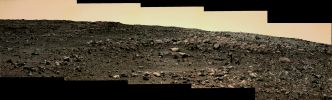
SOL541-Panoramic-GB.jpgRocky Panorama and Skyline - Sol 541 (possible True Colors; credits: Dr G. Barca)56 visitenessun commentoMareKromium
|
|

PSP_005748_1075_RED_abrowse~0.jpgBuried Crater in the SPLD (natural colors; credits: Lunexit)56 visiteThis image of the SPLD shows some of the layers cut off against other layers below and right of center. Geologists call this an “angular unconformity” because the layers do not conform to each other across this boundary.
In this case, the angular unconformity was probably caused by erosion of the SPLD followed by deposition of new SPLD on top of the eroded surface, but faulting could also have caused the observed unconformity.
Near the unconformity is an impact crater, one of dozens found on the SPLD. The presence of these craters implies that the surface of the SPLD has been relatively stable (i.e., little erosion or deposition) in the past few million years.
This is in stark contrast to the NPLD, on which craters are very rare, implying very recent erosion/deposition.MareKromium
|
|
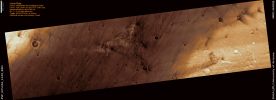
PSP_005456_1650_RED_abrowse-00~0.jpgHome Plate from Orbit (CTX Frame - Enhanced Natural Colors - elab. Lunexit)56 visitenessun commentoMareKromium
|
|

PSP_005424_1700_RED_abrowse~0.jpgAurorae Chaos (MULTISPECTRUM; credits: Lunexit)56 visiteThis observation shows a portion of Aurorae Chaos, chaotic terrain East of the Vallis Marineris Canyon System. Aurorae Chaos extends from Capri and Eos Chasmata on the West, into Hydraotes and Aureum Chaos on the North and East.
Chaotic terrain is thought to form from subsurface collapse following volatile release. It is possible that the Martian crust was at one time enriched in ices that became gases or liquid at relatively low temperatures upon encountering a heat source or was violently shaken. These ices existed in spaces between soil particles. If a large volume of volatiles is suddenly released, then there is a large portion of the soil volume missing. The soil cannot support itself, so it collapses.
Since chaotic terrain is often located at the head of the Martian outflow channels (giant flood plains), it is also possible that the Chaotic Regions are the source of the fluids that formed the outflow channels.
Aurorae Chaos connects to outflow channels via other Chaotic Regions.MareKromium
|
|
SOL418-2P163473227EFFA808P2374L7M1.jpgBoulders (1) - Sol 418 (Natural Colors; credits: Lunar Explorer Italia)56 visitenessun commentoMareKromium
|
|
| 25353 immagini su 2113 pagina(e) |
 |
|
|
|
|
1683 | |
|
|
|
|





