| Piú viste |

North_Polar_Features-North_Polar_Cap-MGS.jpgAnnular Clouds over the North Pole (Natural Colors; credits: NASA/JPL/MSSS)56 visiteCaption NASA:"Two annular (---> somewhat circular) clouds are seen in the upper left corner of this mosaic of MOC wide angle camera daily global mapping images. To the right of the picture's center is the Martian North Polar Cap. The image has a scale of about 7,5 Km (about 4,7 miles) per pixel. Annular clouds are common in mid-Northern Summer in the North Polar Region and may result from eddy currents in the lower atmosphere. The appearance of such clouds happens every year; this year they came like clockwork within a two-week forecasted period, based on the previous 4 Martian Years of experience gained from MGS MOC daily global imaging.
Despite their superficial resemblance to Earth-orbiting satellite views of hurricanes, these cloud features are not the result of strong winds and they typically dissipate later in the day. The pictures used to make this mosaic were acquired less than 2 days before the MOC was turned off for MGS's 5th Mars-Earth Solar Conjunction period. During Conjunction, Mars was on the other side of the Sun, relative to Earth, and thus MGS could not transmit data (through the Sun) during the second half of October".
|
|
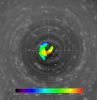
Saturn-PIA08334.jpgThe temperature of Saturn's "Stormy" South Pole56 visiteThe Cassini data presented in this view appear to confirm a region of warm atmospheric descent into the eye of a hurricane-like storm locked to Saturn's south pole. The view shows temperature data from the Cassini spacecraft composite infrared spectrometer overlaid onto an image from the imaging science subsystem wide-angle camera.
The composite infrared spectrometer data refer to a depth in Saturn's upper stratosphere where the pressure is 0.5 millibars (324 kilometers above the 1-bar level), a region higher than that imaged by the imaging camera and visual and infrared spectrometer during the same observation period. The composite infrared spectrometer data show a very small hot spot over the pole, similar in size to the "eye" of the storm seen in the imaging science subsystem images. See also Looking Saturn in the Eye and Saturn's Surprisingly Stormy South for related images.
The color scale at the bottom indicates the temperature in Kelvin corresponding to the colors of the temperature map. Numbers on the grid correspond to lines of latitude and longitude on the planet.
Infrared images taken through the Keck I telescope by ground-based observers had previously shown the south polar spot to be warm. Cassini's composite infrared spectrometer has confirmed this with higher resolution temperature maps of the area (like the map displayed here) and sees a temperature increase of about 2 Kelvin (4 degrees Fahrenheit) at the pole.
The temperatures are in the stratosphere and higher up than the clouds seen by the Cassini imaging and visual and infrared mapping spectrometer instruments, but they suggest that the atmosphere sinks over the south pole. Because the pressure increases with depth, the descending atmosphere compresses and heats up. The warmer temperatures over the south pole also indicate that the vortex winds are decaying with height in the stratosphere. The descent implied by the temperatures nicely supports the lower cloud altitudes observed by the imaging camera and visual and infrared spectrometer instruments at the pole.
The image and atmospheric data were acquired on Oct. 11, 2006, when Cassini was approximately 340,000 kilometers (210,000 miles) from Saturn. The wide-angle camera image was taken using a spectral filter sensitive to wavelengths of infrared light centered at 752 nanometers. The image has been contrast enhanced using digital image processing techniques. The unprocessed image shows an oblique view toward the pole, and was reprojected to show the planet from a perspective directly over the south pole. Scale in the original image was about 17 kilometers (11 miles) per pixel.
|
|
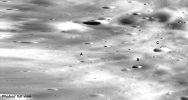
Phobos_from_Mgs-009.jpgPhobos, from MGS (Original NASA/MGS/MSSS Full Frame n. 3)56 visiteLett. E: il secondo (più piccolo, ma certo non meno inesplicabile) Monolito di Phobos.
Nota: nella parte superiore del frame sono visibili anche altri rilievi colonnari - riconoscibili a causa delle ombre assolutamente peculiari che proiettano in condizioni di illuminazione radente - ancora più piccoli.
Le "Colonne di Phobos" e le "Cuspidi di Blair": potrebbe esistere una connessione? Questi rilievi possono essere il frutto di processi geologici simili?
Che ne pensate?MareKromium
|
|
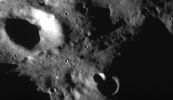
Phobos_from_Mgs-007.jpgPhobos, from MGS (Original NASA/MGS/MSSS Full Frame n. 1)56 visiteLett. A: grappolo di boulders a forma "colonnare" (si direbbe un gruppo di tre boulders allineati secondo un ordine dimensionale coerente ed un ulteriore rilievo, anch'esso di apparenza colonnare, posto nelle immediate vicinanze del primo gruppo).
Lett. B: rilievo anomalo, decisamente alto (a giudicare dall'ombra che proietta), posto sul versante interno di un cratere di modeste diomensioni, a circa mezza altezza della murata.
Lett. C: gruppo di rilievi anomali (si direbbe 3 o 4) - concettualmente molto simili al grappolo di boulders evidenziato sub lett. A - posti sul ciglio di un cratere di medie dimensioni.MareKromium
|
|
OPP-SOL994-1F216428723EFF76WUP1211L0M1.jpgAlmost on the edge... - Sol 99456 visitenessun commentoMareKromium
|
|
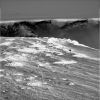
OPP-SOL994-1P216429456EFF76WUP2423R2M1.jpgJust a huge "hole in the ground" (3)56 visitenessun commentoMareKromium
|
|

as04-01-081.jpgAS 04-01-0081 - A slice of Earth (3)56 visitenessun commentoMareKromium
|
|

as04-01-091.jpgAS 04-01-0091 - A slice of Earth (4)56 visitenessun commentoMareKromium
|
|

as09-23-3612.jpgAS 09-23-3612 - ...From above56 visiteMareKromium
|
|

as07-04-1595.jpgAS 07-04-1595 - A smooth coastline56 visiteMareKromium
|
|
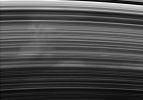
Spokes-PIA08316.jpgSpokes!56 visiteCaption NASA originale:"A broad and ghostly spoke drifts past under the Cassini spacecraft's gaze. The spoke-forming region of the B-Ring displays faint longitudinal variations in brightness, from left to right, a feature seen also in other images.
This view looks toward the unlit side of the Rings from about 35° above the Ring-Plane.
The image was taken in visible light with the Cassini spacecraft narrow-angle camera on Oct. 17, 2006 at a distance of approx. 2 MKM (such as about 1,3 MMs) from Saturn and at a Sun-Saturn-spacecraft, or phase, angle of 158°. Image scale is roughly 12 Km (about 7 miles) per pixel".
|
|

SchiaparelliCrater-processed.jpgA thick layer of dust over Schiaparelli Crater56 visitenessun commentoMareKromium
|
|
| 25353 immagini su 2113 pagina(e) |
 |
|
|
|
|
1682 | |
|
|
|
|





