| Piú viste |

The_Rings-PIA11483.jpgShadows on the Rings56 visite...EccoVi un altro esempio delle "gigantesche navi spaziali" che si muoverebbero attraverso gli Anelli di Saturno, secondo il Dr Bergrun...
In realtà è soltanto la lunga ombra della luna saturniana Tethys la quale, all'avvicinarsi dell'Equinozio, si stende sugli Anelli del Gigante Gassoso, dando l'impressione - ma solo ad un osservatore completamente disattento - della esistenza di un vascello scuro a forma di fuso che si muove attraverso gli Anelli "F" ed "A".
Caption NASA:"Joining other moons in heralding the coming of Saturn's August 2009 Equinox, the moon Tethys casts its shadow across Saturn's F-Ring and part of the A-Ring.
The penumbra, or outer non-opaque part of Tethys' shadow, has intersected the A-ring. Only around the time of Equinox are the shadows of the moons cast onto Saturn's Rings. For an animation of the moon Epimetheus casting a shadow on the A-Ring, see also PIA11651.
The image on the left was taken in Visible Light with the Cassini Spacecraft wide-angle camera on March 20, 2009. The image on the right was taken with the narrow-angle camera at nearly the same time. Tethys itself is not visible in these images, but the small moon Prometheus can be seen between the F and A-Rings in the top of the wide-angle camera image.
This view looks toward the unilluminated side of the Rings from about 37° above the Ring-Plane. The view was obtained from a distance of approx. 880.000 Km (about 547.000 miles) from Saturn and at a Sun-Saturn-Spacecraft, or Phase, Angle of 124°.
Image scale is roughly 49 Km (about 31 miles) per pixel in the wide-angle image. In the narrow-angle camera image, the scale is roughly 5 Km (a little more than 3 miles) per pixel".MareKromium
|
|

SOL085-2P133909841ESF2232P2875L7M1.jpgHeat-Shield - Sol 85 (Darkened and Enhanced Natural Colors; credits for the additional process. and color.: Dr Paolo C. Fienga - Lunar Explorer Italia)56 visitenessun commentoMareKromium
|
|
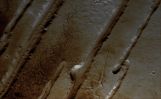
Channels-Panchaia_Rupes-PIA08622-1.jpg"Linear Fractures" or "Through Segments"? - Panchaia Rupes Region (Natural Colors; credits for the additional process. and color.: Dr Paolo C. Fienga - Lunexit Team)56 visiteImage information: VIS instrument;
Latitude: 29,9° North;
Longitude: 138,5° East;
Resolution: 19 meter/pixel.MareKromium
|
|

OPP-SOL061-1N133613905EFF0874P1961L0M1.jpgMartian Rebounds... - Sol 61 (Natural Colors; credits: Lunar Explorer Italia)56 visiteOre 15:49:30 MLTMareKromium
|
|
OPP-SOL070-1N134412368EFF0900P1966L0M1.jpgSmall Ripples and Deep Hollows - Sol 70 (Natural Colors; credits: Lunar Explorer Italia)56 visiteOre 15:44:19 MLTMareKromium
|
|

OneStepAway.jpgOnly One Step Away... (by Roberto Tremolada)56 visitenessun commentoMareKromium
|
|

The_Rings-PIA11486.jpgShadow on the Rings (Natural Colors; credits: Lunar Explorer Italia)56 visiteCaption NASA:"Saturn's moon Tethys casts a wide shadow over the Planet's "F" and "A"-Rings.
Tethys itself is not visible in this image. As Saturn approaches its August 2009 Equinox, the planet's moons cast shadows onto the Rings. To learn more about this special time and to see a movie of a moon's shadow moving across the Rings, see also PIA11651.
This view looks toward the sunlit side of the rings from about 36° below the Ring-Plane.
The image was taken in Visible Light with the Cassini Spacecraft wide-angle camera on April 21, 2009. The view was obtained at a distance of approx. 1,1 MKM (such as about 684.000 miles) from Saturn and at a Sun-Saturn-Spacecraft, or Phase, Angle of 142°.
Image scale is roughly 63 Km (about 39 miles) per pixel".MareKromium
|
|
SOL1180-GB-LXT.jpgPeaceful Horizon - Sol 1180 (Natural Colors; credits: Dr G. Barca & Lunar Explorer Italia)56 visitenessun commentoMareKromium
|
|
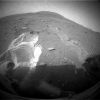
SOL1899-PIA12007.jpgSpirit's "Soft-Sand Grave" - Sol 189956 visiteCaption NASA:"Wheel slippage during attempts to extricate NASA's Mars Rover Spirit from a patch of soft ground during the preceding two weeks had partially buried the wheels by the 1899th Martian Day, or Sol, of the Spirit's Mission on Mars (May 6, 2009). Spirit took this image with its Front HazCam on Sol 1899. With Spirit in the position shown here, the Rover Team temporarily suspended driving attempts while studying the ground around Spirit and planning simulation tests of driving options with a test rover at NASA's Jet Propulsion Laboratory in Pasadena, Calif.
Driving attempts between the time Spirit took a similar image (see PIA12002) 10 Soles earlier and when this image was taken moved the Rover a total of about 36 cm (such as abut 14").
While driving backwards, the Rover drags its right front wheel, which no longer rotates. For scale, the distance between the Wheel Tracks is about 1 meter (40"). This view is looking Northward, with Husband Hill on the horizon".MareKromium
|
|

OPP-SOL1886-1M295614429EFFA0__P2956M2M1.jpgMartian Granite? - Sol 1886 (Natural Colors; credits: Lunar Explorer Italia)56 visitenessun commentoMareKromium
|
|

ESP_012941_0930_RED_abrowse.jpgLandforms on the South Polar Residual Cap (Natural Colors; credits: Lunar Explerer Italia)56 visiteThis HiRISE image is located on the Carbon-Dioxide (CO2) rich Residual South Polar Ice Cap near 86° South Lat. and 353° East Long.
These rounded landforms evolve relatively quickly and erode into the surface of the Ice Cap (approximately 4-5 meters or 15 feet per year).
Their interesting shapes make for a striking appearance on the Surface.MareKromium
|
|
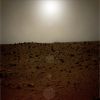
SOL1907-2N295663976EFFB1DNP1902R0M1.jpgPale Sun over Gusev Crater - Sol 1907 (Natural Colors; credits: Lunar Explorer Italia)56 visiteSpirit is embedded in loose, soft terrain on the west side of Home Plate. There is a real risk the Rover may be high-centered (underside touching) on a small mound of rocks right under its belly. Additionally, a left wheel motor stall occurred during the last Rover motion on Sol 1899 (May 6, 2009). No motion has been commanded since.
The project is engaged in a recovery activity. This involves extensive remote sensing observations by the rover of the local soil characteristics, and ground testing using the surface system testbed rover in the sandbox at JPL.
There has been no recurrence of the anomalous behavior that happened between Sol 1872 (April 9, 2009) and Sol 1881 (April 18, 2009). There is still no explanation for the previous anomalies, and the investigation is continuing.
The week provided more good news about solar array energy. Spirit experienced yet another substantial solar array dust cleaning event. On Sol 1900 (May 7, 2009), energy production improved by about 30 percent. With the significant improvement in energy, the rover can now support morning UHF relay passes, which will help with the backlog of collected data onboard. The Mars Odyssey project has made special efforts to support this additional relay.
As of Sol 1905 (May 13, 2009), solar array energy production is estimated around 652 watt-hours, with atmospheric opacity (Tau) at 0,774. The dust factor has improved substantially to 0,678, meaning that 67,8% of Sunlight hitting the solar array penetrates the layer of dust on the array. As of Sol 1906 (May 14, 2009), Spirit's total odometry remains 7729,93 meters (4,8 miles).MareKromium
|
|
| 25353 immagini su 2113 pagina(e) |
 |
|
|
|
|
1680 | |
|
|
|
|





