| Piú viste |
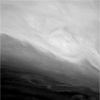
Saturn-W00016803.jpgTurbulence (2)56 visiteCaption NASA:"W00016803.jpg was taken on August 16, 2006 and received on Earth August 18, 2006. The camera was pointing toward Saturn that, at the time, was approx. 219.806 Km away.
This image was taken using the MT3 and CL2 filters".
|
|
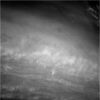
Saturn-W00016804.jpgTurbulence (3)56 visiteCaption NASA:"W00016804.jpg was taken on August 16, 2006 and received on Earth August 18, 2006. The camera was pointing toward Saturn that, at the time, was approx. 219.458 Km away.
This image was taken using the CB2 and CL2 filters".
|
|
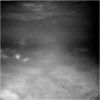
Saturn-W00016810.jpgTurbulence (4)56 visiteCaption NASA:"W00016810.jpg was taken on August 16, 2006 and received on Earth August 18, 2006. The camera was pointing toward Saturn that, at the time, was approximately 191.791 Km away.
This image was taken using the CB2 and CL2 filters".
|
|

90-August Moon.jpgThe "Impact Site" of SMART-156 visiteCaption ESA originale:"Reconnaissance view of the Moon on 20 August 2006 at 00:00 UT.
The Lunar North Pole is up.
The SMART-1 impact is expected on 3 September 2006 in the Lacus Excellentiae Region, at the top of the U-shape feature situated North of the crater Clausius "B". The nominal impact position is marked by the red circle".
|
|

40-Jacobi Crater.jpgJacobi Crater (HR)56 visiteThis HR image was taken by the advanced Moon Imaging Experiment (AMIE) on 18 March 2006 from a distance of about 578 Km from the Moon's surface, with a ground resolution of 52 mt per pixel. It shows part of crater Jacobi in the Moon's Southern Hemisphere. The western crater rim can be seen on the left edge of the image. The imaged area is centred at a Latitude of 56,5° South and a Longitude of 10,9° East, with a field of view of 27 Km. North is up.
Crater Jacobi itself is much larger than this image - 68 Km in diameter - with the imaged area only showing about 1/5th of the crater floor area. The crater is centred at a Latitude of 56,7° South and a Longitude of 11,4° East. The single prominent crater to the upper left of the image centre is Jacobi "W", with a diameter of only 7 Km.
Peculiar surface structure can be seen in the lower left part of the image, and indicates several heavily eroded big-sized craters.
SMART-1 resolution at high solar elevation angle allows for the detection of eroded structures buried under more recent layers, giving a window on the past evolution of the Moon.
The crater is named after the German mathematician Karl Gustav Jacob Jacobi (1804 - 1851), who worked on elliptic functions and was active in the field of celestial mechanics
|
|

42-CuvierC-AMI_EAE3_002085_L,1.jpgCuvier "C"56 visiteCaption ESA originale:"This high-resolution image, taken by the Advanced Moon Imaging Experiment (AMIE) on board ESA’s SMART-1 spacecraft, shows the young crater ‘Cuvier C’ on the Moon.
AMIE obtained this sequence on 18 March 2006 from a distance of 591 Km from the surface, with a ground resolution of 53 mt per pixel. The imaged area is centred at a Latitude of 50,1º South and a Longitude of 11,2º East, with a field of view of 27 Km. The North is on the right of the image.
Cuvier "C", a crater about 10 Km across, is visible in the lower right part of the image. Cuvier "C" is located at the edge of the larger old crater Cuvier, a crater 77 Km in diameter. The upper left quadrant of the image contains the smooth floor of Cuvier, only one fourth of which is visible in this image".
|
|
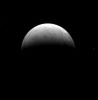
Enceladus-PIA08249.jpgEnceladus56 visiteCaption NASA:"Few large craters are to be found in the wrinkled terrain of Enceladus, where the surface has been reworked by geologic processes presumably resulting from the moon's inner warmth.
Cassini spied the bright crescent of Enceladus on July 23, 2006 at a distance of approx. 628.000 Km (about 391.000 miles).
The image was taken in visible light with the Cassini spacecraft narrow-angle camera at a Sun-Enceladus-spacecraft, or phase, angle of 103°. Image scale is roughly 4 Km (about 2 miles) per pixel".
|
|
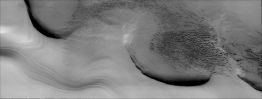
North_Polar_Features-PIA08694-00.jpgNorth Polar Landscape (Original NASA/2001 Mars Odyssey Orbiter b/w Frame)56 visiteImage information: VIS instrument;
Latitude: 83,6° North;
Longitude: 120,3° East;
Resolution: 40 meter/pixel.
|
|

North_Polar_Features-Unconformity-MGS-01.jpgNorth Polar "Unconformity" (Original NASA/MGS/MSSS b/w Frame)56 visiteCaption NASA originale:"This MGS-MOC image shows layered material exposed on a slope in the North Polar Region.
An "unconformity" is visible in the middle/lower left of the image, where layers are abruptly truncated. Unconformities are indicators of drastic change in the Region — the lower layers were deposited first, then eroded, then the upper layers were deposited".
Location near: 81,1° North Lat. and 75,2° West Long.
Image width: ~3 Km (~1,9 mi)
Illumination from: lower left
Season: Northern Spring
|
|

APOLLO 16 AS 16-122-19580.jpgAS 16-122-19580 - King Crater56 visiteThis vertical view of the crater King on the Lunar Far-Side was taken with the Apollo 16 Hasselblad camera. King, approx. 75 Km in diameter and 4 Km deep, is one of the most interesting features on the Far-Side. It is a superb example of a youthful, large crater. It attracted much attention and was the object of numerous scientific studies (Young, Brennan and Wolfe, 1972).
King is the freshest crater on the Far-Side in its size range. Among its many interesting features are:
1) a unique lobster-claw-like central peak;
2) a flat poollike area of dark material on the North rim believed to have once been molten;
3) a very-well-developed field of fine ejecta extending outward for approx. two crater diameters, and
4) a massive landslide on the South-East rim (see arrow).
In this view the Southern part of the central peak has a distinctly ropey appearance and is segmented parallel to the terraces of the adjacent crater wall. The low Sun illumination enhances the fine texture of King's ejecta. Northeast of King the ejecta mantles an old large crater and in the southwest corner of the picture it mantles a relatively smooth terra unit. The slightly raised plateau on which the crater is situated may be part of the ring of an old basin.
|
|
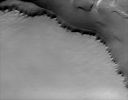
North_Polar_Features-North_Polar_Margin-PIA08705-1.jpgThe North Polar "Margin" (1 - Original NASA/JPL/ASU b/w Frame)56 visiteImage information: VIS instrument;
Latitude: 81,1° North;
Longitude: 299,2° East:
Resolution: 20 meter/pixel.
|
|

OPP-SOL926-1M210388086EFF758ZP2936M2M1.jpgThe "texture" of Mars... - Sol 92656 visitenessun commento
|
|
| 25353 immagini su 2113 pagina(e) |
 |
|
|
|
|
1678 | |
|
|
|
|





