| Piú viste |
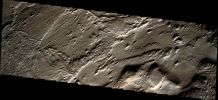
Aeolian_Features-Inverted_Channels-EP-MO-20090323a.jpgInverted Channels in Aeolis Planum (Absolute Natural Colors; credits for the additional process. and color.: Dr Paolo C. Fienga - Lunexit Team)56 visiteCaption NASA:"This VIS image shows a portion of the Eastern side of Aeolis Planum.
The Region has been extensively eroded by the wind. Relics of an earlier surface are located in the central part of the image, in the form of Inverted Channels.
This meaning that the material which filled in the Channels is more resistant to the wind than the surrounding materials".
Coord.: 3,0° South Lat. and 149,7° East Long.MareKromium
|
|

OPP-SOL1833-GB.jpgMicroscopic Vision: Brushed Berries (possible True Colors; credits: Dr G. Barca)56 visitenessun commentoMareKromium
|
|

OPP-SOL1829-GB.jpgMicroscopic Vision: Old Berries (possible True Colors; credits: Dr G. Barca)56 visitenessun commentoMareKromium
|
|

OPP-SOL1826-GB.jpgMicroscopic Vision: Cracks and Old Berries (possible True Colors; credits: Dr G. Barca)56 visitenessun commentoMareKromium
|
|

OPP-SOL1826-PIA11856.jpgUp-Sun at Cook Islands' Outcrop - Sol 1826 (Natural Colors; credits: Lunar Explorer Italia)56 visitenessun commentoMareKromium
|
|

SouthPolarSpiders-PIA11857.jpgSouth Polar Fans (Natural Colors; credits: Lunar Explorer Italia)56 visiteCaption NASA:"Every Winter, Mars' Polar Region is covered with a layer of seasonal CO2 (Carbon Dioxide ice - a.k.a. "dry ice"). In the Spring, jets of gas carry dust from the ground up through openings in the ice.
The dust gets carried downwind by the prevailing wind and falls on top of the Seasonal Ice Layer in a fan-shaped deposit. Many jets appear to be active at the same time since numerous Fans are all deposited in the same direction.
This image from the High Resolution Imaging Science Experiment (HiRISE) camera on NASA's Mars Reconnaissance Orbiter appears to show several times at which jets were active. At the top of this image the Fans are oriented in one direction while at the bottom they are going in a different direction. This suggests that as the ice layer thins, a set of gas jets becomes active, they die down, then further away another set starts up at a later time with a different prevailing wind direction.
This is a reduced-resolution image from the HiRISE Observation observation catalogued as ESP_011934_0945, taken on Feb. 11, 2009. The observation is centered at 85,4° South Latitude and 104,0° East Longitude.
The image was taken at a Local Mars Time of 18:12 and the scene is illuminated from the West, with a Solar Incidence Angle of 79° (meaning that the Sun was about 11° above the Local Horizon).
At a Solar Longitude of 207,9°, the season on Mars is Northern Autumn".MareKromium
|
|

OPP-SOL1826-1827-1828-2.jpgPossible Secondary Crater near Victoria Crater (Resolution Crater) - Sol 1826 up to 1828 (Photo-composite Panorama - Natural Colors; credits: Dr. G. Barca)56 visiteLa NASA dice che "Resolution Crater" è un modesto Cratere Primario; secondo noi, invece, si tratta di un discreto Cratere Secondario (ossìa un cratere generato da un ejecta proveniente dal vicinissimo Victoria Crater). La Verità? La "Versione NASA", ovviamente, va preferita.
Ma quale sia la reale l'origine del Resolution Crater, a nostro modo di vedere - e considerati tutti gli elementi disponibili -, è e resterà comunque un interrogativo aperto.MareKromium
|
|

OPP-SOL1833-GB~0.jpgBrushed Paving - Sol 1833 (possible True Colors; credits: Dr G. Barca)56 visitenessun commentoMareKromium
|
|

OPP-SOL1831-GB.jpgBlue Pebbles - Sol 1831 (possible True Colors; credits: Dr G. Barca)56 visitenessun commentoMareKromium
|
|
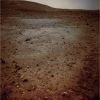
SOL1858-2N291311502EFFB0LTP0747L0M1.jpgPanorama (3) - Sol 1858 (Natural Colors; credits: Lunar Explorer Italia)56 visitenessun commentoMareKromium
|
|
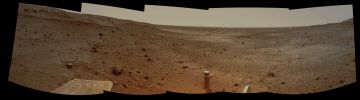
SOL1856-Site_AB0_476_navcam_CYP_R.jpgNew Record Five-Wheel Drive, Spirit's Sol 1856 (Tri-chromatic Version; credits: Lunar Explorer Italia)56 visiteCaption NASA:"NASA's MER Spirit used its NavCam to take the images that have been combined into this 180-degree view of the Rover's surroundings during the 1856th Sol of Spirit's surface mission (such as March 23, 2009). The center of the view is toward the West-South-West.
The Rover had driven 25,82 mt (84,7 feet) West-NorthWestward earlier on Sol 1856. This is the longest drive on Mars so far by a Rover using only 5 wheels. Spirit lost the use of its right-front wheel in March 2006. Before Sol 1856, the farthest Spirit had covered in a single Sol's 5-wheel drive was 24,83 meters (81,5 feet), on Sol 1363 (Nov. 3, 2007).
The Sol 1856 drive made progress on a route planned for taking Spirit around the western side of the low plateau called Home Plate.
A portion of the North-Western edge of Home Plate is prominent in the left quarter of this image, toward the South.
This view is presented as a cylindrical projection with geometric seam correction".MareKromium
|
|

SOL568-2N176788696ESFADAEP1560L0M1.jpgIn the "Kingdom of Tornadoes": Gusev Crater and the Dust Devils (5) - Sol 568 (Enhanced Natural Colors; credits: Lunar Explorer Italia)56 visitenessun commentoMareKromium
|
|
| 25353 immagini su 2113 pagina(e) |
 |
|
|
|
|
1677 | |
|
|
|
|





