| Piú viste |

Rhea-PIA10586.jpgRhea (Natural Colors; credits: Lunar Explorer Italia)56 visiteCaption NASA:"A wide crater dominates the lower right of this image while part of Rhea's brightly lit, wispy terrain can still be seen near the limb of the moon.
Smaller craters are overprinted upon this crater, telling the story of an extremely old feature that has collected impacts over the eons. Younger craters also have been collected on another of Rhea's large basins — Tirawa (see also PIA08976).
North on Rhea (approx. 1528 Km, or about 949 miles across) is up. This view looks toward the Saturn facing-Side of Rhea. The image was taken in visible light with the Cassini Spacecraft narrow-angle camera on Aug. 27, 2008. The view was acquired at a distance of approx. 1,1 MKM (such as about 680,000 miles) from Rhea and at a Sun-Rhea-Spacecraft, or Phase, Angle of 56°.
Image scale is roughly 6 Km (about 4 miles) per pixel".MareKromium
|
|
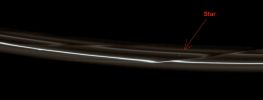
PIA10587.jpgThe "Fragile" F-Ring56 visiteCaption NASA:"Set starkly against the blackness of space are the F-Ring's delicate strands which are periodically gored by its shepherding moon, Prometheus.
Prometheus (approx. 86 Km, or about 53 miles across) and Pandora (approx. 81 Km, or about 50 miles across) both interact with the F-Ring but neither is visible here. Prometheus has the larger effect (see, for instance, PIA08397 for a movie of Prometheus creating a Streamer-Channel in the ring).
A star can be seen through the ring on the right side (Dx) of the image.
This view looks toward the unilluminated side of the Rings from about 33° above the Ring-Plane. The image was taken in visible light with the Cassini Spacecraft narrow-angle camera on Jan. 11, 2009.
The view was acquired at a distance of approx. 1 MKM (such as about 620,000 miles) from Saturn and at a Sun-Saturn-Spacecraft, or Phase, Angle of 37°.
Image scale is roughly 6 Km (about 4 miles) per pixel".MareKromium
|
|

Titan-Map-PIA11149.jpgTitan's Global Digital Map (credits: NASA/JPL/Space Science Institute)56 visiteThis Global Digital Map of Saturn's moon Titan was created using images taken by the Cassini Spacecraft's Imaging Science Subsystem.
The images were taken using a filter centered at 938 nanometers, allowing researchers to examine variations in albedo (or inherent brightness) across the Surface of Titan. Because of the scattering of light by Titan's dense Atmosphere, no topographic shading is visible in these images.
The map is an equidistant projection and has a scale of 4 Km (about 2,5 miles) per pixel. Actual resolution varies greatly across the map, with the best coverage (close to the map scale) near the center and edges of the map and the worst coverage on the Leading Hemisphere (centered around 120° West Long.).
Imaging coverage in the Northern Polar Region continues to improve as Titan approaches northern vernal equinox in August 2009 and the North Pole comes out of shadow. Large dark areas, strongly suspected to be liquid-hydrocarbon-filled lakes, have been documented at high at high latitudes (see PIA11146).
The mean radius of Titan used for projection of this map is 2,575 kilometers (1,600 miles). Until a control network is created for Titan, the satellite is assumed to be spherical.
MareKromium
|
|
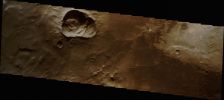
Craters-Herschel_Crater-Dunefield-20090303a-PCF-LXTT.jpgDunefield inside Herschel Crater (Extremely Enhanced Natural Colors; credits for the additional process. and color.: Dr Paolo C. Fienga - Lunexit Team)56 visiteCoord.: 15,5° South Lat. and 131,7° East Long.MareKromium
|
|
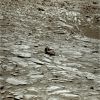
SOL1819-2P287844451EFFAZODP2546L5M1.jpgMeteorite Fragment or Erratic Boulder? - Sol 1819 (Natural Colors; credits: Lunar Explorer Italia)56 visitenessun commentoMareKromium
|
|

OPP-SOL536-1N175770890EFF57KRP1915L0M1.jpgPanorama - Sol 536 (4 - Natural Colors; credits: Lunar Explorer Italia)56 visitenessun commentoMareKromium
|
|

ESP_011648_1730_RED_abrowse-02.jpgOval Mesa on Ganges Mensa (and another "mistery" solved) - Full image, non-map projected and Natural Colors; credits: Lunar Explorer Italia56 visitenessun commentoMareKromium
|
|

ESP_011648_1730_RED_abrowse-01.jpgOval Mesa on Ganges Mensa (and another "mistery" solved) - Full image, map projected, RAW b/w56 visitenessun commentoMareKromium
|
|
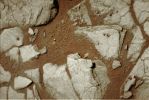
OPP-SOL1773-GB-LXT.jpgMartian Paving - Sol 1773 (possible True Colors; credits: Dr G. Barca & Lunar Explorer Italia)56 visitenessun commentoMareKromium
|
|

ESP_011605_1170_RGB.jpgDefrosting Malea Patera (edm - possible True Colors; credits: Dr M. Faccin)56 visitenessun commentoMareKromium
|
|

Comets-Comet_Lulin_05.jpgComet Lulin and distant Galaxies56 visiteCaption NASA, da "NASA - Picture of the Day" del giorno 7 Marzo 2009:"Now fading in our night sky, Comet Lulin has provided some lovely cosmic vistas. Moving rapidly against the background of stars, Lulin briefly posed with the likes of Saturn and Regulus (Alpha Leo).
But here it is seen against a field of distant galaxies. To reveal the faint background galaxies and trace the Comet's fading tail, the remarkable picture is a blended composite of telescopic exposures aligned with the both the stars and the speedy comet. The largest galaxies seen left of the comet's head or coma are cataloged as NGC 3016, NGC 3019, NGC 3020 and NGC 3024 and lie at a distance of 100 MLY or so.
When the exposures were made, on February 28, the Lulin was about 3,6 Light-Minutes from Earth".MareKromium
|
|

Enceladus-PIA01394.jpgEnceladus, with "Pink" Nuances (by Ted Stryk)56 visitenessun commentoMareKromium
|
|
| 25353 immagini su 2113 pagina(e) |
 |
|
|
|
|
1674 | |
|
|
|
|





