| Piú viste |

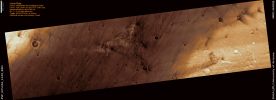
PSP_005748_1075_RED_abrowse~0.jpgBuried Crater in the SPLD (natural colors; credits: Lunexit)56 visiteThis image of the SPLD shows some of the layers cut off against other layers below and right of center. Geologists call this an “angular unconformity” because the layers do not conform to each other across this boundary.
In this case, the angular unconformity was probably caused by erosion of the SPLD followed by deposition of new SPLD on top of the eroded surface, but faulting could also have caused the observed unconformity.
Near the unconformity is an impact crater, one of dozens found on the SPLD. The presence of these craters implies that the surface of the SPLD has been relatively stable (i.e., little erosion or deposition) in the past few million years.
This is in stark contrast to the NPLD, on which craters are very rare, implying very recent erosion/deposition.MareKromium
|
|
PSP_005456_1650_RED_abrowse-00~0.jpgHome Plate from Orbit (CTX Frame - Enhanced Natural Colors - elab. Lunexit)56 visitenessun commentoMareKromium
|
|

PSP_005424_1700_RED_abrowse~0.jpgAurorae Chaos (MULTISPECTRUM; credits: Lunexit)56 visiteThis observation shows a portion of Aurorae Chaos, chaotic terrain East of the Vallis Marineris Canyon System. Aurorae Chaos extends from Capri and Eos Chasmata on the West, into Hydraotes and Aureum Chaos on the North and East.
Chaotic terrain is thought to form from subsurface collapse following volatile release. It is possible that the Martian crust was at one time enriched in ices that became gases or liquid at relatively low temperatures upon encountering a heat source or was violently shaken. These ices existed in spaces between soil particles. If a large volume of volatiles is suddenly released, then there is a large portion of the soil volume missing. The soil cannot support itself, so it collapses.
Since chaotic terrain is often located at the head of the Martian outflow channels (giant flood plains), it is also possible that the Chaotic Regions are the source of the fluids that formed the outflow channels.
Aurorae Chaos connects to outflow channels via other Chaotic Regions.MareKromium
|
|
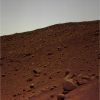
SOL418-2P163473227EFFA808P2374L7M1.jpgBoulders (1) - Sol 418 (Natural Colors; credits: Lunar Explorer Italia)56 visitenessun commentoMareKromium
|
|
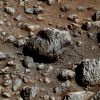
SOL560-GB.jpgUnusually-looking Boulder and Rocks near Spirit - Sol 560 (possible True Colors; credits: Dr G. Barca)56 visitenessun commentoMareKromium
|
|
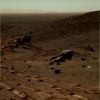
SOL510-GB.jpgRover Tracks and the "foggy" distant Rim of Gusev Crater - Sol 510 (Enhanced and Darkened Natural Colors; credits: Dr G. Barca & Lunar Explorer Italia)56 visitenessun commentoMareKromium
|
|

SOL545-GB.jpgSkyline - Sol 545 (Natural Colors; credits: Dr G. Barca & Lunar Explorer Italia)56 visitenessun commentoMareKromium
|
|
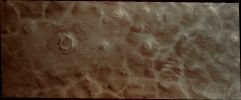
Vastitas_Borealis-NP-MO-20090219a.jpgVastitas' Texture (Natural Colors; credits for the additional process. and color.: Dr Paolo C. Finega - Lunar Explorer Italia)56 visiteCaption NASA:"The Northern Plains of Mars contain an abundance of different textures and appearances. This Region contains mounds separated by channels with an unusual floor pattern. Just how this texture formed is unknown".
Coord.: 70,0° North Lat. and 55,9° East Long.MareKromium
|
|

South_Polar_Feartures-Layers-20090223a-PCF-LXTT.jpgSouth Polar Spring (Darkened Absolute Natural Colors; credits for the additional process. and color.: Dr Paolo C. Fienga - Lunar Explorer Italia)56 visiteCoord. 84,4° South Lat. and 313,9° East Long.MareKromium
|
|
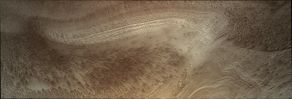
South_Polar_features-Fans-SP-MO-20090224a.jpgSouth Polar Spring: Fans (Natural Colors; credits for the additional process. and color.: Dr Paolo C. Fienga - Lunar Explorer Italia)56 visiteCaption NASA:"As the Sun continues to warm the South Polar Region, spots appear on the ice. The dark material of the spots is apparently mobile, with the wind able to lengthen the spots into streaks".
Coord.: 86,6° South Lat. and 99,1° East Long.MareKromium
|
|

Saturn-PIA10585.jpgSaturnian Terminator (Natural Colors; credits: Lunar Explorer Italia)56 visiteCaption NASA:"The Terminator nearly covers the South Pole of Saturn and its stormy vortex in darkness.
As the Southern Hemisphere moves toward Winter in the Planet's 29-year orbit, darkness eventually will consume the vortex. But this seasonal change also will bring the North Pole into the light.
This view looks toward the sunlit side of the Rings from about 69° below the Ring-Plane.
The image was taken with the Cassini Spacecraft wide-angle camera on Jan. 6, 2009 using a spectral filter sensitive to wavelengths of near-InfraRed Light centered at 752 nanometers. The view was acquired at a distance of approx. 761.000 Km (about 473.000 miles) from Saturn and at a Phase Angle of 96°.
Image scale is roughly 42 Km (approx. 26 miles) per pixel.MareKromium
|
|

Comets-Comet_Lulin03-Richins.jpgThe Two Tails of Comet Lulin56 visiteCaption NASA:"Go outside tonight and see Comet Lulin. From a dark location, you should need only a good star map and admirable perseverance -- although wide-field binoculars might help. Yesterday, Comet Lulin passed its closest to Earth, so that the comet will remain near its brightest over the next few days. The comet is currently almost 180° around from the Sun and so visible nearly all night long, but will appear to move on the sky about 10 full moons a night. Pictured above, Comet Lulin was captured in spectacular form two nights ago from New Mexico, USA.
The central coma of the comet is appearing quite green, a color likely indicating glowing cyanogen and molecular carbon gasses. Bright stars and a distant spiral galaxy are clearly visible in the image background. The yellow dust tail, reflecting sunlight, is visible sprawling to the coma's left trailing behind the comet, while the textured bluish-glowing ion tail is visible to the coma's right, pointing away from the Sun. Over the past few weeks, from the current vantage point of Earth, these two tails appeared to point in opposite directions. Comet Lulin is expected to slowly fade over the next few weeks".MareKromium
|
|
| 25353 immagini su 2113 pagina(e) |
 |
|
|
|
|
1673 | |
|
|
|
|





