| Piú viste |
SOL1518-2M261125314EFFAY00P2959M2M1.jpgUnusually-shaped "Object" on the Solar Panels - SOl 1518 (MULTISPECTRUM; credits: Lunexit)56 visitenessun commentoMareKromium
|
|

Unknown-N00111006.jpgStar-Trails? (2)56 visiteCaption NASA:"Caption NASA:"N00111006.jpg was taken on May 10, 2008 and received on Earth on May 11, 2008. The camera was pointing toward the F-RING of Saturn which, at the time that the picture was taken, was about 454.646 Km away.
This image was taken using the CL1 and CL2 filters and it has not been validated or calibrated".MareKromium
|
|

Unknown-N00111005.jpgStar-Trails? (1)56 visiteOnde evitare spiacevoli malintesi, precisiamo che gli oggetti puntiformi i quali disegnano un piccolo segmento d'arco e che, a nostro avviso, potrebbero e dovrebbero essere degli "Star-Trails", sono a Dx dell'Osservatore, in alto (il più luminoso) ed a Sx dell'Osservatore, uno in alto ed uno in basso (molto deboli). La loro incredibile somiglianza ci ha fatto anche pensare all'ipotesi per cui si tratti di un solo Star-Trail (quello luminoso a Dx) e di due riflessi del medesimo attraverso le ottiche di Cassini (i due di Sx).
L'Anomalìa del frame, infine - sia che gli Star-Trails sìano tre, sia che si tratti di uno solo -, è data dalla circostanza per cui la forma dello/degli Star-Trail/s è il chiaro indice di un movimento della Sonda Cassini. Un movimento che è avvenuto DURANTE la ripresa. Ora, a nostro avviso, è curioso che il brusco cambio di traiettoria della Sonda abbia prodotto la distorsione di un dettaglio (la stella - o le stelle - che è diventata una striscia curva) e non del corpo principale ripreso (una porzione degli Anelli di Saturno).
E' stata questa specifica considerazione che ci ha lasciati un pò perplessi sulla natura dei tre segmenti luminosi curvi (i quali, ribadiamo e chiudiamo, potrebbero e dovrebbero COMUNQUE essere delle semplici Star-Trails).
E Voi che ne pensate?
Caption NASA:"N00111005.jpg was taken on May 10, 2008 and received on Earth on May 11, 2008. The camera was pointing toward the F-RING of Saturn which, at the time that the picture was taken, was about 387.626 Km away.
This image was taken using the CL1 and CL2 filters and it has not been validated or calibrated".MareKromium
|
|

Titan-Craters-Unnamed_Craters-PIA10655.jpgTitanian Craters (Impact Craters?) - radio-image; credits: NASA56 visiteCaption NASA:"This side-by-side view shows a newly discovered impact crater (at left) compared with a previously discovered crater (at right). The new crater was just discovered by the Cassini Spacecraft's Radar Instrument during its most recent Titan flyby on May 12, 2008. This makes the fourth feature definitely identified as an impact crater so far on Titan -- fewer than 100 features are regarded as possible impacts. Compared with Saturn's other moons, which have many thousands of craters, Titan's surface is very sparsely cratered. This is in part due to Titan's dense atmosphere, which burns up the smaller impacting bodies before they can hit the surface. Geological processes, such as wind-driven motion of sand and icy volcanism, may also wipe out craters.
Both images are about 350 Km (approx. 217 miles) in width.
The crater on the right was discovered by Cassini in 2005 and is shown here for comparison. It is about 80 Km (approx. 50 miles) in diameter, with the radar illumination from above.
Called "Sinlap", this crater is estimated to be about 1300 meters (984 feet) deep.
The new feature pictured on the left, which has not been named yet, is bigger than the Sinlap Crater with a diameter of about 112 Km (approx. 70 miles).
The new crater is located at about 26° North Latitude and 200° West Longitude, in the bright Region known as Dilmun, about 1000 Km (approx. 600 miles) north of the Huygens Landing Site.
In its image, also illuminated from above, it appears slightly irregular, suggesting that it was modified after it was formed, perhaps by collapses of segments of its rim onto the floor.
The crater floor appears flat, and two small bright spots indicate a likely central peak complex.
The ejecta blanket (surrounding material) from this crater is less prominent than that of the Sinlap Crater.
The crater's more degraded character suggests it could be older than Sinlap (assuming that erosive processes are the same at both locations, which are at similar latitudes)".MareKromium
|
|
OPP-SOL1526-1~0.jpgFoggy Day over Victoria (Special Processing by Dr Gianluigi Barca)56 visitenessun commentoMareKromium
|
|

OPP-SOL069.jpgGreenish "dust" or "spores"? - Sol 69 (Superdefinition; credits: Dr G. Barca)56 visitenessun commentoMareKromium
|
|
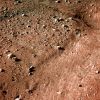
PHOE-SOL001-PIA10682.jpgThe soil of Vastitas Borealis - Sol 1 (Approximate Colors; credits: NASA/JPL-Caltech/University of Arizona )56 visiteCaption NASA:"This image shows a polygonal pattern in the ground near NASA's Phoenix Mars Lander, similar in appearance to icy ground in the arctic regions of Earth.
Phoenix touched down on the Red Planet at 4:53 p.m. Pacific Time (7:53 p.m. Eastern Time), May 25, 2008, in an arctic region called Vastitas Borealis, at 68° North Latitude and 234° East Longitude.
This is an approximate-color image taken shortly after landing by the spacecraft's Surface Stereo Imager, inferred from two color filters, a violet, 450-nanometer filter and an infrared, 750-nanometer filter".
Nota Lunexit: una nuova "dizione" NASA. Ora questi (semi-assurdi) colori non sono più Approximate True o Approximate Natural: adesso sono SOLO "Approximate".
Beh, visti i quattrini, i mezzi, le tecnologie, le menti ed il tempo che si ritrovano a disposizione i nostri Amici di Pasadena, scusateci se, dopo aver visto questa (a nostro parere "quasi inguardabile") elaborazione, non ci sentiamo di fargli i complimenti...MareKromium
|
|
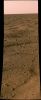
PHOE-SOL001-N-P-Pstcd.jpgVastitas Borealis - Sol 1 (RAW Color Data; credits: Dr Gianluigi Barca)56 visiteAnche questa splendida elaborazione in colori RAW, realizzata dall'ottimo Dr Gianluigi Barca finirà con l'assomigliare molto - a nostro parere - alle elaborazioni NASA in "false" ed "approximate true colors".
Staremo a vedere... MareKromium
|
|

PHOE-SOL002-lg_458.jpgShadows on an orange-greenish soil - Sol 2 (MULTISPECTRUM; credits: Lunexit)56 visitenessun commentoMareKromium
|
|

PHOE-SOL002-lg_509.jpgBack-Shell or Heat-Shield? - Sol 2 (MULTISPECTRUM; credits: Lunexit)56 visiteMareKromium
|
|

PHOE-SOL002-lg_542.jpgTwilights over Vastitas Borealis... - Sol 2 (MULTISPECTRUM; credits: Lunexit)56 visitenessun commentoMareKromium
|
|

PHOE-SOL002-lg_501.jpgDistant Mountains... - Sol 2 (MULTISPECTRUM; credits: Lunexit)56 visitenessun commentoMareKromium
|
|
| 25353 immagini su 2113 pagina(e) |
 |
|
|
|
|
1669 | |
|
|
|
|





