| Piú viste |

SOL932-1-2.jpgHigh Tau...Again! - Sol 932 (natural colors; credits: Dr G. Barca & Lunexit)56 visitenessun commentoMareKromium
|
|
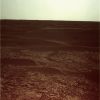
OPP-SOL1702-1P279291760EFF93LGP2378R1M1.jpgEtched Terrain, on the way to Endeavour - Sol 1702 (possible natural colors; credits: Lunexit)56 visitenessun commentoMareKromium
|
|
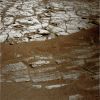
OPP-SOL1710-3.jpgThe Beautiful "Martian Paving" - Sol 1710 (possible True Colors; credits: Dr G. Barca & Lunexit)56 visitenessun commentoMareKromium
|
|
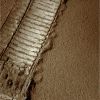
OPP-SOL1702-3.jpgRover Tracks - Sol 1702 (possible True Colors; credits: Dr G. Barca)56 visitenessun commentoMareKromium
|
|
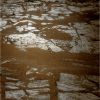
OPP-SOL1710-3~0.jpgThe Beautiful "Martian Paving" - Sol 1710 (possible True Colors; credits: Dr G. Barca & Lunexit)56 visitenessun commentoMareKromium
|
|

Martian_Horizon-I28598005_BTR-PCF-LXTT.pngDaedalia Planum and the Atmosphere of Mars (Enhanced Natural Colors; credits for the additional process. and color.: Dr Paolo C. Fienga - Lunexit Team)56 visiteOn May 25, 2008, the Phoenix Lander arrived at Mars and raced to a safe touchdown on the Northern Plains. At the same time, NASA's Mars Odyssey orbiter turned its radio antenna to listen for signals from the Spacecraft and relayed them to mission controllers on Earth.
As an added benefit of the radio monitoring, an instrument aboard Mars Odyssey, the Thermal Emission Imaging System (or THEMIS), got a chance to take an image profiling the Martian Atmosphere as seen above the edge (or limb) of the Planet.
In normal operation, THEMIS points straight down at the ground passing below the orbiter. Scientists term this viewing geometry as "Nadir-looking", referring to the point opposite the Zenith, which is straight overhead.
THEMIS is basically a camera, and its fundamental mission is to image Mars at 10 IR and 5 visual "colors". The visual images map the landforms, while the IR images detect surface temperatures and identify mineral compositions.
To communicate with the Phoenix Lander, the location of Odyssey's antenna required mission control to roll and tilt the entire Spacecraft so the dish pointed at the ground. And THEMIS (which is bolted to the side of Odyssey) rolled and tilted with it, turning its gaze off toward the Limb of Mars, 90° from its usual perspective.
During the roll, THEMIS made this image which sweeps from the cratered surface of Daedalia Planum northward to the visible edge of Mars. It also includes the Atmosphere (seen edge on) and the blackness of space.
"Oblique views like these - which we call 'off-Nadir images' - suggest an additional role for THEMIS", says Philip Christensen of Arizona State University's School of Earth and Space Exploration. A Regents' Professor of Geological Sciences, Christensen is the director of the Mars Space Flight Facility as well as the designer and Principal Investigator for THEMIS.
"We would like to take such oblique views more often in the future", he says, noting they can help out in the study of the Martian Atmosphere. Such studies are crucial for understanding Mars' weather and climate.
Christopher Edwards, a graduate student at the Mars Space Flight Facility, explains, "We can use THEMIS to map relative temperature differences in the Atmosphere, extending from the Surface to Space. Tracked over months and years, these measurements should give us data on the different sizes of particles caught in the air."
Sideways viewing offers additional benefits as well, including letting the THEMIS team fill gaps in the visual coverage of the surface.
The global image map of Mars at visual wavelengths still has many blacked-out sections sprinkled across it, where coverage is incomplete. Also, clouds and haze have obscured the ground at times when the Spacecraft is flying over.
But with THEMIS operating in Nadir-only mode, months or even years may pass before it can re-observe an area on the ground under clear conditions.
"Looking off-nadir - even 20° or less - would make it much easier to fill these gaps", says Christensen.
NASA is considering new mission rules for Mars Odyssey that would allow THEMIS to point away from the nadir as part of routine operations. If enacted, the rules would go into effect after Mars Odyssey finishes its role as radio relay for Phoenix.
In addition, explains Christensen, NASA is also considering another possible modification: "After the Phoenix Mission wraps up this fall, NASA may change the orbit of Mars Odyssey".
This would alter the spacecraft's orbit to pass overhead at 3 p.m. (15:00) instead of the current 5:30 p.m. (17:30) time. The result would give significant benefits for THEMIS and the scientists who use its data.
"Changing the orbit to an earlier time of day magnifies the day-night temperature contrast in the surface rocks", says Christensen. Strong temperature differences make it possible for scientists to detect different kinds of rocks on the surface using THEMIS.
Says Christensen, "This would give us a lot better data to carry out the mineral identification part of THEMIS' mission".MareKromium
|
|

PSP_002290_1585andPSP_001868_1585-MemnoniaFossae-Channel-CollapseFeatures.jpgChannel and Graben in Memnonia Fossae (Hi-Def-3D - Extremely Enhanced Natural Colors; credits: Dr M. Faccin & Lunar Explorer Italia)56 visiteLatitude (centered): 21,5° South
Longitude (East): 211,2 °
Range to target site: 261,1 Km (approx. 163,2 miles)
Original image scale range: 26,1 cm/pixel (with 1 x 1 binning) so objects ~78 cm across are resolved
Map projected scale: 25 cm/pixel and North is up
Map projection: EQUIRECTANGULAR
M.L.T.: 15:37 (middle afternoon)
Emission angle: 9,3°
Phase angle: 70,6°
Solar Incidence Angle: 63°, with the Sun about 27 ° above the Local Horizon
Solar Longitude: 153,1° (Northern Summer)MareKromium
|
|
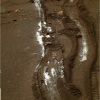
SOL1100-3.jpgRover Tracks, Salt and Sulphates - Sol 1100 (possible True Colors; credits: Dr G. Barca & Lunexit)56 visitenessun commentoMareKromium
|
|
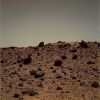
SOL1101-3.jpgBeautiful Skyline... - Sol 1101 (possible True Colors; credits: Dr G. Barca & Lunexit)56 visitenessun commentoMareKromium
|
|
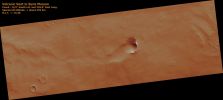
Psp_001840_1660_red.jpgVolcanic Vent in Syria Planum (natural colors; credits: Lunar Explorer Italia)56 visitePrevious images of this area by other space missions indicate that this is a shield volcano with very shallow slopes. What HiRISE reveals is that it is completely covered by a blanket of dust.
While volcanic featues remain obscure, the dust does exhibit some very strange patterns. As you zoom into the middle of the image, the ground appears covered with a fine network of light and dark polygons. But at full resolution, it can be seen that these polygons are actually the edges of small scallops.
The dust is apparently held together by some unknown means, giving it sufficient strength to be carved into this strange pattern.MareKromium
|
|
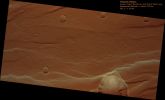
Psp_001840_2000_red.jpgTharsis' Plains (natural colors; credits: Lunar Explorer Italia)56 visiteThis HiRISE image samples the plains between the large shelf volcanoes in the Tharsis Region of Mars.
The long scarps in the area have been formed by faults as the ground was pulled apart. The large circular depression on the edge of the image is a giant collapse pit that appears to be related to the opening up of crust.
If you look at this image carefully, much of the plains appears blurry, as if the picture was out of focus. But HiRISE remains in perfect focus and it is Mars that is actually this blurry. Soft wind-blown dust mutes all the features in the area to create this effect.MareKromium
|
|

Psp_001860_1685_red.jpgLight-colored terrain in the Southern Highlands (possible True Colors; credits: Lunar Explorer Italia)56 visiteThis HiRISE image shows part of the floor of a large impact crater in the southern highlands, north of the giant Hellas impact basin. Most of the crater floor is dark, with abundant small ripples of wind-blown material. However, a pit in the floor of the crater has exposed light-toned, fractured rock.
The light-toned material appears fractured at several different scales. These fractures are called joints, and result from stresses on the rock after its formation.
Joints are similar to faults, but have undergone virtually no displacement. With careful analysis, joints can provide insight into the forces that have affected a unit of rock, and thus into its geologic history. The fractures appear dark; this may be due to trapping of dark, wind-blown sand in the crack, to precipitation of different minerals along the fracture, or both.MareKromium
|
|
| 25353 immagini su 2113 pagina(e) |
 |
|
|
|
|
1664 | |
|
|
|
|





