| Piú viste |
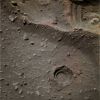
SOL2086-GB.jpgThe "Mark", near Spirit - Sol 2086 (Natural Colors; credits: Dr G. Barca)56 visitenessun commentoMareKromium
|
|
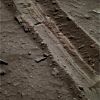
SOL2085-GB.jpgDeep Rover Tracks, with Small Rocks, Pebbles and Reddish Sands - Sol 2085 (Natural Colors; credits: Lunexit)56 visiteUn'ottima elaborazione (curata dal nostro eccezionale Dr Barca) che ci mostra una curiosità: di regola, quando le tracce lasciate da Spirit diventano piuttosto profonde, emerge - dalla Sub-Surface di Gusev - del terriccio bianco, dai riflessi azzurri (sali e/o solfati); in questo caso, invece, accade l'esatto contrario!
E cioè, dal di sotto del terriccio superficiale - di colore marrone-chiaro/cenere, con chiazze verdognole -, emerge della sabbia color rosso scuro (porzione centrale e superiore del solco).
Curioso! Specialmente se considerate il fatto che questo color-processing non altera i dati-colore disponibili, ma si limita ad estrarli, evidenziandoli...
Avete una spiegazione per questo fenomeno?MareKromium
|
|

OPP-SOL1029-MF.jpgBerryLand - Sol 1029 (High-Def-3D and Natural Colors; credits: Dr M. Faccin)56 visitenessun commentoMareKromium
|
|

OPP-SOL0976-MF.jpgVictoria's Rim - Sol 976 (High-Def-3D; credits: Dr M. Faccin)56 visitenessun commentoMareKromium
|
|
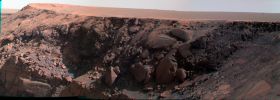
OPP-SOL0972-MF.jpgVictoria's Rim - Sol 972 (High-Def-3D; credits: Dr M. Faccin)56 visitenessun commentoMareKromium
|
|

OPP-SOL0965-MF.jpgSpherules - Sol 965 (High-Def-3D; credits: Dr M. Faccin)56 visitenessun commentoMareKromium
|
|
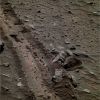
SOL2085-GB~0.jpgRover Track and Reddish Dust - Sol 2085 (possible True Colors; credits: Dr G. Barca)56 visitenessun commentoMareKromium
|
|

KBO-3-Artist_Conception.jpgKuiper's Belt Object occulting a Star56 visiteIn a paper published in the December 17th issue of the journal Nature, Hilke Schlichting of the California Institute of Technology in Pasadena, Calif., and her collaborators are reporting that the telltale signature of the small vagabond was extracted from Hubble's pointing data, not by direct imaging.
Hubble has three optical instruments called Fine Guidance Sensors (FGS). The FGSs provide high-precision navigational information to the space observatory's attitude control systems by looking at select guide stars for pointing. The sensors exploit the wavelike nature of light to make precise measurement of the location of stars.
Schlichting and her co-investigators determined that the FGS instruments are so good that they can see the effects of a small object passing in front of a star. This would cause a brief occultation and diffraction signature in the FGS data as the light from the background guide star was bent around the intervening foreground KBO.
They selected 4,5 years of FGS observations for analysis. Hubble spent a total of 12.000 hours during this period looking along a strip of sky within 20° of the Solar System's Ecliptic Plane, where the majority of KBOs should dwell. The team analyzed the FGS observations of 50.000 guide stars in total.
Scouring the huge database, Schlichting and her team found a single 0,3-second-long occultation event. This was only possible because the FGS instruments sample changes in starlight 40 times a second. The duration of the occultation was short largely because of the Earth's orbital motion around the Sun.
They assumed the KBO was in a circular orbit and inclined 14° to the Ecliptic. The KBO's distance was estimated from the duration of the occultation, and the amount of dimming was used to calculate the size of the object. "I was very thrilled to find this in the data", says Schlichting.
Hubble observations of nearby stars show that a number of them have Kuiper Belt–like disks of icy debris encircling them. These disks are the remnants of planetary formation. The prediction is that over billions of years the debris should collide, grinding the KBO-type objects down to ever smaller pieces that were not part of the original Kuiper Belt population.
The finding is a powerful illustration of the capability of archived Hubble data to produce important new discoveries. In an effort to uncover additional small KBOs, the team plans to analyze the remaining FGS data for nearly the full duration of Hubble operations since its launch in 1990.MareKromium
|
|
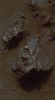
PSP_002101_1875_red-01.jpgMojave Crater Floor and Central Uplift (EDM - Natural Colors; credits: Lunexit)56 visiteThis HiRISE sub-image shows a portion of the Central Uplift structure in Mojave Crater.
Central Uplifts are a typical feature of large impact craters on the Earth, the Moon and Mars; craters larger than 6 or 7 Km in diameter on Mars typically form this mountain-like peak in the central portion of the crater interior.
This peak consists of rocks originating from several kilometers beneath the pre-impact surface. Mojave has a very prominent Central Uplift as it has a diameter of approx. 60 Km (about 37 miles).
In this image, Boulders as large as 15 mt (50 feet) across have been eroded from the massive uplifted rock and have rolled downslope.
Fine-grained Debris has also collected in the topographic lows and has been shaped by the wind into Dunes and Ripples. Notably absent from this image are the striking Drainage Channels and Alluvial Fans that are abundant on the Wall-Terraces and Ejecta of Mojave Crater (see PSP_001415_1875).
These features were likely formed by Surface Runoff of liquid water, which may have been released from the Subsurface during the impact event that formed Mojave.
Previously, it had been suggested that a brief, torrential downpour over Mojave Crater delivered the water. However, Mars Orbiter Camera's (MOC) images of Mojave's Central Uplift have previously shown no evidence for Surface Runoff, and the higher resolution of this HiRISE image (2.4 MB) confirms that this part of the Crater appears untouched by liquid water.
So the question remains: by what means was the water, in the form of Runoff, supplied to Mojave? This question, in addition to several others regarding this phenomenon, are currently being investigated by the HiRISE team and their collaborators.MareKromium
|
|
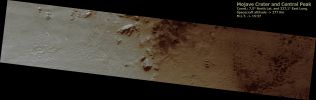
PSP_002101_1875_red-00~0.jpgMojave Crater Floor and Central Uplift (CTX Frame - Natural Colors; credits: Lunexit)56 visiteThis full HiRISE image shows that the Crater Floor - South of the Central Uplift - is densely pitted and fractured. These Pits, many of which are partially filled with dark sand, lack raised rims and a circular form.
This suggests that they are not impact craters. In fact, very few definite impact craters are seen on the Floor and Walls of Mojave, implying that it is incredibly young and relatively well preserved for a crater of its size.
HiRISE images covering Mojave Crater and the surrounding Region are yielding new insights into impact processes on Mars. MareKromium
|
|

ESP_013951_1955_RED_abrowse-01.jpgDark Syrtis Major (EDM - Natural Colors; credits: Dr Paolo C. Fienga - Lunexit Team)56 visiteIn this EDM of Syrtis Major, ancient Noachian Bedrock is exposed. This is rock made in the early Soles of Martian History.
An Impact Crater (about 50 Km in diameter) into this rock exposes Layers along its Wall. These Layers may be made from several different geologic materials, such as Lava Flows, Debris from nearby impact craters, or deposits of Dust or Sand.
They may also represent different periods of deposition and erosion. The Layers are of varying thickness: some of the lighter, resistant units are less than 10 meters thick, while some of the darker layers might be over 100 meters thick.MareKromium
|
|
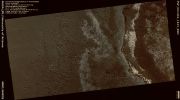
PSP_001493_1815_RED_abrowse-1.jpgTerra Meridiani (possible True Colors; credits: Dr Paolo C. Fienga - Lnexit Team)56 visiteThis HiRISE image shows dark sand covering bright Bedrock in the Terra Meridiani (Meridiani Planum) Region of Mars.
The MER Opportunity Rover is currently exploring Meridiani, but is located about 500 Km to the West-South/West from this area.
There are three broad classes of Terrain in this image: the regular spacing of the Dark Ridges, with one side of the Ridges (in this case generally facing North/West) shallower than the other, indicates that the material is windblown sand deposited in the form of Dunes or large Ripples. On the slopes of and in between the Dunes and Ripples are smaller-scale Ripples.
The dark orangish tone of the Sand and the analysis of analogous material by Opportunity indicates that is composition might be Basaltic and this is in contrast to most sand on Earth, which is dominated by Quartz.MareKromium
|
|
| 25353 immagini su 2113 pagina(e) |
 |
|
|
|
|
1660 | |
|
|
|
|





