| Piú viste |

M-031-GB1.JPGM-31: The "Andromeda Galaxy" (Spiral Galaxy in Andromeda)56 visiteMareKromium
|
|

ZZ-Mercury-Craters-Machaut_Crater-CN0131770808M_web.pngMachaut Crater (natural colors; credits: Lunexit)56 visiteDate Acquired: October 6, 2008
Image Mission Elapsed Time (MET): 131770808
Instrument: Narrow Angle Camera (NAC) of the Mercury Dual Imaging System (MDIS)
Resolution: 100 meters/pixel (0,06 miles/pixel)
Scale: This image is about 100 Km across (approx. 60 miles)
Spacecraft Altitude: about 3900 Km (approx. 2400 miles)
Of Interest: Machaut is the name of a crater, approx. 106 Km (about 66 miles) in diameter, first seen under high-Sun conditions by Mariner 10 in the 1970s. The crater is named for the medieval French composer and poet Guillaume de Machaut.
This NAC image shows an amazing new view of Machaut taken during MESSENGER’s second flyby of Mercury. The slanting rays of the Sun cast shadows that reveal numerous small craters and intricate features.
The largest crater within Machaut appears to have been inundated by lava flows similar to those that have filled most of the floor of the larger feature. The adjacent, slightly smaller crater was formed at a later time and excavated material below the lava-formed surface.
MESSENGER science team members will also be studying the shallow ridges that crisscross Machaut’s floor.MareKromium
|
|

The_Helix_Nebula.JPGThe "Helix Nebula"56 visiteMareKromium
|
|

Saturn-PIA10493.jpgSaturn (natural colors; credits: NASA)56 visiteCaption NASA:"The Cassini Spacecraft looks toward the sunlit face of Saturn's Rings, whose shadows continue to slide southward on the Planet toward their temporary disappearance during equinox in August 2009.
This two-frame color mosaic was created from images taken as part of a photometry observation of the Rings. Photometry observations are useful for determining a host of ring particle properties.
This view looks toward the sunlit side of the Rings from about 3° below the Ring-Plane. Images taken using red, green and blue spectral filters were combined to create this natural color view. The images were acquired with the Cassini Spacecraft wide-angle camera on Aug. 22, 2008 at a distance of approx. 1,2 MKM (such as about 728.000 miles) from Saturn.
Image scale is roughly 66 Km (about 41 miles) per pixel".MareKromium
|
|
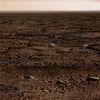
PHOE-SOL139-lg40083-40084-40086-2.jpgHorizon... - Sol 139 (possible True Colors; credits: Dr G. Barca)56 visitenessun commentoMareKromium
|
|

OPP-SOL372-3~0.jpgDeep-down in the trench... - Sol 372 (possible true-colors - version 2; credits: Dr G. Barca)56 visitenessun commentoMareKromium
|
|
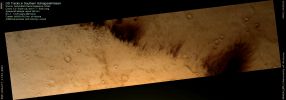
PSP_006477_1745_RED_abrowse-00~0.jpgDD Tracks in Southern Schiaparelli Basin (context frame - False Colors; credits: Lunexit)56 visiteDust-Devils (DD) are vortices of wind that form when air rising from a warm surface encounters shear in the above atmosphere.
Martian Dust-Devils can attain gargantuan proportions, reaching the size of terrestrial tornadoes with plumes that tower up to 9 Km above the surface.
Dust-Devils play an important role in sustaining the aerosols that make up Mars’ Red Sky and in cleaning the Martian Surface after a Dust Storm.
Nota Lunexit: sono quindi i DD, secondo la NASA, la "causa maggiore" del Cielo Rosso di Marte? Interessante riflessioni ed interessante quesito: dunque il Cielo di Marte NON E', naturalmente, "rosso" o "arancio", ma è "tinto di rosso/arancio"!
Pensateci sopra...
MareKromium
|
|

PHOE-SOL142-lg40602-40603-40604-2.jpgThe "Trenches" - Sol 142 (Superdefinition and possible True Colors; credits: Dr G. Barca)56 visitenessun commentoMareKromium
|
|

PHOE-SOL143-lg40998-40999-41000-2.jpgInside the "Icy Trench"... - Sol 143 (Superdefinition and possible True Colors; credits: Dr G. Barca)56 visitenessun commentoMareKromium
|
|

Haumea2.jpgHaumea and other "Dwarf" Companions56 visiteCaption NASA:"One of the strangest objects in the Outer Solar System was classified as a Dwarf Planet last week (September 2008) and given the name Haumea.
This designation makes Haumea the 5th designated Dwarf Planet after Pluto, Ceres, Eris, and Makemake. Haumea's smooth but oblong shape make it extremely unusual. Along one direction, Haumea is significantly longer than Pluto, while in another direction Haumea has an extent very similar to Pluto, while in the third direction is much smaller.
Haumea's orbit sometimes brings it closer to the Sun than Pluto, but usually Haumea is further away.
Illustrated above, an artist visualizes Haumea as a nearly featureless ellipsoid. Quite possibly, however, Haumea has interesting craters and surface features that currently remain unknown. Originally discovered in 2003 and given the temporary designation of 2003 EL61, Haumea was recently renamed by the IAU for a Hawaiian goddess. Haumea has two small moons discovered in 2005, recently renamed Hi'iaka and Namaka after the daughters of the Goddess".MareKromium
|
|

Comets-Comet_Holmes-UZ_PIA11228-2.jpgComet 17-P Holmes now in the Outer Solar System56 visiteSpitzer's infrared picture at left hand side of this frame reveals fine dust particles that make up the Outer Shell, or "Coma", of the Comet. The Nucleus of the Comet is within the bright whitish spot in the center, while the yellow area shows solid particles that were blown from the Comet in the explosion.
The Comet is headed away from the Sun, which lies beyond the right-hand side of these pictures.
The contrast-enhanced picture on the right shows the Comet's Outer Shell, and strange "filaments", or "Streamers", of dust. The Streamers and shell are a yet another mystery surrounding Comet Holmes. Scientists had initially suspected that the Streamers were small dust particles ejected from fragments of the Nucleus, or from hyerpactive jets on the Nucleus, during the October 2007 explosion.
If so, both the Streamers and the Shell should have shifted their orientation as the Comet followed its orbit around the Sun.
Radiation pressure from the Sun should have swept the material back and away from it. But pictures of Comet Holmes taken by Spitzer over time show the Streamers and Shell in the same configuration, and not pointing away from the Sun. The observations have left astronomers stumped.
The horizontal line seen in the contrast-enhanced picture is a trail of debris that travels along with the Comet in its orbit.
The Spitzer picture was taken with the Spacecraft's multiband imaging photometer at an infrared wavelength of 24 microns.MareKromium
|
|
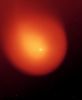
Comets-Comet_Holmes-UZ_PIA11228-1.jpgComet 17-P Holmes now in the Outer Solar System (IR)56 visiteNASA's Spitzer Space Telescope captured the picture of comet Holmes in March 2008, 5 months after the comet suddenly erupted and brightened a millionfold overnight. The contrast of the picture has been enhanced (see the next frame) to show the anatomy of the comet.
Every 6 years, comet 17P/Holmes speeds away from Jupiter and heads inward toward the Sun, traveling the same route typically without incident. However, twice in the last 116 years, in November 1892 and October 2007, comet Holmes mysteriously exploded as it approached the Asteroid Belt. Astronomers still do not know the cause of these eruptions.
Nota Lunexit: la "causa" di queste repentine eruzioni della Cometa 17-P Holmes le quali avvengono - guarda caso - durante il transito della medesima attraverso la Fascia degli Asteroidi potrebbe essere RAGIONEVOLMENTE rinvenuta nella verificazione di impatti con corpi erranti di piccole/piccolissime dimensioni (l'occorrere di impatti con uno o più oggetti di dimensioni medie o medio/grandi porterebbe inevitabilmente alla frammentazione/distruzione completa del nucleo di 17-P Holmes ed alla sua relativa e definitiva sparizione). Che gli "outbursts" possano essere (anche) l'ovvia conseguenza di un impatto ad altissima velocità è stato recentemente dimostrato dall'esperimento (come ricorderete contestatissimo) effettuato dalla NASA sulla Cometa Tempel-1, la quale fu centrata da un'ogiva metallica e, all'atto dello "scontro spaziale", aumentò la sua luminosità in maniera agevolmente percepibile anche da Terra.MareKromium
|
|
| 25353 immagini su 2113 pagina(e) |
 |
|
|
|
|
1658 | |
|
|
|
|





