| Piú viste |

OPP-SOL1063-1.jpgFrom inside Victoria - Sol 1063 (True Colors; credits: Dr G. Barca)56 visitenessun commentoMareKromium
|
|

PSP_009161_1450_RED-00.jpgLong Shadows over Ariadnes Colles (ctx frame- natural colors; credits: Lunexit)56 visiteAriadnes Colles is a labyrinth-like cluster of hills, mesas and knobs located near Terra Cimmeria, in the Southern Highlands of Mars.
This image, which covers a portion of that labyrinth, was acquired only a few Soles away from Winter Solstice.
Winter Solstice occurs in the shortest Sol of the year, when the Sun travels the lowest in the Martian sky, making shadows appear very long. These conditions are ideal to analyze modest relief features, that would pass unnoticed when illuminated from above but are highlighted when illuminated from the side.MareKromium
|
|
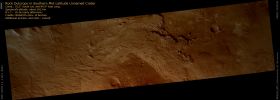
PSP_009151_1465_RED.jpgRock Outcrops in Southern Mid-Latitude Crater (natural colors; credits: Lunexit)56 visiteThis image shows part of the floor of a large Impact Crater in the Southern Hemisphere. The crater lies at the edge of the Hellas Impact Basin; although it is roughly 50 Km across, it is dwarfed by the giant Hellas structure, which has seen a varied and interesting geologic history.
This image captures a diverse range of rocks on the Crater Floor. A small cliff running across the middle of the image marks the edge of one rock unit, but variations in tone or texture in the northern part of the image suggest a varied history of deposition. Exposures of light, intermediate and dark materials may correspond to different types of deposition, or perhaps alteration after the rocks were laid down. Some units appear rich in boulders, suggesting that they are breaking up into blocks, while at other sites there are thin layers.
This diversity indicates a varied geologic history. Hellas Basin is a low Region, and may have once held lakes or seas where sediments could have been deposited.
This site is also just west of Hadriaca Patera, an old volcano. Sediment could also have been deposited by wind, or in streams on the surface. Unraveling the history of the region will require many images to illustrate the diversity of rocks and map out where they occur.MareKromium
|
|
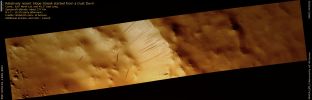
PSP_009192_1890_RED-00.jpgRelatively Recent Slope Streak started from a Dust Devil (ctx frame - natural colors; credits: Lunexit)56 visiteThis Slope Streak occurred in the time between a Viking image of the bottom of this crater (713A57, which saw no streak) and a MOC image (R12/01917, as reported by Schorghofer et al. (2007).
That paper suggested that the Slope Streak may have been caused by a Dust Devil that had passed by (its track is visible in the MOC image). Our HiRISE image shows that there isn’t a small hill or anything at this Slope Streak’s apex, but that the dust devil track really does intersect with the apex. It is likely that the Dust Devil may have caused this Slope Streak.
Dark Slope Streaks are visible in many places on the Martian surface, often where the dust cover is thick.
One explanation for Dark Slope Streaks is that they are little avalanches in the dust. The apexes of Slope Streaks (such as the point where they start from) are often at little hills or ridges on a larger slope, with the thinking that the dust here is already close to being too steep, and then any little perturbation will start one of these tiny avalanches.
Small craters have also been seen at slope streak apexes.MareKromium
|
|
PHOE-SOL094-MF.jpgThe "Trench" - Sol 94 (True Colors; credits: Dr M. Faccin)56 visitenessun commentoMareKromium
|
|
SOL1344-2.jpgIgneous Variety - Sol 1344 (True Colors; credits: Dr G. Barca)56 visitenessun commentoMareKromium
|
|
PHOE-SOL095-MF.jpgThrough the Clouds... - Sol 95 (natural colors; credits: Dr M. Faccin)56 visitenessun commentoMareKromium
|
|

Mercury-PIA11013.jpgMapping a "Volcano"56 visiteMESSENGER Science Team members are busy studying in detail the newly discovered volcanoes on Mercury (see also PIA10942). This figure, recently published in Science magazine, shows a NAC mosaic of the largest volcano currently identified on Mercury and a geologic sketch map of the major features in the surrounding area.
The “irregularly-shaped depressions” are believed to correspond to volcanic vents, and the “margin of the dome-like feature” marks the outer limits of lava flows from the vents that are thought to have covered up the underlying surface of “hummocky plains”.
The unlabeled double line outlines bright material associated with the volcano, believed to be pyroclastic deposits ejected during volcanic eruptions at the vents. A “highly-embayed impact crater” also appears to have had lava flow up to its rim, while a slightly more distant impact crater is “relatively fresh” and unchanged by any lava.
The volcano is located just inside the rim of the Caloris Impact Basin (see also PIA10383), labeled as “Caloris Basin Rim Units” on this map. Maps such as this are aiding scientists as they work to understand the history of volcanism on Mercury.
Date Acquired: January, 14th, 2008
Image Mission Elapsed Time (MET): Mosaic of 108826812 and 108826877
Instrument: Narrow Angle Camera (NAC) of the Mercury Dual Imaging System (MDIS)
Spacecraft Altitude: about 10.500 Km (approx. 6500 miles)MareKromium
|
|
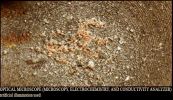
PHOE-SOL095-MF1.jpgMicroscopic Vastitas - Sol 95 (True Colors; credits: Dr M. Faccin)56 visitenessun commentoMareKromium
|
|

SOL1366-1.jpgGusev's Landscape - Sol 1366 (True Colors; credits: Dr G. Barca)56 visitenessun commentoMareKromium
|
|
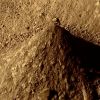
PHOE-SOL088-PIA11058.jpgMartian "Caterpillar" - Sol 88 (natural colors; credits: Lunexit)56 visiteAs NASA's Phoenix Mars Lander excavates trenches, it also builds piles with most of the material scooped from the holes. The piles, like this one called "Caterpillar", provide researchers some information about the soil.
On Aug. 24, 2008, during the late afternoon of the 88th Martian day after landing, Phoenix's Surface Stereo Imager took separate exposures through red, green and blue filters that have been combined into this approximately true-color image. This conical pile of soil is about 10 cm (4") tall.
The sources of material that the Robotic Arm has dropped onto the Caterpillar pile have included the "Dodo" and ""Upper Cupboard" trenches and, more recently, the deeper "Stone Soup" trench.
Observations of the pile provide information, such as the slope of the cone and the textures of the soil, that helps scientists understand properties of material excavated from the trenches.
For the Stone Soup trench in particular, which is about 18 cm (7") deep, the bottom of the trench is in shadow and more difficult to observe than other trenches that Phoenix has dug. The Phoenix team obtained spectral clues about the composition of material from the bottom of Stone Soup by photographing Caterpillar through 15 different filters of the Surface Stereo Imager when the pile was covered in freshly excavated material from the trench.
The spectral observation did not produce any sign of water-ice, just typical soil for the site. However, the bigger clumps do show a platy texture that could be consistent with elevated concentration of salts in the soil from deep in Stone Soup. The team chose that location as the source for a soil sample to be analyzed in the lander's wet chemistry laboratory, which can identify soluble salts in the soil.MareKromium
|
|
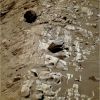
SOL1457-1.jpgSmall Boulders and Layered Rocks - Sol 1457 (True Colors; credits: Dr G. Barca)56 visitenessun commentoMareKromium
|
|
| 25353 immagini su 2113 pagina(e) |
 |
|
|
|
|
1651 | |
|
|
|
|





