| Piú viste |
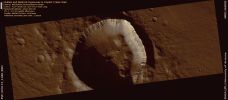
PSP_009155_1480_RED.jpgGullies and Bedrock Exposures in Impact Crater Wall (natural colors; credits: Lunexit)56 visiteThis image shows a rather pristine crater with Gullies and Bedrock Exposures. The Gullies are mostly on the South-Facing (such as the Poleward facing) wall. Some of the gully channels are very sharp, indicating that they have not been modified much since they formed.
Other channels criss-cross each other, demonstrating that there were multiple periods of activity. Scientists do not know how closely these were spaced in time.
The South and East walls of the Crater (upper right of the frame) have very distinct bright layers. These layers are possibly Ancient Bedrock. These walls also have what appear to be bright Landslides.MareKromium
|
|
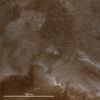
PSP_009138_2025_RED-01.jpgMineralogical Diversity in Nili Fossae (edm - natural colors; credits: Lunexit)56 visitenessun commentoMareKromium
|
|

ZZ-Mercury-Limb-PIA10938.jpgMercury’s Craters from a New Perspective56 visiteAs MESSENGER approached Mercury, the NAC acquired images to create a mosaic of the entire Planet. The mosaic shown here was created from about half of those images and is shown in an orthographic projection. This view is in contrast to the cylindrical equidistant map mosaic previously released. For this mosaic, an orthographic projection was used to create a view that has the perspective that one would see from deep space. Over three decades earlier, Mariner 10 viewed this portion of Mercury’s Surface, and the craters that were named on the basis of those images are labeled on this mosaic.
The MESSENGER images of this same territory are allowing scientists to study Mercury’s surface under different illumination conditions, and these complementary views provide new insight into the nature of the geologic features on Mercury.
Date Acquired: January 14, 2008
Instrument:Mosaic created with images taken by the Narrow Angle Camera (NAC) of the Mercury Dual Imaging System (MDIS)
Resolution: 1,5 Km/pixel (0,93 miles/pixel)
Scale: this mosaic shows Mercury from the Equator nearly to the North Pole, a distance of about one Mercury radius (2440 Km, such as approx. 1516 miles)MareKromium
|
|

ZZ-Mercury-Craters-Atget_Crater-PIA10934.jpgAtget Crater (natural colors; credits: Lunexit)56 visiteRecently named for the French photographer Eugène Atget, Atget Crater, seen in the middle of the lower portion of this NAC image, is distinctive on Mercury's Surface due to its dark color. Atget Crater is located within Caloris Basin, near Apollodorus Crater and Pantheon Fossae, which are also both visible in this image to the North-West of Atget. The dark color of the floor of Atget is in contrast to other craters within Caloris Basin that exhibit bright materials on their floors, such as the craters Kertész and Sander. Other craters on Mercury, such as Basho and Neruda, have halos of dark material but the dark material does not cover the crater floors. Understanding the variety of bright and dark materials associated with different craters will provide insight into Mercury's composition and the processes that acted on Mercury's Surface.
Date Acquired: January 14, 2008
Image Mission Elapsed Time (MET: 108828540
Instrument: Narrow Angle Camera (NAC) of the Mercury Dual Imaging System (MDIS)
Resolution: 520 meters/pixel (0,32 miles/pixel)
Scale: This image shows a scene about 530 Km (approx. 330 miles) across
Spacecraft Altitude: about 20.300 Km (approx. 12.600 miles)MareKromium
|
|

ZZ-Mercury-Limb-PIA10359.jpgCaloris Basin (natural colors; credits: Lunexit)56 visiteThis natural-color image of Mercury shows the great Caloris Impact Basin (see also PIA10383), visible in this image as a large, circular feature in the center of the picture. The contrast between the colors of the Caloris Basin Floor and those of the surrounding plains indicate that the composition of Mercury's surface is variable. Many additional geological features with intriguing color signatures can be identified in this image. For example, the bright spots just inside the rim of Caloris Basin are thought to mark the location of Volcanic Features, such as the volcano shown in this previously released Narrow Angle Camera (NAC) image PIA10942.
MESSENGER Science Team members are studying these regional color variations in detail, to determine the different mineral compositions of Mercury's surface and to understand the geologic processes that have acted on it. (...)
Date Acquired: January 14, 2008
Image Mission Elapsed Times (MET): 108827278-108827328
Instrument: Wide Angle Camera (WAC) of the Mercury Dual Imaging System (MDIS)
Resolution: about 2,3 Km (approx. 1,4 miles/pixel)
Scale: Caloris Basin is about 1550 Km in diameter (approx. 960 miles)
Spacecraft Altitude: approx. 13.000 Km (about 8000 miles)MareKromium
|
|

ZZ-Mercury-Craters-Kertész_Crater-PIA10933.jpgKertész Crater (Saturated Natural Colors; credits for the additional process. and color.: Dr Paolo C. Fienga/Lunar Explorer Italia/Italian Planetary Foundation)56 visiteLocated in the Western Edge of Mercury's giant Caloris Basin, Kertész Crater (recently named for André Kertész, a Hungarian-born American photographer) has some unusual, bright material located on its floor. Sander crater, located in the North-Western Edge of Caloris Basin, also shows bright material on its floor.
The MESSENGER Science Team is investigating the nature and composition of these bright materials and making comparisons between these two craters both located at the edges of Caloris Basin.
Just North-East of Kertész, a small crater has very bright rays and ejecta in this image, indicating that the crater is young.
Date Acquired: January 14, 2008
Image Mission Elapsed Time (MET): 108826812
Instrument: Narrow Angle Camera (NAC) of the Mercury Dual Imaging System (MDIS)
Resolution: 260 meters/pixel (0,16 miles/pixel
Scale: Kertész Crater is about 34 Km (approx. 21 miles) in diameter
Spacecraft Altitude: about 10.200 Km (approx. 6.340 miles)MareKromium
|
|

ZZ-Mercury-Limb-PIA10936.jpgDürer Basin (natural colors; credits: Lunexit)56 visiteMESSENGER snapped this image of Mercury’s horizon about 56 minutes before the Spacecraft’s closest pass by the Planet. The distinctive peak-ring basin Dürer (named from Mariner 10 photos for the German artist Albrecht Dürer) is visible.
The smaller crater Mickiewicz (named for the Polish poet Adam Mickiewicz) can also be seen, with a smaller central peak-ring structure in the middle of its crater floor.
Craters form ring structures during the impact process that creates the crater, and the number and characteristics of the rings depend on the crater’s size. Raditladi, imaged for the first time by MESSENGER and recently named, also shows a pronounced peak-ring structure.
Date Acquired: January 14, 2008
Image Mission Elapsed Time (MET): 108821505
Instrument: Narrow Angle Camera (NAC) of the Mercury Dual Imaging System (MDIS)
Scale: Dürer crater is about 190 Km (approx. 120 miles) in diameter
Spacecraft Altitude: about 18.300 Km (approx. 11.400 miles)MareKromium
|
|

ZZ-Mercury-Terminator-PIA10937-0.jpgNorthern Latitudes and a possible Orbital Anomaly (natural colors; credits: Lunexit)56 visiteAbout 91 minutes after MESSENGER’s closest pass by the Planet, MDIS acquired this image of Mercury’s Northern Surface, which is one in a set of 48 that form a mosaic of the departing Planet. In this image, the left portion of the Surface fades into darkness at the Terminator, the line between the sunlit dayside of the Planet and the dark night side.
The left-side portions of the surface that are just coming out of the darkness are being hit with the first rays of morning sunlight. Some of the surface to the right of this scene can be viewed in this previously released image looking toward Mercury’s North Pole (PIA10193).
Date Acquired: January 14, 2008
Image Mission Elapsed Time (MET): 108830334
Instrument: Narrow Angle Camera (NAC) of the Mercury Dual Imaging System (MDIS)
Resolution: 0,8 Km/pixel (0,5 miles/pixel) Scale: The width of this image is about 800 Km (approx. 500 miles)
Spacecraft Altitude: about 30.700 Km (approx. 19.100 miles)MareKromium
|
|
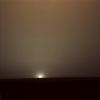
PHOE-SOL090-PIA11054-2.jpgIce Cold Sunrise on Mars - Sol 90 (natural colors; credits: Lunexit)56 visiteFrom the location of NASA's Phoenix Mars Lander, above the Martian Arctic Circle, the Sun does not set during the peak of the Martian Summer.
This period of maximum solar energy is past — on Sol 86, the 86th Martian Day after the Phoenix landing, the Sun fully set behind a slight rise to the North for about half an hour.
This red-filter image taken by the lander's Surface Stereo Imager, shows the Sun rising on the morning of Sol 90, Aug. 25, 2008, the last day of the Phoenix nominal mission.
The image was taken at 51 minutes past Midnight (Local Solar Time) during the slow sunrise that followed a 75 minute "night". The skylight in the image is light scattered off atmospheric dust particles and ice crystals.
The setting Sun does not mean the end of the Mission. In late July, the Phoenix Mission was extended through September, rather than the 90-Sol duration originally planned as the Prime Mission.MareKromium
|
|
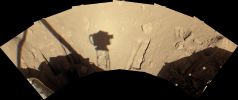
PHOE-SOL090-PIA11055.jpgVastitas' Surface, according to NASA - Sol 90 (natural colors; credits: NASA)56 visiteDuring the first 90 Martian Days, or Soles, after its May 25, 2008, landing on an Arctic Plain of Mars, NASA's Phoenix Mars Lander dug several trenches in the workspace reachable with the Lander's Robotic Arm (LRA).
The Lander's Surface Stereo Imager camera recorded this view of the workspace on Sol 90, early afternoon Local Mars time (overnight Aug. 25 to Aug. 26, 2008). The shadow of the the camera itself, atop its mast, is just left of the center of the image and roughly a third of a meter (one foot) wide.
The workspace is on the north side of the lander. The trench just to the right of center is called "Neverland".MareKromium
|
|

OPP-SOL1094-1.jpgVictoria's Paving - Sol 1094 (True Colors; credits: Dr G. Barca)56 visitenessun commentoMareKromium
|
|

OPP-SOL1074-1.jpgFrom inside Victoria - Sol 1074 (True Colors; credits: Dr G. Barca)56 visitenessun commentoMareKromium
|
|
| 25353 immagini su 2113 pagina(e) |
 |
|
|
|
|
1650 | |
|
|
|
|





