| Piú viste |

Craters-Charlier_Crater-MO-20090716a.jpgThe "Warm Sands" of Charlier Crater (IR Image)56 visiteCaption NASA:"This daytime IR image shows the large sand sheet on the Floor of Charlier Crater. The brightness is due to the warmth of the sand during the day".
Coord.: 68,9° South Lat. and 190,6° East Long.MareKromium
|
|
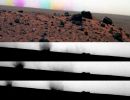
SOL1919-PIA12121.jpgColorful Effect from sequential shots of moving Dust Devils - Sol 191956 visiteCaption NASA:"While the Panoramic Camera (PanCam) on NASA's Mars Exploration Rover Spirit was taking exposures with different color filters during the 1919th Martian Day of the Rover's Mission (May 27, 2009), several Dust Devils moved across the field of view. Because several seconds intervened between shots with different filters, the location of the Dust Devils changed between the exposures.
The three grayscale images stacked from the bottom of this four-part view are the separate exposures through filters centered on wavelengths of 750 nanometers, 530 nanometers and 430 nanometers. Contrast has been stretched to emphasize the Dust Devils on the horizon.
At the top is a composite image combining those exposures to yield a color scene of the Martian ground. The time intervals between the exposures result in the darker Dust Devil appearing blue at its first location, violet at its second location and yellow at its third location. A second Dust Devil was consolidating during the first two exposures and appears orange at its location when the third exposure was taken. In the foreground is the northern end of a ridge called "Tsiolkovsky", about 25 meters (about 80 feet) from Troy.
Dust Devils occur on both Mars and on Earth when solar energy heats the Surface, resulting in a layer of warm air just above the Surface. Since the warmed air is less dense than the cooler atmosphere above it, it rises, making a swirling thermal plume that picks up the fine dust from the surface and carries it up into the atmosphere. This plume of dust moves with the local wind".MareKromium
|
|
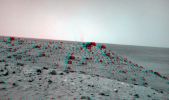
SOL1913-PIA12122.jpgDust Devil West of Spirit - Sol 1913 (3D - credits: NASA/JPL-Caltech)56 visiteCaption NASA:"The NavCam on NASA's Mars Exploration Rover Spirit caught this stereo view of a Dust Devil during the 1913th Martian Day, or Sol, of the Rover's Mission on Mars (May 21, 2009).
The view is to the West from Spirit's position at the "Troy" location where Spirit had become embedded a few weeks earlier.
The dust-lofting whirlwind is out on the plain west of the Columbia Hills range that Spirit has been exploring since 5 months after landing on the plain in January 2004.
In the foreground is the northern end of a ridge called "Tsiolkovsky", about 25 meters (about 80 feet) from Troy.
This view combines images from the left-eye and right-eye sides of the NavCam. It appears three-dimensional when seen through red-blue glasses with the red lens on the left".MareKromium
|
|
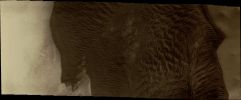
Craters-Charlier_Crater-20090717a-PCF-LXTT.jpgLarge Dunefield inside Charlier Crater (Absolute Natural Colors; credits for the additional process. and color.: Dr Paolo C. Fienga - Lunar Explorer Italia)56 visiteCoord.: 68,2° South Lat. and 191,2° East Long.MareKromium
|
|
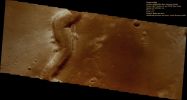
Channels-Nirgal_Vallis-MO-20090720a.jpgNirgal Vallis (Enhanced Natural Colors; credits: Lunar Explorer Italia)56 visitenessun commentoMareKromium
|
|

The_Rings-PIA11539.jpgShadowing the "Gap"...56 visiteCaptin NASA:"The shadow of the moon Tethys is cast onto Saturn's "A"-Ring, almost blanketing the Enke Gap.
The novel illumination geometry created as Saturn approaches its August 2009 Equinox allows moons orbiting in or near the plane of Saturn's equatorial rings to cast shadows onto the Rings.
These scenes are possible only during the few months before and after Saturn's Equinox which occurs only once in about 15 Earth years. To learn more about this special time and to see a movie of a moon's shadow moving across the rings, see PIA11651 and PIA11660.
This view looks toward the sunlit side of the Rings from about 29° below the Ring-Plane. The image was taken in Visible Light with the Cassini Spacecraft narrow-angle camera on May 25, 2009. The view was acquired at a distance of approx. 759.000 Km (about 472.000 miles) from Saturn and at a Sun-Saturn-spacecraft, or Phase, angle of 56°.
Image scale is roughly 4 Km (about 2,5 miles) per pixel".MareKromium
|
|

ESP_012570_1670_RED_abrowse.jpgLight and Intermediate-Toned Material near Morava Valles (Natural Colors; credits: Lunar Explorer Italia)56 visitenessun commentoMareKromium
|
|
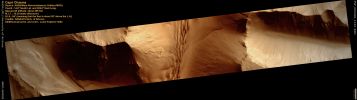
PSP_009446_1650_RED_abrowse.jpgCapri Chasma (Natural Colors; credits: Lunar Explorer Italia)56 visitenessun commentoMareKromium
|
|
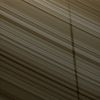
The_Rings-PIA11544.jpgShadows on the "B"-Ring (Natural Colors; credits: Lunar Explorer Italia)56 visiteCaption NASA:"The shadow of the moon Epimetheus stretches across the B-Ring in this image taken by Cassini as Saturn approaches its 2009 Equinox. The novel illumination geometry created as Saturn approaches its August 2009 Equinox allows moons orbiting in or near the plane of Saturn's Equatorial Rings to cast shadows onto the Rings.
These scenes are possible only during the few months before and after Saturn's Equinox, which occurs only once in about 15 Earth years.
This view looks toward the sunlit side of the rings from about 42° below the Ring-Plane.
The image was taken in Visible Light with the Cassini Spacecraft narrow-angle camera on June 8, 2009. The view was obtained at a distance of approx. 700.000 Km (about 435.000 miles) from Saturn and at a Sun-Saturn-Spacecraft, or Phase, Angle of 129°.
Image scale is roughly 4 Km (about 2,5 miles) per pixel".MareKromium
|
|

Craters-UnnamedCraterinPlanumChronium-20090729a-01.jpgExhumed Crater in Planum Chronium (edm - Natural Colors; credits: Lunexit)56 visitenessun commentoMareKromium
|
|

ESP_011610_1825-02.jpgFresh Triplet! (perspective view - Natural Colors and Natural Enhanced Colors; credits: Dr M. Faccin)56 visitenessun commentoMareKromium
|
|
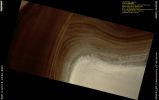
PSP_010374_2650_RED_abrowse.jpgNorth Polar Layers (Natural Colors; credits: Lunar Explorer Italia)56 visitenessun commentoMareKromium
|
|
| 25353 immagini su 2113 pagina(e) |
 |
|
|
|
|
1646 | |
|
|
|
|





