| Piú viste |

Titan-Seas-Kraken_Mare-PIA11626-00.jpgKraken Mare (Natural Colors; credits: Lunexit)56 visiteCaption NASA:"In the top right of this Cassini image, the Southern end of Titan's huge lake of liquid hydrocarbons called Kraken Mare is visible near the moon's North Pole.
See PIA11146 to learn more about Titan's lake districts and to see a map.
Near the moon's Equator are the albedo features Senkyo on the right and Aztlan on the left. This view looks toward the Saturn-Facing Side of Titan. North is up and rotated 31° to the right.
The image was taken with the Cassini Spacecraft wide-angle camera on Oct. 12, 2009 using a spectral filter sensitive to wavelengths of Near-InfraRed Light centered at 939 nanometers.
The view was acquired at a distance of approx. 252.000 Km (about 157.000 miles) from Titan and at a Sun-Titan-Spacecraft, or Phase, Angle of 11°.
Image scale is roughly 15 Km (a little more than 9 miles) per pixel".MareKromium
|
|

Titan-Seas-Kraken_Mare-PIA11626-01.jpgKraken Mare (the Map)56 visiteKraken Mare is - so far - the largest known body of liquid on the Surface of Titan.
It was discovered in 2007 by the Cassini Probe and was so named in 2008 after the Kraken, a legendary sea monster. Kraken Mare is believed to be the largest of numerous seas and lakes in Titan's North Polar Region.
It should be a sea of Hydrocarbons whose discovery was further confirmed by Radar Imagery. Only a portion of the Kraken Sea has been imaged by radar, but its wider extent is indicated in Visible Light images that indicate a larger expanse. Kraken Mare is believed to be similar in size to the Caspian Sea. An island in the sea is named Mayda Insula.
As part of the proposed "Titan/Saturn System Mission", a probe would splash down on Kraken Mare in order to study and scrutinize its composition, depth and numerous other properties.
Nota Lunexit: "...and numerous other properties...". Quali??? Lifeforms living into it, maybe???...MareKromium
|
|

OPP-SOL2043-GB.jpgRover Tracks, Pebbles and Colourful Sand - Sol 2043 (Natural Colors; credits: Dr G. Barca)56 visitenessun commentoMareKromium
|
|

Titan-N00141759_to_N00141771_RAWC-SD.jpgTitan (Superdefinition and Enhanced Natural Colors; credits for the additional process. and color.: Dr M. Faccin - Lunexit Team)56 visitenessun commentoMareKromium
|
|
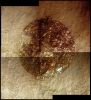
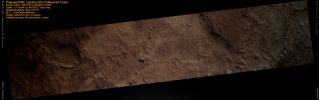
OPP-SOL2070-MI-Layer-MF.jpgThe Texture of a Martian Rock - Sol 2070 (Superdefinition & Natural Colors; credits: Dr M. Faccin)56 visiteOsservate MOLTO attentamente la regione centrale dell'area abrasa: non Vi potrà sfuggire il fatto che la superficie lucente della roccia sembra "sfogliarsi", quasi che si tratti di un velo di vernice ormai divenuto troppo vecchio...
ATTENZIONE: il parallelo che abbiamo fatto tra questa immagine e una "vernice che si scrosta" è volutamente provocatorio; sia chiaro: noi NON stiamo implicando in alcun modo che la roccia osservata sia un manufatto! Noi ci limitiamo a sottolineare la - curiosa - circostanza per cui lo strato lucido della pietra, come ben evidenziato dal lavoro dell'abrasore di cui il Rover è dotato, sembra - effettivamente - parzialmente scrostato rispetto alla superficie grezza della stessa (ergo non si dovrebbe trattare di una componente della texture originale della roccia, bensì di un qualcosa che si è depositato sulla stessa - e facendo "presa"! - in un momento successivo).
Ecco: questo è un "clue", a nostro parere, da studiare e valutare...MareKromium
|
|

Enceladus-N00146851_53.jpgFountains of Light (Natural Colors; image processing credits: Dr M. Faccin)56 visiteCon questa meravigliosa fotocomposizione rappresentativa delle "Fontane di Luce" che, come sapete, caraterizzano il Polo Sud di Encelado, ci pregiamo ed onoriamo di salutare l'Amico (o gli Amici) che ci legge (o leggono) dall'Osservatorio Astronomico di Arcetri.
Un Caro Saluto e Cieli Sereni a Voi dal Lunexit-Team!MareKromium
|
|
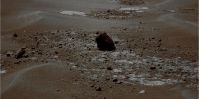
OPP-SOL2057-GB-LXT.jpgApproaching a small - and yet unusually-positioned and oddly-looking - Boulder - Sol 2057 (Natural Colors; credits: Dr G. Barca & Lunexit)56 visitenessun commentoMareKromium
|
|
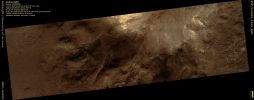
ESP_014439_1505_RED_abrowse.jpgCentral Uplift (Natural Colors; credits: Lunexit)56 visitenessun commentoMareKromium
|
|
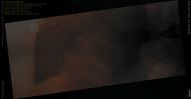
PSP_007126_1210_RED_abrowse~0.jpgLike a "dried-up" Waterfall (True Colors + MULTISPECTRUM; credits: Lunexit)56 visiteThis image shows a large gully in the wall of a crater in the Southern Hemisphere. Such gullies are among the most recent landforms on Mars, and were probably carved by liquid water.
The source of the water is still unknown; it could have been groundwater from a shallow aquifer or melted snow or ground ice from a different climate.
This gully is not particularly fresh, but it is among the largest observed; several sub-channels merge in the alcove on the upper slope, in the north part of the image (Dx).
Numerous faint troughs and lineations are visible downslope, likely indicating old channels that have been buried or reworked. The upper alcove exposes a dense cluster of boulders not seen on the adjacent slope. This could indicate that smaller material has been removed by the gullies, exposing the boulders without transporting them far.MareKromium
|
|
PSP_007124_1765_RED_abrowse~0.jpgProposed MSL Landing Site in Miyamoto Crater (MULTISPECTRUM; credits: Lunexit)56 visiteMiyamoto Crater is located in South-Western Meridiani Planum (and South-West of the Mars Exploration Rover Opportunity Landing Site).
This image shows fairly smooth plains and some areas covered by Windstreaks.
The streaks suggest that wind is an active process here, depositing surface material downwind in this distinctive form. This Landing Site is adjacent to the Hematite-bearing plains unit where the Opportunity Rover sits.
The CRISM instrument has detected Phyllosilicates (Clay Minerals) at this Landing Site, which scientists believe to have formed in the presence of water.
The Mars Science Laboratory rover would investigate the mineral diversity here, which includes Phyllosilicates and Sulfate Minerals.
MareKromium
|
|

ESP_014342_0930-00.jpgSouth Polar Residual Cap Intraseasonal Change Monitoring (CTX Frame - Natural Colors; credits: Lunexit)56 visitenessun commentoMareKromium
|
|

ESP_014342_0930-09.jpgSouth Polar Residual Cap Intraseasonal Change Monitoring (EDM n.9 - Natural Colors; credits: Lunexit)56 visitenessun commentoMareKromium
|
|
| 25353 immagini su 2113 pagina(e) |
 |
|
|
|
|
1637 | |
|
|
|
|





