| Piú viste |

OPP-SOL0193.jpgThe Dunefield inside Endurance Crater - Sol 193 (by Dr M. Faccin)56 visitenessun commentoMareKromium
|
|
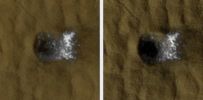
SubsurfaceIce-PIA12219.jpgSubsurface Ice (Natural Colors; credits: Lunexit)56 visiteThis 12-meter-wide (39-foot-wide) Impact Crater located in Mid-Latitude Northern Mars was created by an impact that occurred between July 3, 2004, and June 28, 2008, as bracketed by before-and-after images (not shown here).
The images shown here were taken by the High Resolution Imaging Science Experiment camera on NASA's Mars Reconnaissance Orbiter on Nov. 19, 2008, (left) and on Jan. 8, 2009. Each image is about 35 meters (115 feet) across.
The impact that dug the Crater excavated water ice from below the Surface. It is the bright material visible in this pair of images. This Crater is at 46,16° North Latitude and 188,51° East Longitude.MareKromium
|
|

SubsurfaceIce-PIA12217.jpgSubsurface Ice (Natural Colors; credits: Lunexit)56 visiteThe High Resolution Imaging Science Experiment camera on NASA's Mars Reconnaissance Orbiter took these images of a fresh, 6-meter-wide (20-foot-wide) crater on Mars on Oct. 18, 2008, (left) and on Jan. 14, 2009. Each image is about 35 meters (115 feet) across.
This crater's depth is estimated to be 1,33 meters (4,4 feet).
Images (not shown here) taken by the Thermal Emission Imaging System camera on NASA's Mars Odyssey orbiter and by the Context Camera on the Mars Reconnaissance Orbiter show that the impact that excavated this crater occurred sometime between Dec. 22, 2008 and July 5, 2008.
The impact exposed water ice from below the Surface. It is the bright material visible in this pair of images. The change in appearance from the earlier image to the later one resulted from some of the ice sublimating away during the Martian Northern-Hemisphere Summer, leaving behind dust that had been intermixed with the ice. The thickening layer of dust on top obscured the remaining ice.
This crater is at 43,28° North Latitude and 164,22° East Longitude.MareKromium
|
|
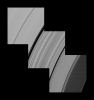
The_Rings-PIA11664.jpgSpiral Corrugation across the C and D-Rings56 visiteCaption NASA:"Alternating light and dark bands, extending a great distance across Saturn’s D and C-Rings, are shown here in these Cassini images taken one month before the Planet’s August 2009 Equinox.
The C-Ring stretches across the upper left and middle of the image. The D-Ring is barely visible amid the noise in the lower right of the image.
The periodic brightness variations in the Rings have a subtler, narrow appearance in this mosaic of three Cassini images than other larger features of the Rings, such as the Columbo Gap which appears as a black arc on the left of the center frame of the mosaic. These brightness variations are almost certainly caused by the changing slopes in the rippled Ring-Plane, much like the corrugations of a tin roof.
Although previous Cassini observations (see PIA08325) had revealed corrugations in the D-Ring extending over 500 miles (about 800 Km), this image shows these features extending for 6200 miles (about 10.000 Km) into the C-Ring.
Later Equinox images revealed the true dimension of this Corrugation, extending completely across the C ring, right up to the inner B-Ring edge for a total breath of about 17.000 Km (approx. 11.000 miles) -- see PIA11670 and PIA11671.
This and other new imagery supports earlier evidence that something dramatic happened in the early 1980s to initiate this feature.
In 2006, imaging scientists speculated that a collision with a comet or asteroid may have disturbed the D-Ring. That explanation seems less likely now that this and other new images show the effect spread over a much broader radial range, extending right up to the inner B-Ring. Scientists continue to investigate the cause of this disturbance.
Whatever caused the corrugation apparently tilted a vast region of the inner rings relative to Saturn’s gravitational field in a relatively short period of time during the early 1980s. In the intervening years, the natural tendency for inclined orbits to systematically and slowly wobble at different rates, depending on their distance from Saturn, has created a tightly wound spiral corrugation in the Ring-Plane.
This view looks toward the unilluminated side of the Rings from about 24° above the Ring-Plane.
The D-Ring has been brightened relative to C-Ring to enhance visibility.
The images were taken in Visible Light with the Cassini Spacecraft narrow-angle camera on July 11, 2009. The view was acquired at a distance of approx. 470.000 Km (about 292.000 miles) from Saturn and at a Phase Angle of 25°.
Image scale is roughly 2 Km (about 1,25 miles) per pixel".MareKromium
|
|
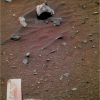
SOL2020-GB.jpgColourful Sands near Spirit - Sol 2020 (Possible True Colors; credits: Dr G. Barca)56 visitenessun commentoMareKromium
|
|
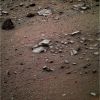
SOL2023-GB.jpgColourful Sand, Rocks and Pebbles - Sol 2023 (Possible True Colors; credits: Dr G. Barca)56 visitenessun commentoMareKromium
|
|
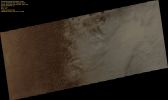
Craters-DouglassCrater-20090930a.jpgDunefield inside Douglass Crater - Aonia Terra (Natural Colors; credits: Lunar Explorer Italia)56 visitenessun commentoMareKromium
|
|

SOL2021-GB-LXT.jpgAntenna MAST and Surface - Sol 2021 (Natural Colors; credits: Dr G. Barca & Lunexit)56 visitenessun commentoMareKromium
|
|
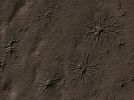
ESP_014413_0930_RED_abrowse-01.jpgRadial Channels carved by CO2 - a.k.a.: The "Spiders" (EDM - Natural Colors; credits: Lunexit)56 visiteIn this EDM we can see, now that all the seasonal frost is gone, the actual appearence of the "Spiders" and we can both use stereo images (when available) or shadows (if any) to measure the depth of the Channels carved into the ground (which, by the way, are usually 1 or 2 meters deep).MareKromium
|
|

ESP_014181_0920_RED_abrowse.jpgThe South Polar Residual Cap (Natural Colors; credits: Lunexit)56 visitenessun commentoMareKromium
|
|
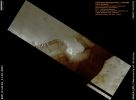
ESP_014190_1130_RED_abrowse.jpgUSGS Dune Database Entry Number 0403-669 (Natural Colors; credits: Lunexit)56 visitenessun commentoMareKromium
|
|
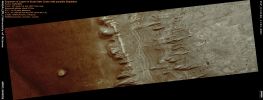
ESP_014186_1745_RED_abrowse.jpgExposures of Layers in South Gale Crater (Natural Colors; credits: Lunexit)56 visitenessun commentoMareKromium
|
|
| 25353 immagini su 2113 pagina(e) |
 |
|
|
|
|
1633 | |
|
|
|
|





