| Piú viste |

PSP_006968_1735_RED_abrowse~0.jpgMound of Layers in East Candor Chasma (MULTISPECTRUM; credits: Lunexit)56 visiteThis image shows the Northern portion of East Candor Chasma, part of the Valles Marineris Canyon System. In the center of the image is a light-toned mound that has dozens of layers exposed along its edge. As the upper layers weather and break apart into smaller grains, these grains subsequently fall down the edge, burying layers beneath and producing triangular-shaped debris aprons.
The color image of the mound doesn’t show any significant color variations between the different layers.
However, another instrument on MRO called CRISM (Compact Reconnaissance Imaging Spectrometer for Mars) has observed compositional differences between the layers and these results have been helpful in deciphering the origin of these layers.
This deposit is one of several examples exhibiting sulfate-rich layers with alternating hydration states. Cliff-forming Kieserite-rich layers alternate with slope-forming polyhydrated sulfate layers. (Kieserite is a mineral containing Magnesium).
The apparent lack of slumping, channels, cross-bedding or bed truncation supports quiescent water or deposition from the air as the most likely origin for the layers.MareKromium
|
|

PSP_006969_1725_RED_abrowse-00.jpgThe Floor of Noctis Labyrinthus (context frame - MULTISPECTRUM; credits: Lunexit)56 visiteThis image shows part of Noctis Labyrinthus, the “Labyrinth of the Night.” This is a system of connecting troughs which form a maze-like network at the western end of Valles Marineris, the giant canyon system of Mars.
The individual troughs are usually kilometers across; this image shows part of the floor of one of the troughs, with some intriguing fine-scale features.
Near the center of the image, the floor is broken up into many small knobs and hills, probably eroded remnants of a larger geologic unit.MareKromium
|
|

Titan-W00049900.jpgLost in the Space of Saturn... (natural colors; credits: Lunexit)56 visiteTitano: il disco, appena percettibile, splende di un leggero color giallo. Siamo a circa 1,8 MKM dalla "Luna Nebbiosa".MareKromium
|
|

Helene-N00123958.jpgHelene56 visiteHelene is one of the named Minor Moons of Saturn. Also known as Saturn XII (or S12), Helene is an irregularly shaped (---> nonspherical) body measuring about 22 miles (such approx. 36 Km), by about 20 miles (approx. 32 Km), by about 18 miles (approx. 30 Km).
Helene orbits Saturn at a mean distance of about 234.500 miles (approx. 377.400 Km) and has an Orbital Period of 2,7369 Earth Days — the Rotational Period is unknown but is assumed to be the same as the Orbital Period (meaning that Helene shall always show the same side to Saturn - just like the Moon does to Earth).
Helene was discovered by French astronomers P. Laques and J. Lecacheaux in 1980 during ground-based observations of Saturn.
Another moon, Dione, is co-orbital with Helene: that is, Helene orbits Saturn at the same distance as Dione but precedes Dione by about 60°.
Before the present name was adopted, the moon was referred to as "Dione-B" or also "Electra".MareKromium
|
|

SOL814-1_copia2.jpgPeaceful Horizon... - Sol 814 (possible True Colors; credits: Dr G. Barca)56 visitenessun commentoMareKromium
|
|

NGC-6543-HST_peris-3d.gifNGC 6543 - The "Cat's Eye Nebula"56 visiteMareKromium
|
|

PSP_010219_2785_RED_abrowse-01.jpgDunes in Abalos Undae (edm - possible True Colors; credits: Lunexit)56 visiteThis enhanced-color close-up (1,2 Km across) shows an example of dunes in Abalos Undae.
The enhanced color data illuminate differences in composition: the dunes appear of a green/bluish color because of their basaltic composition, while the reddish-white areas are probably covered in dust and residual ice. Upon close inspection, tiny ripples and grooves are visible on the surface of the dunes (both ripples and grooves are formed by wind action, as are the dunes themselves).
It is possible that these dunes are no longer migrating (the process of dune formation forces dunes to move in the direction of the main winds) and that the tiny ripples are the only active parts of the dunes today.MareKromium
|
|
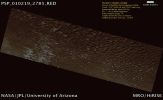
PSP_010219_2785_RED_abrowse-00.jpgDunes in Abalos Undae (ctx frame - possible True Colors; credits: Lunexit)56 visiteThe Abalos Undae Dunefield stretches westward, away from a portion (Abalos Colles) of the ice-rich North Polar Layered Deposits that is separated from the main Planum Boreum dome by two large chasms (---> abissi, crepacci).
These dunes are special because their sands may have been derived from erosion of the Rupes Tenuis unit (the lowest stratigraphic unit in Planum Boreum, beneath the icier layers) during formation of the chasms.
Some researchers have argued that these chasms were formed partially by melting of the polar ice.MareKromium
|
|

PSP_010222_1815_RED.jpgLight-toned Bedrock in Terra Meridiani (possible True Colors; credits: Lunexit)56 visiteThis observation shows part of a broad expanse of bare rock in Terra Meridiani. This is a large area with abundant sedimentary rocks forming a stack hundreds of meters thick, and now being eroded into a landscape reminiscent of the South-Western United States.
The timescale involved in depositing and eroding these layers is evident from the remnant impact craters preserved here. The large arc in the image is the rim of one crater; the smaller, circular dark spots are traces of other impacts. Light sediments are found both inside and outside the large crater, indicating that this crater formed during the period of sediment deposition. It is likely that this depression, which was probably more than a kilometer deep when it formed, was completely filled and buried and is now being exhumed. Crater densities are often used to estimate the age of surfaces on Mars, but here the rate of erosion is enough to erase small craters, reducing the apparent age of the surface. These rocks probably date from an early era of Martian History, but no fresh, pristine craters are visible.
The smaller circular patches are also impact craters seen somewhere in a complex cycle of burial and erosion. They are filled with dark material which probably mantled the region at one point, most likely after all of the light material was deposited. In some places this appears to have been hardened into rock, as in the large dark circle in the north-central part of the image. Material eroded from this hardened mantle may now be forming the ripples seen in many places as it is blown by the wind; the color of the ripples is similar to the slabs of dark mantle.
At the finest scale, the light sediments are intricately textured. A diverse assortment of fine cracks called joints are visible. The scale and density of these joints varies across the image; this suggests variations in the properties of the rocks. Although the image as a whole is a relatively flat plain, at small scale the surface is intricately rough. The balance between erosion and rock strength has left a surface with many small knobs, mesas, cliffs, and bumpy textures.
Further evidence for the diversity of rocks here comes from the enhanced color. The dark mantling materials are generally blue in the RGB color image while the sediments are generally pale, but a diverse range of hues indicates variations in the composition (or in the amount of sand and dust trapped on the surface by textures of varying roughness). This helps to highlight layering and shows which rocks are most similar to each other.MareKromium
|
|
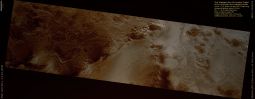
PSP_007961_2530_RED.jpgWestern Rim Region of Korolev Crater (possible True Colors; credits: Lunexit)56 visiteThis image was originally suggested by Ehsan Sanaei’s high school astronomy club in Yazd, Iran. They write, “[We are interested in] exploring the impact region near the northern Martian Pole and observing the contrast between ice-covered and [non-ice covered] Regions.”
Mrs. Stoica’s 9th grade class, at Tudor Vianu High-School of Computer Science, in Bucharest, Romania, helped to analyze the image by writing that “we observe a major crater, a small mountain chain, dunes and a series of small valleys and crevasses which [contain] ice.”
Indeed, this image shows part of the western rim of Korolev Crater, a prominent 80-Km-diameter crater located in the Northern Polar Region. It was taken in Northern Spring and shows dark regions of dust and sediment and bright regions of ice and frost. At highest resolution both bright and dark areas of the surface are covered by polygonal fracture patterns.
Although much of the ice has likely started to sublimate (change from a solid to a gas) in the darker regions, ice fills the fractures.MareKromium
|
|

SOL844-3.jpgThe distant Rim of Gusev Crater - Sol 844 (possible True Colors; credits: Dr G. Barca & Lunexit)56 visitenessun commentoMareKromium
|
|

SOL820-3.jpgRocky Skyline - Sol 820 (possible True Colors; credits: Dr G. Barca & Lunexit)56 visitenessun commentoMareKromium
|
|
| 25353 immagini su 2113 pagina(e) |
 |
|
|
|
|
1623 | |
|
|
|
|





