| Piú viste |

PHOE-SOL143-lg40998-40999-41000-2.jpgInside the "Icy Trench"... - Sol 143 (Superdefinition and possible True Colors; credits: Dr G. Barca)56 visitenessun commentoMareKromium
|
|

Haumea2.jpgHaumea and other "Dwarf" Companions56 visiteCaption NASA:"One of the strangest objects in the Outer Solar System was classified as a Dwarf Planet last week (September 2008) and given the name Haumea.
This designation makes Haumea the 5th designated Dwarf Planet after Pluto, Ceres, Eris, and Makemake. Haumea's smooth but oblong shape make it extremely unusual. Along one direction, Haumea is significantly longer than Pluto, while in another direction Haumea has an extent very similar to Pluto, while in the third direction is much smaller.
Haumea's orbit sometimes brings it closer to the Sun than Pluto, but usually Haumea is further away.
Illustrated above, an artist visualizes Haumea as a nearly featureless ellipsoid. Quite possibly, however, Haumea has interesting craters and surface features that currently remain unknown. Originally discovered in 2003 and given the temporary designation of 2003 EL61, Haumea was recently renamed by the IAU for a Hawaiian goddess. Haumea has two small moons discovered in 2005, recently renamed Hi'iaka and Namaka after the daughters of the Goddess".MareKromium
|
|

Comets-Comet_Holmes-UZ_PIA11228-2.jpgComet 17-P Holmes now in the Outer Solar System56 visiteSpitzer's infrared picture at left hand side of this frame reveals fine dust particles that make up the Outer Shell, or "Coma", of the Comet. The Nucleus of the Comet is within the bright whitish spot in the center, while the yellow area shows solid particles that were blown from the Comet in the explosion.
The Comet is headed away from the Sun, which lies beyond the right-hand side of these pictures.
The contrast-enhanced picture on the right shows the Comet's Outer Shell, and strange "filaments", or "Streamers", of dust. The Streamers and shell are a yet another mystery surrounding Comet Holmes. Scientists had initially suspected that the Streamers were small dust particles ejected from fragments of the Nucleus, or from hyerpactive jets on the Nucleus, during the October 2007 explosion.
If so, both the Streamers and the Shell should have shifted their orientation as the Comet followed its orbit around the Sun.
Radiation pressure from the Sun should have swept the material back and away from it. But pictures of Comet Holmes taken by Spitzer over time show the Streamers and Shell in the same configuration, and not pointing away from the Sun. The observations have left astronomers stumped.
The horizontal line seen in the contrast-enhanced picture is a trail of debris that travels along with the Comet in its orbit.
The Spitzer picture was taken with the Spacecraft's multiband imaging photometer at an infrared wavelength of 24 microns.MareKromium
|
|
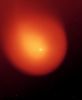
Comets-Comet_Holmes-UZ_PIA11228-1.jpgComet 17-P Holmes now in the Outer Solar System (IR)56 visiteNASA's Spitzer Space Telescope captured the picture of comet Holmes in March 2008, 5 months after the comet suddenly erupted and brightened a millionfold overnight. The contrast of the picture has been enhanced (see the next frame) to show the anatomy of the comet.
Every 6 years, comet 17P/Holmes speeds away from Jupiter and heads inward toward the Sun, traveling the same route typically without incident. However, twice in the last 116 years, in November 1892 and October 2007, comet Holmes mysteriously exploded as it approached the Asteroid Belt. Astronomers still do not know the cause of these eruptions.
Nota Lunexit: la "causa" di queste repentine eruzioni della Cometa 17-P Holmes le quali avvengono - guarda caso - durante il transito della medesima attraverso la Fascia degli Asteroidi potrebbe essere RAGIONEVOLMENTE rinvenuta nella verificazione di impatti con corpi erranti di piccole/piccolissime dimensioni (l'occorrere di impatti con uno o più oggetti di dimensioni medie o medio/grandi porterebbe inevitabilmente alla frammentazione/distruzione completa del nucleo di 17-P Holmes ed alla sua relativa e definitiva sparizione). Che gli "outbursts" possano essere (anche) l'ovvia conseguenza di un impatto ad altissima velocità è stato recentemente dimostrato dall'esperimento (come ricorderete contestatissimo) effettuato dalla NASA sulla Cometa Tempel-1, la quale fu centrata da un'ogiva metallica e, all'atto dello "scontro spaziale", aumentò la sua luminosità in maniera agevolmente percepibile anche da Terra.MareKromium
|
|

PHOE-SOL144-lg41031-41032-41033-2.jpgMicroscopic Vastitas: Numbers - Sol 144 (Superdefinition and possible True Colors; credits: Dr G. Barca)56 visiteUn'elaborazione semplicemente superlativa, di GRAN LUNGA migliore delle "migliori" elaborazioni ufficiali NASA aventi contenuto analogo...MareKromium
|
|

Dione-PIA10496.jpgThe Bright Canyons of Dione56 visiteCaption NASA:"Dione's defining feature, the fractures on its Trailing Side, shine brilliantly in this Cassini Spacecraft view.
The view was acquired from a position 33° South of the moon's Equator. Lit terrain seen here is on the Trailing Side of Dione (approx. 1123 Km, or about 698 miles across). North is up and rotated 8° to the right.
The image was taken in visible light with the Cassini spacecraft narrow-angle camera on Sept. 11, 2008. The view was obtained at a distance of approximately 833,000 kilometers (517,000 miles) from Dione and at a Phase Angle of 67°. Image scale is about 5 Km (a little more than 3 miles) per pixel.
The image was taken with the Cassini Spacecraft wide-angle camera on Aug. 26, 2008 using a spectral filter sensitive to wavelengths of infrared light centered at 752 nanometers.
The view was acquired at a distance of approx. 397.000 Km (about 246.000 miles) from Saturn.
Image scale is roughly 20 Km (about 13 miles) per pixel".MareKromium
|
|
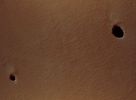
PSP_009488_1745_RED_abrowse-01.jpgMartian Caves (edm n. 1 - possible natural colors; credits: Lunexit)56 visiteThe pair of Pit Craters visible here are the smallest “anomalous” pits known to exist at this time. These have either vertical or sub-vertical interior walls (sub-vertical means that they are not visible from a nearly overhead viewing perspective), and each pit is deep enough that sunlight does not hit the floor when the Sun is at or near the Zenith.
Unfortunately, the only thermal-infrared camera currently orbiting Mars cannot resolve features this small, so the temperature characteristics of these pits must remain unknown for now, underscoring the need for a high-resolution thermal instrument on future missions.
Intriguingly, when pit craters on Earth have similar characteristics to the pair shown here, they often have cave entrances in their bases connecting to large underground networks. Current investigations are determining whether the anomalous Martian Pits may be shown to contain such entrances.MareKromium
|
|
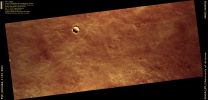
PSP_009488_1745_RED_abrowse-00.jpgMartian Caves (ctx frame - possible natural colors; credits: Lunexit)56 visitePit Craters exist in Volcanic Regions across Mars, and form when surface materials collapse into large underground cavities. Such pits are generally bowl-shaped, filled with sediment, and are relatively shallow when compared with their diameters.
Recently, a small number of anomalous Pit Craters were identified with strikingly different visible and thermal characteristics such as: sheer cliff walls; deep interiors that can extend out-of-sight beneath the surface and temperature fluctuations that behave unlike any known feature on Mars.MareKromium
|
|
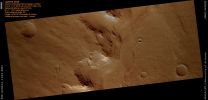
Psp_009601_1920_red.jpgLayered Shelf (possible natural colors; credits: Lunexit)56 visiteThis image shows the edge of a Layered Shelf in a large Impact Crater. Sediments form a bench with a flat top and steep edge along part of the interior wall. This site shows part of the steep edge of those deposits.
The bench is formed by an upper layer that is relatively hard and resistant, while lower rocks are soft. Once the upper cap layer is removed, the weaker material below is easily eroded. This structure can be seen here: at the very top of the bench is a relatively steep lip, while material below has a muted appearance. A few steep outcrops lower on the slope suggest that there could be other strong layers.
Because of pervasive dust cover, it is difficult to learn much about the nature of the rocks here. Dust builds up by settling out after the many large Martian Dust Storms. (The dark streaks running downhill are seen in many dusty parts of Mars and are thought to be traces of dust avalanches). However, some small-scale structures are visible through the dust. Some fine layering is also visible, particularly near the base of the slope.
The layers are probably still covered by dust, but not enough to completely obscure the underlying structure.MareKromium
|
|

Dunes-Dunefield_in_Nereidum_Montes-20071214a-PCF-LXTT.jpgDark Dunefield in Western Nereidum Montes (Natural Colors; credits for the additional process. and color.: Dr Paolo C. Fienga - Lunexit Team)56 visitenessun commentoMareKromium
|
|
PHOE-SOL146-lg41553-41554-41555-2.jpgNumbers! - Sol 146 (Superdefinition and possible True Colors; credits: Dr G. Barca)56 visitenessun commentoMareKromium
|
|
OPP-SOL1676-1P276984290EFF91DUP2362R2M1.jpgVictoria Crater Panorama - Sol 1676 (Tri-chromatic Version; credits: Dr G. Barca & Lunexit)56 visitenessun commentoMareKromium
|
|
| 25353 immagini su 2113 pagina(e) |
 |
|
|
|
|
1621 | |
|
|
|
|





