| Piú viste |

OPP-SOL947-1P212253277ESF7600P2585R2M1.jpgMartian Paving near Victoria (2) - Sol 94756 visitenessun commento
|
|

Japetus-PIA08273.jpgDuotone Moon56 visiteCaption NASA originale:"The many impact scars borne by Japetus are made far more conspicuous in the Region of Transition from its dark Hemisphere to its bright one.
In this terrain, the dark material that coats Cassini Regio accentuates slopes and crater floors, creating a land of stark contrasts.
The image was taken in visible light with the Cassini spacecraft narrow-angle camera on Sept. 6, 2006 at a distance of approx. 2,2 MKM (about 1,4 MMs) from Japetus and at a Sun-Japetus-spacecraft, or phase, angle of 26°. Image scale is roughly 13 Km (about 8 miles) per pixel".
|
|
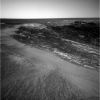
OPP-SOL952-1N212701027EFF76EVP0657L0M1.jpgThe features of Victoria Crater, from Duck Bay (2) - Sol 95256 visitenessun commento
|
|
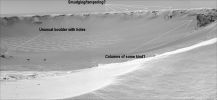
OPP-SOL952-site_B76_275_navcam_CYL_L-B953R1-2.jpgVictoria Crater, from Duck Bay (2)56 visitenessun commento
|
|
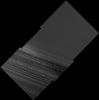
R-NorthPolarLayers-PIA08791_modest.jpgNorth Polar Layers (or "Bands")56 visiteThe HiRISE on NASA's MRO acquired this image during its first day of test imaging from the spacecraft's low-altitude mapping orbit, such as on Sept. 29, 2006.
This image of Mars' North Polar Layered Deposits was taken during the summer season (Solar Longitude of 113,6°), when CO2 frost had evaporated from the surface. The bright spots seen here are most likely patches of water frost, but the location of the frost patches does not appear to be controlled by topography. Layers are visible at the right side of the image, mostly due to difference in slope between them. The variations in slope are probably caused by differences in the physical properties of the layers. Thinner layers that have previously been observed in these deposits are visible, and may represent annual deposition of water ice and dust that is thought to form the polar layered deposits. These deposits are thought to record global climate variations on Mars, similar to ice ages on Earth. HiRISE images such as this should allow Mars' climate record to be inferred and compared with climate changes on Earth.
Image TRA_000825_2665 was taken by the High Resolution Imaging Science Experiment (HiRISE) camera onboard the Mars Reconnaissance Orbiter spacecraft on September 29, 2006. Shown here is the full image, centered at 86.5 degree latitude, 172.0 degrees east longitude. The image is oriented such that north is to the top. The range to the target site was 298.9 kilometers (186.8 miles). At this distance the image scale is 59.8 centimeters (23.5 inches) per pixel (with two-by-two binning} so objects about 1.79 meters (70 inches) across are resolved. In total the original image was 12.2 kilometers 7.58 mile; 10024 pixels) wide and 6.1 kilometers (3.79 miles; 5000 pixels) long. The image was taken at a local Mars time of 3:30 PM and the scene is illuminated from the southwest with a solar incidence angle of 63.5 degrees, thus the sun was about 26.5 degrees above the horizon.
|
|

R-PIA08788-2.jpgOlympia Undae (2)56 visiteThis image shows three representations of the 72 colors. The left panel is a nearly true-color composite in which the blue, green, and red planes are 0.44, 0.53, and 0.60 micrometer light -- nearly as the human eye would see. The contrast between the bright ice and dark dunes is so large that the dunes are barely seen. The middle panel is false color constructed from infrared wavelengths just beyond the range of the human eye. The blue, green, and red planes cover 0.80, 0.95, and 1.06 micrometer light. In this rendering of the data the differences between ice- and soil-rich regions are not as apparent because the colors of ice and dust are similar in this wavelength region. The right panel uses 1.15, 1.8, and 2.25 micrometer light in the blue, green and red planes and provides a dramatically different view of the scene. The areas of highest ice content appear in blue, and those with a mix of dust and ice -- most of the scene -- appear yellowish. The dunes are now visible against the ice because of their higher brightness at longer infrared wavelengths, and appear ruddy brown.
|
|
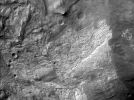
R-JusChasma-PIA08789.jpgJus Chasma56 visiteThe high resolution camera on NASA's Mars Reconnaissance Orbiter captured its first image of Mars in the mapping orbit, demonstrating the full resolution capability, on Sept. 29, 2006. The High Resolution Imaging Science Experiment (HiRISE) acquired this image at 8:16 AM (Pacific Time), and parts of the image became available to the HiRISE team at 1:30 PM. With the spacecraft at an altitude of 280 kilometers (174 miles), the image scale is 29.7 centimeters per pixel (about 12 inches per pixel).
This sub-image covers a small portion of the floor of Ius Chasma, one branch of the giant Valles Marineris system of canyons. The image illustrates a variety of processes that have shaped the Martian surface. There are bedrock exposures of layered materials, which could be sedimentary rocks deposited in water or from the air. Some of the bedrock has been faulted and folded, perhaps the result of large-scale forces in the crust or from a giant landslide. The darker unit of material at right includes many rocks. The image resolves rocks as small as small as 90 centimeters (3 feet) in diameter. At bottom right are a few dunes or ridges of windblown sand. If a person was located on this part of Mars, he or she would just barely be visible in this image.
Image TRA_000823_1720 was taken by the High Resolution Imaging Science Experiment (HiRISE) camera onboard the Mars Reconnaissance Orbiter spacecraft on September 29, 2006. Shown here is a small portion of the full image. The full image is centered at minus 7.8 degrees latitude, 279.5 degrees East longitude. The image is oriented such that north is to the top. The range to the target site was 297 kilometers (185.6 miles). At this distance the image scale is 29.7 centimeters per pixel (with one-by-one binning) so objects about 89 centimeters (35 inches) across are resolved. The image was taken at a local Mars time of 3:30 PM and the scene is illuminated from the west with a solar incidence angle of 59.7 degrees, thus the sun was about 30.3 degrees above the horizon. At an Ls of 113.6 degrees, the season on Mars is Northern Summer/Southern Winter.
|
|
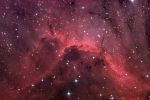
IC_5067.jpgIC 5067 - Emission Nebula56 visite"...Nil perpetuum: pauca diuturna sunt..."
(Livio)
"...Nulla dura in eterno e ben poche cose sono durevoli..."
|
|

NGC-3576.jpgNGC 3576 - Emission Nebula56 visite"...Audacter calumniare: semper aliquid haeret..."
(F. Bacone)
"...(occorre) calunniare audacemente, poichè - in ogni caso - qualche ombra resterà comunque sulla testa sul calunniato (ancorchè egli fosse assolto da qualsiasi responsabilità)..."
|
|
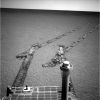
OPP-SOL953-1N212785100EFF76EVP0773R0M1.jpgThe way behind "Duck Bay" (1) - Sol 95356 visitenessun commento
|
|

OPP-SOL248-b_sol248_Lpan_a.jpgA new interpretation of the "Colors of Mars" (5) - Sol 24856 visitenessun commento
|
|
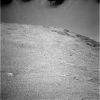
OPP-SOL957-1P213145702EFF76LJP2394L7M1.jpgVictoria Crater (7) - Sol 95756 visiteCaption NASA:"Left PanCam Non-linearized Full frame EDR acquired on Sol 957 of Opportunity's mission to Meridiani Planum at approx. 13:50:23 MLT, camera commanded to use Filter 7 (432 nm)".
|
|
| 25353 immagini su 2113 pagina(e) |
 |
|
|
|
|
1620 | |
|
|
|
|





