| Piú viste |

M-051.JPGM-51: The Whirlpool Galaxy (in Canes Venatici)56 visiteMareKromium
|
|

M-033-GB.JPGM-33: The "Triangulum Galaxy" (also "The Pinwheel") Spiral Galaxy in Triangulum56 visiteMareKromium
|
|

M-031-GB1.JPGM-31: The "Andromeda Galaxy" (Spiral Galaxy in Andromeda)56 visiteMareKromium
|
|

The_Helix_Nebula.JPGThe "Helix Nebula"56 visiteMareKromium
|
|

Saturn-PIA10493.jpgSaturn (natural colors; credits: NASA)56 visiteCaption NASA:"The Cassini Spacecraft looks toward the sunlit face of Saturn's Rings, whose shadows continue to slide southward on the Planet toward their temporary disappearance during equinox in August 2009.
This two-frame color mosaic was created from images taken as part of a photometry observation of the Rings. Photometry observations are useful for determining a host of ring particle properties.
This view looks toward the sunlit side of the Rings from about 3° below the Ring-Plane. Images taken using red, green and blue spectral filters were combined to create this natural color view. The images were acquired with the Cassini Spacecraft wide-angle camera on Aug. 22, 2008 at a distance of approx. 1,2 MKM (such as about 728.000 miles) from Saturn.
Image scale is roughly 66 Km (about 41 miles) per pixel".MareKromium
|
|
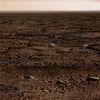
PHOE-SOL139-lg40083-40084-40086-2.jpgHorizon... - Sol 139 (possible True Colors; credits: Dr G. Barca)56 visitenessun commentoMareKromium
|
|

OPP-SOL372-3~0.jpgDeep-down in the trench... - Sol 372 (possible true-colors - version 2; credits: Dr G. Barca)56 visitenessun commentoMareKromium
|
|
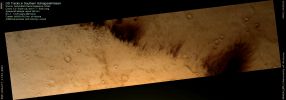
PSP_006477_1745_RED_abrowse-00~0.jpgDD Tracks in Southern Schiaparelli Basin (context frame - False Colors; credits: Lunexit)56 visiteDust-Devils (DD) are vortices of wind that form when air rising from a warm surface encounters shear in the above atmosphere.
Martian Dust-Devils can attain gargantuan proportions, reaching the size of terrestrial tornadoes with plumes that tower up to 9 Km above the surface.
Dust-Devils play an important role in sustaining the aerosols that make up Mars’ Red Sky and in cleaning the Martian Surface after a Dust Storm.
Nota Lunexit: sono quindi i DD, secondo la NASA, la "causa maggiore" del Cielo Rosso di Marte? Interessante riflessioni ed interessante quesito: dunque il Cielo di Marte NON E', naturalmente, "rosso" o "arancio", ma è "tinto di rosso/arancio"!
Pensateci sopra...
MareKromium
|
|

PHOE-SOL142-lg40602-40603-40604-2.jpgThe "Trenches" - Sol 142 (Superdefinition and possible True Colors; credits: Dr G. Barca)56 visitenessun commentoMareKromium
|
|

PHOE-SOL143-lg40998-40999-41000-2.jpgInside the "Icy Trench"... - Sol 143 (Superdefinition and possible True Colors; credits: Dr G. Barca)56 visitenessun commentoMareKromium
|
|
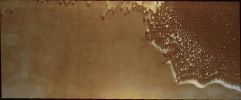
North_Polar_Features-The_Erg-PCF-LXTT-5.jpgVastitas Borealis and the North Polar Erg (Absolute Natural Colors; credits for the additional process. and color.: Dr Paolo C. Fienga - Lunexit Team)56 visiteCoord.: 76,5° North Lat. and 295,6° East Long.MareKromium
|
|

Haumea2.jpgHaumea and other "Dwarf" Companions56 visiteCaption NASA:"One of the strangest objects in the Outer Solar System was classified as a Dwarf Planet last week (September 2008) and given the name Haumea.
This designation makes Haumea the 5th designated Dwarf Planet after Pluto, Ceres, Eris, and Makemake. Haumea's smooth but oblong shape make it extremely unusual. Along one direction, Haumea is significantly longer than Pluto, while in another direction Haumea has an extent very similar to Pluto, while in the third direction is much smaller.
Haumea's orbit sometimes brings it closer to the Sun than Pluto, but usually Haumea is further away.
Illustrated above, an artist visualizes Haumea as a nearly featureless ellipsoid. Quite possibly, however, Haumea has interesting craters and surface features that currently remain unknown. Originally discovered in 2003 and given the temporary designation of 2003 EL61, Haumea was recently renamed by the IAU for a Hawaiian goddess. Haumea has two small moons discovered in 2005, recently renamed Hi'iaka and Namaka after the daughters of the Goddess".MareKromium
|
|
| 25353 immagini su 2113 pagina(e) |
 |
|
|
|
|
1619 | |
|
|
|
|





