| Piú viste |

20000608.jpgThe "Saddle" (Extremely Saturated True Colors; credits: Lunar Explorer Italia)56 visitenessun commentoMareKromium
|
|
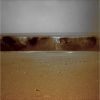
OPP-SOL1666-1P276097874EFF90__P2357R2M1.jpgFarewell Victoria! - Sol 1666 (possible True Colors; credits: Lunexit)56 visitenessun commentoMareKromium
|
|
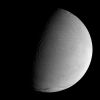
Enceladus-PIA10483.jpgThe Leading Hemisphere of Enceladus56 visiteCaption NASA:"During a distant flyby encounter with Enceladus, Cassini imaged the moon's wrinkled Leading Hemisphere.
At the scale visible here, this region of the surface is generally devoid of impact craters, suggesting that the terrain has been modified and renewed during the moon's history.
To the North lies a heavily cratered and presumably older Region. The sinuous boundary of the geologically active South Polar Region is seen at bottom. North on Enceladus is toward the top of the image.
The image was taken in visible green light with the Cassini Spacecraft narrow-angle camera on Sept. 30, 2007. The view was acquired at a distance of approx. 108.000 Km (such as about 67.000 miles) from Enceladus and at a Sun-Enceladus-Spacecraft, or phase, angle of 75°.
Image scale is 644 meters (2111 feet) per pixel".MareKromium
|
|
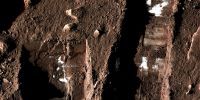
PHOE-SOL121-lg35721-35722-35735-2.jpgIcy Trenches... - Sol 121 (Superdefinition and natural colors; credits: Dr G. Barca)56 visitenessun commentoMareKromium
|
|

OPP-SOL209-1N146736846EFF35BGP1981R0M1.jpgNice, but...A Fake?!!? - Sol 209 (natural colors; credits: Lunexit)56 visiteCome scrivemmo in passato, esiste - a nostro parere - una FORTE possibilità che i NASA frames RAW i quali "rigettano" la colorizzazione di tipo Multispettrale, sìano dei frames (in qualche modo) già "taroccati" alla fonte.
Ed anche l'osservazione (accurata) del frame RAW in b/w lascia ampi spazi ai dubbi...
Insomma: a nostro avviso, questa "cartolina da Marte" (al pari di centinaia - o forse migliaia... - di altre immagini simili) è un (come minimo, un mezzo) falso.
Certo: e se Voi ci chiedeste il motivo (eventuale) del falso? Beh, la nostra risposta (onesta) è che non ne abbiamo idea.
Ma questa immagine - guardatela BENE nella sua versione RAW (è il frame che precede)! - non è convincente.
E' troppo "liscia", troppo "perfetta", troppo "calibrata" (soprattutto nella sua luminosità, alle soglie dell'impossibile)...E comunque, se la paragonate alle altre che la precedono ed a quelle che la seguono, non potrete non notare la differenza...MareKromium
|
|

SOL0317-MF-LXT.jpgRocks and Boulders - Sol 317 (Hi-Def3-D - credits and Copyright: Dr M. Faccin and Lunar Explorer Italia)56 visitenessun commentoMareKromium
|
|

Craters-Unnamed_Crater_with_Dunefield-PCF-LXTT.jpgUnnamed Crater with small Dunefield in Utopia Planitia (Enhanced and Saturated Natural Colors; credits for the additional process. and color.: Dr Paolo C. Fienga - Lunexit Team)56 visitenessun commentoMareKromium
|
|

OPP-SOL0087-1-3D_copia.jpgSmall Crater and "Pointed Rocks" on the way to Endurance - Sol 87 (Hi-Def3-D - Natural Colors; credits and Copyright: Dr G. Barca and Lunar Explorer Italia)56 visiteE vai: un "Capolavoro" dopo l'altro...Osservate attentamente le rocce acuminate in primo piano e provate a cogliere il dislivello esistente fra la superficie su cui si trova il Rover mentre riprende e la superficie ripresa (ostacoli e "Trappole" incluse).
Solo la Tridimensionalità, in fondo, può farci realmente capire il motivo per cui il VERO miracolo degli "Oltre 1600 Soles" è stato nella "sopravvivenza" dei Rover non solo e non tanto alla "crudezza" del Clima Marziano quanto, piuttosto, ai rischi connessi alle loro peregrinazioni - guidate in modalità remota e con uno scarto temporale fra la scelta dell'azione da compiere, il comando operativo (ordine di esecuzione) e l'esecuzione dell'ordine (exx.: viaggia; curva; sali; scendi; procedi a velocità costante per "n" minuti o "x" metri etc.) prossimo, a volte, a quasi 20 minuti!
Per quanto attiene lo specifico di questa elaborazione, possiamo solo ribadire il concetto iniziale: Capolavoro.MareKromium
|
|

Psp_009460_1745_red.jpgCeti Mensa (edm - natural colors; credits: Lunexit)56 visiteThis image gives us another clue to the formation of Ceti Mensa. Close-up examination shows fine banding in the layers of Ceti Mensa that is exposed by the ongoing erosion. The banding is produced by alternating bright and dark material. The thickness of the individual bands ranges from a few meters down to the resolution limit of the image, a few tens of centimeters. The bands are parallel, although they appear wavy on the irregular, eroded surface.
The banding visible in this image most closely resembles terrestrial lake deposits and similar rocks formed in aqueous, low energy depositional environments. Structures such as cross-bedding that are hallmarks of wind-deposited sediments are absent, as are cobbles and clasts that are typical of glacial sediments. If this interpretation is correct, the thickness of Ceti Mensa suggests formation in standing bodies of water that were several kilometers deep.MareKromium
|
|
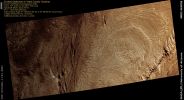
PSP_009460_1745_RED_abrowse-00.jpgCeti Mensa (ctx frame - natural colors; credits: Lunexit)56 visiteThis image shows a steep-sided depression in light-toned, layered rocks in the Valles Marineris Canyon System.
This formation, known as Ceti Mensa, is located in Western Candor Chasma in the Northern Valles.
The origin of Ceti Mensa and other Layered Deposits within the canyons is a source of much debate: proposed interpretations include lake deposits, deposits of volcanic ash, deposits of windblown sand and dust and glacial deposits. Recent spectral observations by the Mars Express and Mars Reconnaissance Orbiter Spacecraft have identified crystalline Iron Oxides and Hydrated Magnesium Sulfate minerals on Ceti Mensa.
These minerals are regarded as indicators of the presence of liquid water during their formation.
The Hydrated Sulfate mineral "Kieserite", in particular, most commonly forms on Earth by evaporation of brines.MareKromium
|
|

PHOE-SOL134-lg39371-39372-39373-2.jpgThe Frozen Trench - Sol 134 (Superdefinition and possible True Colors; credits: Dr G. Barca)56 visiteUn'immagine perfetta, sulle cui sottili "sfumature" cromatiche si potrebbe discutere per qualche tempo...MareKromium
|
|
PHOE-SOL134-lg39371-39372-39373-3.jpgThe Frozen Trench: perspective view - Sol 134 (Superdefinition and possible True Colors; credits: Dr G. Barca)56 visitenessun commentoMareKromium
|
|
| 25353 immagini su 2113 pagina(e) |
 |
|
|
|
|
1617 | |
|
|
|
|





