| Piú viste |

SOL813-2P198554634EFFAR00P2408R1M1.jpgRocky terrain in High Definition (3)56 visitenessun commento
|
|

Saturn-PIA08159.jpgCrescent Moons (1)56 visiteCaption NASA originale:"The tilted crescent of Saturn displays lacy cloud bands here along with a bright Equatorial Region and threadlike ring shadows on the Northern Hemisphere. Three moons are visible here: Mimas (397 Km, or about 247 miles across) at left and faint, is aligned with the Ring-Plane. At right are Rhea (1.528 Km, or about 949 miles across, at top) and Tethys (1.071 Km, or 665 miles across, below Rhea).
The image was taken in polarized infrared light with the Cassini spacecraft wide-angle camera on March 11, 2006, at a distance of approximately 2,8 MKM (approx. 1,8 MMs) from Saturn.
The image scale is roughly 166 Km (about 103 miles) per pixel".
|
|

Saturn-PIA08161.jpgCrescent Moons (2)56 visiteCaption NASA originale:"Three of Saturn's moons are captured with the Planet in this exquisite family portrait. At top, Saturn is bedecked with the shadows of its innermost rings.
Tethys appears at lower right, closest to Cassini. Janus (181 Km, or about 113 miles across) and Mimas (397 Km, or about 247 miles across) are on the far side of the immense Ringed Planet.
Mimas is just about to slip behind Saturn.
The image was taken in visible light with the Cassini spacecraft narrow-angle camera on March 13, 2006, at a distance of approx. 2,7 MKM (such as about 1,6 MMs) from Saturn. The image scale is about 17 Km (approx. 11 miles) per pixel on Janus and Mimas, and 14 about Km (such as about 9 miles) per pixel on Tethys".
|
|
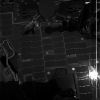
SOL813-2N198537748EFFAR00P1988L0M1.jpgBright reflections - Sol 81356 visiteUn Sole - apparentemente - molto luminoso, si riflette sui pannelli solari di Spirit, generando una serie di artifacts ai quali siamo abituati (su tutti, il cosiddetto "effetto goccia").
Un'immagine interessante, oltre che suggestiva.
|
|

South_Polar_Features-Swiss_Cheese_Terrain-00.JPGEarly Fall at the South Pole56 visiteCaption NASA originale:"This MGS-MOC image shows a portion of the South Polar Residual Cap. The darkened edges of the pits and mesas are evidence of the removal — by sublimation — of frozen CO2 during the recent Martian Summer.
Summer ended and Autumn began in January 2006, shortly before this image was acquired".
Location near: 86,8° South; 90,5° West
Image width: ~3 Km (~1,9 mi)
Illumination from: upper left
Season: Southern Summer
|
|

Craters-Crater_Cluster-PIA08088-1.jpgSeeps, Dust and Landslides in a Crater Cluster (Original NASA/2001 Mars Odyssey Orbiter b/w Frame)56 visiteImage information: VIS instrument;
Latitude: 18,8° North;
Longitude: 18,5° East;
Resolution: 18 meter/pixel.
|
|

OPP-SOL797-1N198933365EFF6912P1785L0M1.jpgMartian Sandglasses & Martian Paving (1) - Sol 79756 visitenessun commento
|
|

The Rings-PIA08163-2.jpgThe "E-Ring" of Saturn: the "Enceladus Ring" (2)56 visiteThis appearance implies that the particles in this part of the Ring have nonzero inclinations (a similar affect is seen in Jupiter's Gossamer Ring). An object with a nonzero inclination does not orbit exactly at Saturn¿s Ring-Plane: its orbit takes it above and below it. Scientists are not entirely sure why the particles should have such inclinations, but they are fairly certain that the reason involves Enceladus. One possible explanation is that all the E-Ring particles come from the plume of icy material that is shooting due South out of the moon's Pole.
This means all of the particles are created with a certain velocity out of the Ring-Plane, and then they orbit above and below that plane.
Another possible explanation is that Enceladus produces particles with a range of speeds, but the moon gravitationally scatters any particles that lie very close to the Ring-Plane, giving them nonzero inclinations. Stray light within the camera system is responsible for the broad, faint "Y" shape across the image.
The image was taken in visible light with the Cassini spacecraft wide-angle camera on March 15, 2006, at a distance of approximately 2.4 million kilometers (1.5 million miles) from Saturn. The image scale on the sky at the distance of Saturn is 142 kilometers (88 miles) per pixel.
|
|

Craters-Unnamed_Crater-Terra_Cimmeria.JPGUnnamed Crater with Gullies in Terra Cimmeria (Original NASA/MGS/MSSS b/w Frame)56 visiteCaption NASA originale:"This MGS-MOC image shows an array of gullies in the North-NorthWest wall of a crater in Terra Cimmeria. These features may have been formed through the interaction of several processes including, but not limited to, mass wasting and/or seepage and runoff of groundwater".
Location near: 33,5° South Lat. and 207,2° West Long.
Image width: ~3 Km (~1,9 mi)
Illumination from: upper left
Season: Southern Summer
|
|
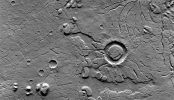
Chaotic_Terrain-Memnonia-PIA08104-1.jpgChaotic Terrain between Memnonia Fossae and Elysium Planitia (1 - Original NASA/JPL/ASU b/w Frame)56 visiteCaption NASA originale:"These arcuate fractures are located on the margin between Memnonia Fossae and Elysium Planitia".
Image information: VIS instrument;
Latitude: 1,4° North;
Longitude: 177,5° East;
Resolution: 18 meter/pixel.
|
|
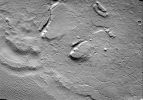
Chaotic_Terrain-Memnonia-PIA08104-2.jpgChaotic Terrain between Memnonia Fossae and Elysium Planitia (2 - Original NASA/JPL/ASU b/w Frame)56 visitenessun commento
|
|

NGC-0055-PIA04923.jpgNGC 55 - Spiral Galaxy56 visite"...Credo che il giusto è un istrion beffardo,
E nel viso e nel cuor,
Che tutto è in lui bugiardo:
Lagrima, bacio, sguardo,
Sacrificio ed onor..."
Arrigo Boito - "Otello"
|
|
| 25353 immagini su 2113 pagina(e) |
 |
|
|
|
|
1612 | |
|
|
|
|





