| Piú viste |

PSP_009114_2645_RED.jpgEroding Dunes in Chasma Boreale (natural colors; credits: Lunexit)56 visiteSand moves along a planetary surface by a process scientists call “saltation”, whereby the individual grains are driven by the wind and bounce forward in short hops. In a process that is not yet completely understood, sheets of saltating sand grains organize themselves into sand dunes, visible in this image as the dark features.
Sand dunes move by having the wind push sand grains up and over the top of the dune where they then slide down to the base. The steep side of the dune that the sand grains slide down is called "slip-face" and it is the constant transport of sand from the downwind side of the dune to the "slip-face" that makes the dune move forward in this direction. HiRISE data allow us to see which side of these dunes has the steeper slope (such as the aforementioned "slip-face"), telling us what direction the dune — and strong near surface winds — are moving.
Yet something else is also happening to these particular dunes. Dark streaks lead away from the dunes toward the lower left of the image. These streaks are caused by sand grains being blown off the dunes and saltating away. This is not ordinarily a cause for concern because in a stable dune, individual grains are constantly added and removed; however, there does not appear to be any influx of sand upwind of these dunes, so they are probably being eroded.
It is also interesting that these streaks do not point in the same direction as the "slip-face". One possible scenario is that the dunes migrated Westward when sand supply was more plentiful. Today, the wind direction has shifted, blowing more toward the South-West, and the influx of new sand has ceased, such that in the future, the dunes will completely erode away. Repeated HiRISE observations will be able to look for changes in the shape and size of these dunes.MareKromium
|
|
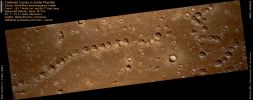
PSP_009177_1985_RED.jpgCratered Cones in Isidis Planitia (natural colors; credits: Lunexit)56 visiteThis image shows part of a broad field of cratered cones in the Isidis Planitia region of Mars. The cones occur over a wide area and are commonly aligned in chains, like those here.
The cratered-cone morphology suggests formation by eruption of some material. The cones resemble small volcanoes on Earth called cinder cones, and are approximately the same size. Another possibility is that these are mud volcanoes, formed by eruption of wet, pressurized mud. This has been suggested as an important process in some parts of Mars. The aligned chains probably indicate sites of weakness, perhaps faults, where lava or mud could preferentially rise.
The scene is relatively bland in color, but this could be due to a thin coating of dust veiling color differences. The cones are clearly not very young or pristine; they have a battered, pitted appearance. However, they have not been heavily eroded, as features like the cone rims are still sharp in most cases. This state is typical of the cones in Isidis region.
MareKromium
|
|

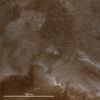
PSP_009138_2025_RED-00.jpgMineralogical Diversity in Nili Fossae (ctx frame - natural colors; credits: Lunexit)56 visiteThere is evidence of phyllosilicate material (clays) throughout this Nili Fossae Region. The evidence comes from the OMEGA experiment on the European Space Agency’s Mars Express Spacecraft and CRISM on the Mars Reconnaissance Orbiter, Infrared Spectrometers that can identify minerals on the surface of Mars.
In the Nili Fossae Region, the spectrometers have found remarkable diversity in surface composition. Because of the evidence for clays and other interesting geology, Nili Fossae is also being considered as a Landing Site for the Mars Science Laboratory Rover.
HiRISE has targeted several places where OMEGA and CRISM show extreme diversity, with this being one example. In this specific area, low-calcium pyroxene (LCP) materials are adjacent to these clays.
The cracked terrain areas evident at the highest resolution - see the next edm frame - provide clues to the sequence of events which occurred in Nili Fossae.MareKromium
|
|
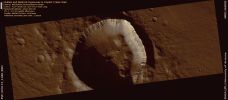
PSP_009155_1480_RED.jpgGullies and Bedrock Exposures in Impact Crater Wall (natural colors; credits: Lunexit)56 visiteThis image shows a rather pristine crater with Gullies and Bedrock Exposures. The Gullies are mostly on the South-Facing (such as the Poleward facing) wall. Some of the gully channels are very sharp, indicating that they have not been modified much since they formed.
Other channels criss-cross each other, demonstrating that there were multiple periods of activity. Scientists do not know how closely these were spaced in time.
The South and East walls of the Crater (upper right of the frame) have very distinct bright layers. These layers are possibly Ancient Bedrock. These walls also have what appear to be bright Landslides.MareKromium
|
|
PSP_009138_2025_RED-01.jpgMineralogical Diversity in Nili Fossae (edm - natural colors; credits: Lunexit)56 visitenessun commentoMareKromium
|
|

ZZ-Mercury-Craters-Kertész_Crater-PIA10933.jpgKertész Crater (Saturated Natural Colors; credits for the additional process. and color.: Dr Paolo C. Fienga/Lunar Explorer Italia/Italian Planetary Foundation)56 visiteLocated in the Western Edge of Mercury's giant Caloris Basin, Kertész Crater (recently named for André Kertész, a Hungarian-born American photographer) has some unusual, bright material located on its floor. Sander crater, located in the North-Western Edge of Caloris Basin, also shows bright material on its floor.
The MESSENGER Science Team is investigating the nature and composition of these bright materials and making comparisons between these two craters both located at the edges of Caloris Basin.
Just North-East of Kertész, a small crater has very bright rays and ejecta in this image, indicating that the crater is young.
Date Acquired: January 14, 2008
Image Mission Elapsed Time (MET): 108826812
Instrument: Narrow Angle Camera (NAC) of the Mercury Dual Imaging System (MDIS)
Resolution: 260 meters/pixel (0,16 miles/pixel
Scale: Kertész Crater is about 34 Km (approx. 21 miles) in diameter
Spacecraft Altitude: about 10.200 Km (approx. 6.340 miles)MareKromium
|
|

ZZ-Mercury-Terminator-PIA10937-0.jpgNorthern Latitudes and a possible Orbital Anomaly (natural colors; credits: Lunexit)56 visiteAbout 91 minutes after MESSENGER’s closest pass by the Planet, MDIS acquired this image of Mercury’s Northern Surface, which is one in a set of 48 that form a mosaic of the departing Planet. In this image, the left portion of the Surface fades into darkness at the Terminator, the line between the sunlit dayside of the Planet and the dark night side.
The left-side portions of the surface that are just coming out of the darkness are being hit with the first rays of morning sunlight. Some of the surface to the right of this scene can be viewed in this previously released image looking toward Mercury’s North Pole (PIA10193).
Date Acquired: January 14, 2008
Image Mission Elapsed Time (MET): 108830334
Instrument: Narrow Angle Camera (NAC) of the Mercury Dual Imaging System (MDIS)
Resolution: 0,8 Km/pixel (0,5 miles/pixel) Scale: The width of this image is about 800 Km (approx. 500 miles)
Spacecraft Altitude: about 30.700 Km (approx. 19.100 miles)MareKromium
|
|
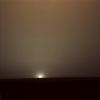
PHOE-SOL090-PIA11054-2.jpgIce Cold Sunrise on Mars - Sol 90 (natural colors; credits: Lunexit)56 visiteFrom the location of NASA's Phoenix Mars Lander, above the Martian Arctic Circle, the Sun does not set during the peak of the Martian Summer.
This period of maximum solar energy is past — on Sol 86, the 86th Martian Day after the Phoenix landing, the Sun fully set behind a slight rise to the North for about half an hour.
This red-filter image taken by the lander's Surface Stereo Imager, shows the Sun rising on the morning of Sol 90, Aug. 25, 2008, the last day of the Phoenix nominal mission.
The image was taken at 51 minutes past Midnight (Local Solar Time) during the slow sunrise that followed a 75 minute "night". The skylight in the image is light scattered off atmospheric dust particles and ice crystals.
The setting Sun does not mean the end of the Mission. In late July, the Phoenix Mission was extended through September, rather than the 90-Sol duration originally planned as the Prime Mission.MareKromium
|
|
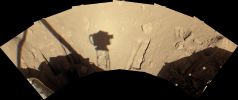
PHOE-SOL090-PIA11055.jpgVastitas' Surface, according to NASA - Sol 90 (natural colors; credits: NASA)56 visiteDuring the first 90 Martian Days, or Soles, after its May 25, 2008, landing on an Arctic Plain of Mars, NASA's Phoenix Mars Lander dug several trenches in the workspace reachable with the Lander's Robotic Arm (LRA).
The Lander's Surface Stereo Imager camera recorded this view of the workspace on Sol 90, early afternoon Local Mars time (overnight Aug. 25 to Aug. 26, 2008). The shadow of the the camera itself, atop its mast, is just left of the center of the image and roughly a third of a meter (one foot) wide.
The workspace is on the north side of the lander. The trench just to the right of center is called "Neverland".MareKromium
|
|

OPP-SOL1094-1.jpgVictoria's Paving - Sol 1094 (True Colors; credits: Dr G. Barca)56 visitenessun commentoMareKromium
|
|

OPP-SOL1074-1.jpgFrom inside Victoria - Sol 1074 (True Colors; credits: Dr G. Barca)56 visitenessun commentoMareKromium
|
|

OPP-SOL1063-1.jpgFrom inside Victoria - Sol 1063 (True Colors; credits: Dr G. Barca)56 visitenessun commentoMareKromium
|
|
| 25353 immagini su 2113 pagina(e) |
 |
|
|
|
|
1611 | |
|
|
|
|





