| Piú viste |

PSP_008930_1880_RED.jpgStair-Stepped Mounds in Meridiani Planum (natural, but enhanced, colors; credits: Lunexit)56 visiteThis image shows layered sedimentary rocks that fill an impact crater in the Meridiani Planum Region of Mars.
These layered rocks may have formed through the accumulation of sediment (sand and dust) that were transported into this crater by blowing wind or flowing water. These sediments formed an extensive deposit that once covered the floor of the surrounding impact crater.
This crater is so large that the HiRISE image is entirely within it, and the crater rim is not visible. These sedimentary rocks were then eroded, likely by the wind. The original sand and dust were deposited in distinct layers within the crater; these layers now give the mounds their distinctive stair-stepped appearance, and are all that remain from this once extensive deposit.MareKromium
|
|
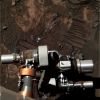
SOL948-2.jpgLooking Down - Sol 948 (true colors; credits: Dr G. Barca)56 visiteUn immagine come questa, di regola, viene "captionata" con un "nessun commento". Ma questa volta abbiamo deciso di fare un'eccezione.
Come forse avrete notato, da un paio di giorni, in ragione del nostro Studio su "433-Eros", stiamo ricevendo qualche palata di escrementi sulla faccia, da parte di alcuni personaggi che si ritengono "Professionisti" dell'interpretazione delle fotografie.
Ora, tralasciando le qualità pratiche e morali di questi poveracci, vorremmo solo ricordarVi una cosa: questo frame, al pari di centinaia (oggi migliaia) di altri, in origine era un "RAW-NASA-b/w". Adesso è una finestra che si apre su Marte e lo mostra così come è.
Ecco: i "detrattori" di Lunexit e dei Professionisti che la rendono "viva" (il Dr Barca e tutti gli altri), prima di aprir bocca, dovrebbero guardare queste immagini e capire (o meglio: provare a capire) cosa significa Professionalità e Sacrificio e poi, una volta afferrato il concetto (se ci riescono), stare zitti e cercarsi un altro "hobby".
E chi sono costoro? Ancora una volta, "quelli che vedono i mulini a vento, e li chiamano giganti".
Che tristezza...MareKromium
|
|
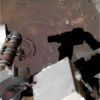
SOL973-2.jpgLooking Down - Sol 973 (true colors; credits: Dr G. Barca)56 visitenessun commentoMareKromium
|
|
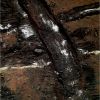
SOL1064-1.jpgCriss-Crossing Rover Tracks - Sol 1064 (Enhanced Possible True Colors; credits: Dr G. Barca)56 visitenessun commentoMareKromium
|
|
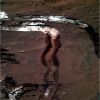
SOL1099-1.jpgRover Tracks, Colourful Dust and White Sulphates - Sol 1099 (natural colors; credits: Dr G. Barca)56 visitenessun commentoMareKromium
|
|

20000217b.jpgOver Eros' horizon (natural colors; credits: Lunexit)56 visiteThis incredible picture of Eros, taken on February 14, 2000, shows the view looking from one end of the asteroid across the gouge on its underside and toward the opposite end. In this mosaic, constructed from two images taken after the NEAR Spacecraft was inserted into orbit, features as small as 120 feet (35 meters) across can be seen.
House-sized boulders are present in several places; one lies on the edge of the giant crater separating the two ends of the asteroid. A bright patch is visible on the asteroid in the top left-hand part of this image, and shallow troughs can be see just below this patch.
The troughs run parallel to the asteroid's long dimension.
(Mosaic of images 0125971425, 0125971487)MareKromium
|
|

20000405.jpgOld Craters (natural colors; credits: Lunexit)56 visiteEros' many craters have a range of ages dating back to the last time the asteroid's surface was "wiped clean" by geologic processes. This NEAR Shoemaker image of the tip of the asteroid, taken March 6, 2000, from a range of 201 Km (about 125 miles), shows craters with a variety of shapes and sizes.
When small craters first form, they typically have sharp rims and round floors. As they age, progressively smaller craters are superimposed, rounding the rims and pitting the walls and floors until the original underlying crater becomes almost unrecognizable.
(Image 0127738155)MareKromium
|
|

Titan-Channels-Unnamed_Channels-PIA10956.jpgXanadu's Channels (false colors; credits: Lunexit)56 visiteOn the final flyby of Cassini's original 4-year tour, its radar mapper captured these unusual channels on Titan at the edge of Xanadu, the widest seen in this area (For a radar image of Xanadu, see PIA08428). These might be active rivers carrying methane or debris, or they might be dry riverbeds similar to earthly "arroyos".
Past Cassini radar images have revealed different types of channels on Titan's surface (see PIA03565 and PIA07366). They vary from bright to dark in radar (rough to smooth), and from fan-shaped to braided to meandering.
Some, drain into lakes; others disappear. Some of these channels may be several hundred meters, or feet, deep.
This image, taken from the flyby on May 28, 2008, shows the border of Xanadu as the bright-dark boundary running from the upper left to lower right. Southward from that boundary is an unusual set of channels. While these are brighter (more roughly textured) than the surrounding terrain, some are only slightly brighter, and some are as wide as 5 Km (about 3 miles) — about the size of the River Thames at its mouth east of London.
They appear to flow out of the rough Region of Xanadu.
Careful inspection reveals smaller tributaries that wind through the brighter and apparently rougher terrain to the north. A close-up of one of the widest channels is shown at the lower left.
Scientists think that many of the channels on Titan are carved by methane deposited on the surface from strong but infrequent rainstorms. A bright channel may be dry, with the rough riverbed of icy particles (like those seen at the Huygens Landing Site) producing the radar brightness. The darker channels in this image resemble the dry lakes seen in the North Polar area of Titan, so they may be dry as well, with their smoother (radar-dark) surfaces caused by finer-grained sediment deposits on the channel floors.
This image shows an area located at 15° South Latitude and 121° West Longitude. It is about 450 Km (about 280 miles) across, and has approximately 1 Km (0,62-mile) resolution.
North is up.MareKromium
|
|
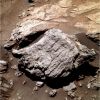
SOL1141-1.jpgLayered Boulder - Sol 1141 (True Colors; credits: Dr G. Barca)56 visitenessun commentoMareKromium
|
|
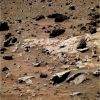
SOL1134-1.jpgRocky Landscape - Sol 1134 (natural colors; credits: Dr G. Barca)56 visitenessun commentoMareKromium
|
|

PSP_008982_1965.jpgLayered Deposits in Arabia Terra Region (True Colors; credits: Dr M. Faccin & Lunexit)56 visiteThis image shows the floor of an Unnamed Impact Crater in Arabia Terra that has Layered Deposits. There are many craters in this Region where layering is observed.
These layers are often exposed along the sides of large isolated mounds, small knobs and mesas, and other positive relief features. In some cases, the layering is expressed as narrow sinuous ridge-like structures along crater floors.
The presence of Layered Deposits is of particular interest because these materials are not likely to be related to the impact event, but rather post-impact infill of the crater. Modification of the deposits has now revealed layers of material.
HiRISE and other instruments onboard the Mars Reconnaissance Orbiter may provide more clues to the origin of the these deposits.MareKromium
|
|
Enceladus-N00118361.jpgThe Unbelievable Surface of Enceladus, from ONLY 545 Km!56 visiteCaption NASA:"Caption NASA:"N00118365.jpg was taken on August 11, 2008 and received on Earth August 12, 2008. The camera was pointing toward ENCELADUS that, at the time, was approximately 545 Km away.
The image was taken using the CL1 and CL2 filters and it has not been validated or calibrated".
Note Lunexit: tutta la Regione ripresa pare essere - letteralmente - un "groviglio" di crepacci e di canali che si intersecano e che evidenziano, sulle loro estremità, l'esistenza di rilievi davvero singolari (alcuni a forma sferoidale, ed altri, molto irregolari, che ci ricordano i "rami contorti" di una sorta di foresta pietrificata). Comune a tutti i rilievi visibili è l'abedo: elevatissima (si tratta forse di grandi "blocchi di ghiaccio"? Probabilmente si).
Un numero elevato di boulders è chiaramente distinguibile sull'intera scena e, in particolare, sul versante illuminato del crepaccio situato nell'angolo superiore Sx del frame (un crepaccio che, a nostro parere, lascia altresì intuire - se si osserva con estrema attenzione - la presenza di "chiazzature" le quali possono ricordare i "seeps" Marziani).
Un grandissimo frame, reso ancora più straordinario dal fatto che il panorama ripreso giace a ridosso del Terminatore!MareKromium
|
|
| 25353 immagini su 2113 pagina(e) |
 |
|
|
|
|
1607 | |
|
|
|
|





