| Piú viste |
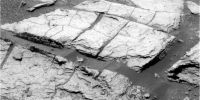
OPP-SOL725-1P192544146ESF64L0P2595L2M1.jpgOutcrops' detail - Sol 72556 visiteCaption originale:"Left Pan-Cam Non-linearized Sub-frame EDR acquired on Sol 725 of Opportunity's mission to Meridiani Planum at approximately 11:19:28 MLT.
Camera commanded to use Filter 2 (753 nm)".
|
|

OPP-SOL725-1F192547010EFF64LOP1214R0M1.jpgBeautiful outcrops and foggy horizon (2) - Sol 72556 visiteCaption originale:"Right Front Haz-Cam Non-linearized Full frame EDR acquired on Sol 725 of Opportunity's mission to Meridiani Planum at approximately 12:05:56 MLT".
|
|

Saturn-PIA07695.jpgDark Saturn, Bright Rings56 visiteCaption originale:"The Cassini spacecraft looked toward the darkened night side of Saturn to capture the eerie glow of the Rings, which, not being blocked by the Planet's bulk, remained brilliant in full Sunlight.
The image was taken in visible light with the Cassini spacecraft wide-angle camera on Dec. 24, 2005, at a distance of approx. 286.000 Km (roughly 178.000 miles) from Saturn.
The image scale is about 13 Km (approx. 8 miles) per pixel".
|
|
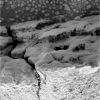
OPP-SOL727-1M192731756EFF64LOP2956M2M1.jpgMartian "Corals" (3) - Sol 72756 visiteCaption originale:"Microscopic Imager Non-linearized Full frame EDR acquired on Sol 727 of Opportunity's mission to Meridiani Planum at approximately 14:03:21 MLT.
Microscopic Imager dust cover commanded to be OPEN".
|
|

Janus&Epimetheus-PIA07699.jpgHigh-Phase in the Darkness: Janus and Epimetheus56 visiteThis close pairing of Janus and Epimetheus shows the 2 moons at "high phase," meaning that only a thin sliver of sunlit terrain is visible on each moon. Portions of each are also lit feebly by reflected light from Saturn.
Janus (181 Km, or about 113 miles across) is at top and Epimetheus (116 Km, or about 72 miles across) is below.
The image was taken in visible light with the Cassini spacecraft narrow-angle camera on Dec. 25, 2005, at a distance of approx. 479.000 Km(roughly 298.000 miles) from Janus and about 455,000 Km (roughly 283.000 miles) from Epimetheus. The image scale is about 3 Km (approx 2 miles) per pixel on both moons.
|
|

Titan-Full_Disk-PIA02145-1.jpgTitan: Visual + IMS (1)56 visiteThe three mosaics shown here were composed with data from Cassini's visual and infrared mapping spectrometer taken during the last 3 Titan flybys, on Oct. 28, 2005 (1), Dec. 26, 2005 (2), and Jan. 15, 2006 (3).
These false-color images were constructed from images taken at the following wavelengths: 1,6 microns (blue), 2,01 (green), and 5 microns (red).
The viewing geometry of the December flyby is roughly on Titan's opposite Hemisphere from the flybys in October and January.
There are several important features to note in the images. The first is that the South Polar cloud system was very bright during the December flyby, while during the October and January flybys, it is barely visible, indicating that the atmosphere over Titan's South Pole is very dynamic.
|
|

Titan-Full_Disk-PIA02145-3.jpgTitan: Visual + IMS (3)56 visitenessun commento
|
|
South_Polar_Regions-Clouds-PIA02171-2.jpgClouds (RAW and b/w NASA Original Frame)56 visiteIn questa immagine si possono vedere delle sottili (quasi trasparenti...) formazioni nuvolose che sovrastano le Regioni Presso-Sud Polari di Marte. L'evidente sottigliezza delle nuvole è indicativa della circostanza per cui esse dovrebbero essere composte in larga prevalenza da ghiaccio d'acqua. Da ricordare, quindi, che le formazioni nuvolose "spesse", su Marte, sono invece prevalentemente costituite da polveri.
Image information: VIS instrument;
Latitude: 86,7° South;
Longitude: 212,3° East;
Resolution: 17 meter/pixel.
|
|

Coprates_Chasma-PIA02173-00.jpgFeatures of Coprates Chasma (Original NASA/2001 Mars Odyssey Orbiter b/w Frame) 56 visiteImage information: VIS instrument;
Latitude: - 14,8° North;
Longitude: 304,3° East;
Resolution: 17 meter/pixel.
|
|

Titan-PIA07701~0.jpgThe atmosphere of Titan56 visiteThis view of Titan reveals structure in the moon's complex atmosphere. The geometry of the Cassini spacecraft's view of Titan during this flyby was similar to that of Voyager 1's pass in 1980.
The image was taken in visible violet light and shows the detached high haze layer that envelops Titan, with additional complexity to its structure in the far North. Some of this atmospheric structure is also visible in a color view (PIA07700) taken at about the same time..
The image was taken with the Cassini spacecraft wide-angle camera on Dec. 26, 2005, at a distance of approx. 194.000 Km (such as about 121.000 miles) from Titan and at a Sun-Titan-spacecraft, or phase, angle of 29°. The image scale is 11 Km (about 7 miles) per pixel.
|
|
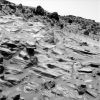
SOL749-2P192766769EFFAO55P2271L2M1.jpgHome Plate, from very close (1) - Sol 74956 visiteCaption originale:"Left PanCam Non-linearized Full frame EDR acquired on Sol 749 of Spirit's mission to Gusev Crater at approx. 11:34:46 MLT. Camera commanded to use Filter 2 (753 nm)".
Nota: portate l'immagine sino al full-size e poi provate a contare i rilievi anomali, simili ai razor-blades di Meridiani Planum, ma molto più affilati e di dimensioni decisamente più grandi.
Difficile fare commenti...
|
|
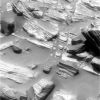
SOL749-2P192767004EFFAO55P2271R7M1.jpgHome Plate, from very close (2) - Sol 74956 visiteCaption originale:"Right PanCam Non-linearized Full frame EDR acquired on Sol 749 of Spirit's mission to Gusev Crater at approx. 11:38:34 MLT. Camera commanded to use Filter 7 (1009 nm)".
|
|
| 25353 immagini su 2113 pagina(e) |
 |
|
|
|
|
1605 | |
|
|
|
|





