| Piú viste |
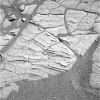
OPP-SOL791-1P198408172EFF68Q9P2574L7M1~0.jpgRazor-blades & recent water... (2) - Sol 79156 visiteIn June, the sand was dry and cracks were filled in or worn away.
Cracks do form in drying mud, but this is not mud, Sumner said. There was no explanation for the formation of these types of cracks in sulfate sands before Opportunity landed, she said. Chavdarian also looked at two types of thin, brittle fins poking a few inches out of the desert sand, usually facing into the wind. The most common type was found only in January, when the sand was moist. Chavdarian and Sumner think that the fins are formed when water seeps into cracks in the sand, carrying minerals with it. The water evaporates away, leaving behind those minerals, which are exposed as the wind blows sand away. Windblown material sticks to the exposed fin, making it larger and stronger.
If the cracks and fins seen by Opportunity on Mars are formed in the same way as the features at White Sands, it would provide evidence for water at the surface of Mars away from the Polar Ice Caps, which are mostly formed by CO2 and water ice.
|
|
OPP-SOL792-1N198499947EFF68VNP0695L0M1.jpgPanorama (3) - Sol 79256 visitenessun commento
|
|

SOL812-2M198449692EFFAR00P2956M2M1.jpgThe "texture" of the soil... - Sol 81256 visiteCaption originale:"Microscopic Imager Non-linearized Full frame EDR acquired on Sol 812 of Spirit's mission to Gusev Crater at approximately at approximately 12:18:54 MLT.
Microscopic Imager dust cover commanded to be OPEN".
|
|
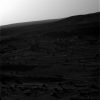
SOL813-2P198554279EFFAR00P2408R1M1.jpgFoggy horizon... (1) - Sol 81356 visiteSpirit is basking in the Sun, relatively speaking, on a 10,8°, North-facing slope in Gusev Crater on Mars. After turning away from the Rover's previous heading toward "McCool Hill" last week, Spirit started driving toward a nearby area known as "Low Ridge Haven" and arrived there over the weekend. Because rover drivers were able to get Spirit to a place where the solar panels tilt more steeply toward the Sun, the Rover's power output increased by 50 to 60 watt-hours per Sol.
That gives the Rover enough energy for about 1 (one) hour of daytime remote science.
|
|
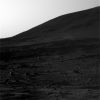
SOL813-2P198554379EFFAR00P2408R1M1.jpgFoggy horizon... (2) - Sol 81356 visiteSo far in this location, Spirit has collected a 360° panorama with the NavCam, a smaller panorama with the PanCam, 2 targeted observations with the Miniature Thermal Emission Spectrometer and 5 targeted images with the PanCam. Spirit also collected data with instruments on the Robotic Arm, including the Microscopic Imager, the Alpha Particle X-ray Spectrometer and the Mössbauer Spectrometer. All the rock and soil targets in this area are being informally named after Antarctic research stations and explorers.
|
|
SOL813-2P198554431EFFAR00P2408R1M1.jpgFoggy horizon... (3) - Sol 81356 visitenessun commento
|
|

SOL813-2P198554525EFFAR00P2408R1M1.jpgRocky terrain in High Definition (1)56 visitenessun commento
|
|
SOL813-2P198554578EFFAR00P2408R1M1.jpgRocky terrain in High Definition (2)56 visitenessun commento
|
|

SOL813-2P198554634EFFAR00P2408R1M1.jpgRocky terrain in High Definition (3)56 visitenessun commento
|
|

Saturn-PIA08159.jpgCrescent Moons (1)56 visiteCaption NASA originale:"The tilted crescent of Saturn displays lacy cloud bands here along with a bright Equatorial Region and threadlike ring shadows on the Northern Hemisphere. Three moons are visible here: Mimas (397 Km, or about 247 miles across) at left and faint, is aligned with the Ring-Plane. At right are Rhea (1.528 Km, or about 949 miles across, at top) and Tethys (1.071 Km, or 665 miles across, below Rhea).
The image was taken in polarized infrared light with the Cassini spacecraft wide-angle camera on March 11, 2006, at a distance of approximately 2,8 MKM (approx. 1,8 MMs) from Saturn.
The image scale is roughly 166 Km (about 103 miles) per pixel".
|
|

Saturn-PIA08161.jpgCrescent Moons (2)56 visiteCaption NASA originale:"Three of Saturn's moons are captured with the Planet in this exquisite family portrait. At top, Saturn is bedecked with the shadows of its innermost rings.
Tethys appears at lower right, closest to Cassini. Janus (181 Km, or about 113 miles across) and Mimas (397 Km, or about 247 miles across) are on the far side of the immense Ringed Planet.
Mimas is just about to slip behind Saturn.
The image was taken in visible light with the Cassini spacecraft narrow-angle camera on March 13, 2006, at a distance of approx. 2,7 MKM (such as about 1,6 MMs) from Saturn. The image scale is about 17 Km (approx. 11 miles) per pixel on Janus and Mimas, and 14 about Km (such as about 9 miles) per pixel on Tethys".
|
|
SOL813-2N198537748EFFAR00P1988L0M1.jpgBright reflections - Sol 81356 visiteUn Sole - apparentemente - molto luminoso, si riflette sui pannelli solari di Spirit, generando una serie di artifacts ai quali siamo abituati (su tutti, il cosiddetto "effetto goccia").
Un'immagine interessante, oltre che suggestiva.
|
|
| 25353 immagini su 2113 pagina(e) |
 |
|
|
|
|
1602 | |
|
|
|
|





