| Piú viste |

SOL653-2P184338232EFFAIBMP2298R2M1.jpgOn the way down: Mars-scape (4) - Sol 65356 visitenessun commento
|
|

SOL653-2P184339011EFFAIBMP2298R2M1.jpgOn the way down: Mars-scape (5) - Sol 65356 visitenessun commento
|
|
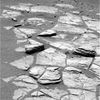
OPP-SOL632-1P184288114EFF63__P2414L5M1.jpgMartian Paving (2) - Sol 63256 visitenessun commento
|
|

Dione&Co.-PIA07628.jpgDione, Tethys and Pandora56 visiteOriginal caption:"This excellent grouping of 3 moons - Dione, Tethys and Pandora - near the Rings, provides a sampling of the diversity of worlds that exists in Saturn's Realm. A 330-Km-wide (about 205 miles) impact basin can be seen near the bottom right on Dione (at left). Ithaca Chasma and the Region imaged during the Cassini spacecraft¿s Sept. 24, 2005, flyby can be seen on Tethys (middle). Little Pandora makes a good showing here as well, displaying a hint of surface detail. Tethys is on the far side of the Rings in this view; Dione and Pandora are much nearer to the Cassini spacecraft.
Rememeber that Dione is approx. 1.126 Km (about 700 miles) across. Tethys is approx. 1.071 Km (about 665 miles) across and Pandora is 84 Km (roughly 52 miles) across.
This image was taken in visible blue light with the Cassini spacecraft narrow-angle camera on Sept. 22, 2005, at a distance of approx. 1,2 MKM (about 800.000 miles) from Saturn. The image scale is about 5 Km (approx. 3 miles) per pixel on Dione and Pandora and 9 kilometers (6 miles) per pixel on Tethys".
|
|
Craters-Holden_Crater-2-PIA03192.jpgHolden Crater's Dunes (2)56 visiteProsieguo del frame precedente; nessun commento.
|
|

SOL660-2P184960775EFFAJB1P2400R1M1.jpgRocky Panorama (4) - Sol 66056 visiteCerchiature Rosse: a Sx, una bizzarra pseudo-roccia caratterizzata da una profonda crepa e da dettagli superficiali "piallati"; a Dx, una pseudo-roccia con "buco" (oppure con "ombra circolare") sulla sua superficie.
Cerchiatura Verde: un'altra - a nostro parere - ombra impossibile (la si può verificare portando il frame al full-size e poi ingrandendo l'immagine - e cercando di non "sgranarla").
|
|

Calypso-PIA07633.jpgCalypso (in false colors)56 visiteThis color image provides the best look yet at Saturn's moon Calypso, a Trojan of the larger moon Tethys. Calypso trails Tethys in its orbit by 60°. Telesto is the other Tethys Trojan, orbiting Saturn 60°ahead of Tethys. Calypso is only 22 Km (about 14 miles) across. Calypso, like many other small Saturnian moons and small asteroids, is irregularly shaped by overlapping large craters. Although the resolution here is not as high as in Cassini's best images of Pandora and Telesto, this moon appears to also have loose surface material capable of smoothing the appearance of craters. (...) The images were taken with the Cassini spacecraft narrow-angle camera on Sept. 23, 2005, at a distance of approx. 101.000 Km (about 63.000 mi) from Calypso and at a phase angle of 61°. Resolution in the original image was 602 mt per pixel (...) ".
Nota: notiamo un'incredibile somiglianza fra Calypso e l'asteroide 433-Eros. Coincidenza, o c'è una sorta di "marchio di fabbrica" che unisce le piccole lune agli asteroidi?
|
|

Einstein_s Ring-HST.jpgThe "Einstein's Ring" (Gravitational Lensing)56 visiteThe thin blue bull's-eye patterns in these 8 HST images appear like neon signs floating over reddish-white blobs. The blobs are giant elliptical galaxies roughly 2 to 4 BLY away. The bull's-eye patterns are created as the light from galaxies twice as far away is distorted into circular shapes by the gravity of the giant elliptical galaxies.
This phenomenon is called Gravitational Lensing, first predicted by Albert Einstein almost a century ago.
Gravitational Lensing occurs when the gravitational field from a massive object warps space and deflects light from a distant object behind it.
The bull's-eye patterns are so-called "Einstein rings", which are the most elegant manifestation of the "Lensing" phenomenon.
Einstein's Rings are produced when (at least) two galaxies are, from our viewpoint, almost perfectly aligned, one behind the other.
|
|
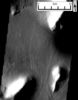
Islands.jpgThe Islands of Mars (Original NASA-2001 Mars Odyssey Orbiter b/w Frame)56 visiteNew HR images of mid-latitude Mars are revealing glacier-formed landscapes far from the Martian Poles, says a leading Mars Researcher.
Conspicuous trains of debris in valleys, arcs of debris on steep slopes and other features far from the polar ice caps bear striking similarities to glacial landscapes of Earth, says Brown University's James Head III. When combined with the latest climate models and orbital calculation for Mars, the geological features make a compelling case for Mars having ongoing climate shifts that allow ice to leave the poles and accumulate at lower latitudes.
"The exciting thing is a real convergence of these things, said Head, who will present the latest Mars climate discoveries on Sunday, 16 October, at the Annual Meeting of the Geological Society of America in Salt Lake City (Utah). "For decades people have been saying that deposits at mid and equatorial latitudes look like they are ice-created, said Head. But without better images, elevation data and some way of explaining it, ice outside of Mars' polar regions was a hard sell.
Now high-resolution images from the Mars Odyssey spacecraft's Thermal Emission Imaging System combined with images from the Mars Global Surveyor spacecraft's Mars Orbiter Camera and Mars Orbiter Laser Altimeter can be compared directly with glacier features in mountain and polar regions of Earth. The likenesses are hard to ignore.
For instance, consider what Head calls "lineated valley fill." These are lines of debris on valley floors that run downhill and parallel to the valley walls, as if they mark some sort of past flow. The same sorts of lines of debris are seen in aerial images of Earth glaciers. The difference is that on Mars the water ice sublimes away (goes directly from solid ice to gas, without any liquid phase between) and leaves the debris lines intact. On Earth the lines of debris are usually washed away as a glacier melts.
|
|

Itokawa-07.jpgOrbiting around Itokawa (4)56 visiteThe deep-space exploration technologies that the Top World's Space Agencies are pursuing consist of 3 major elements:
1) high efficiency electric propulsion for cruise;
2) rendez-vous with target destinations and
3) round-trip flights back to the Earth.
As of this time Hayabusa has accomplished the first and second of these elements, leading the way for the Space Exploration Agencies of the World.
Furthermore, robotic sample collection and return from an extra terrestrial object has not been executed before, and is not currently planned, except for Hayabusa, which will attempt to gather a bulk sample from Itokawa.
Hayabusa’s success clearly shows that Japan’s deep space exploration technology has reached the level of the World’s most developed Space Agencies, and that Japan is now in a Leadership Position in some select engineering fields.
Thus Hayabusa opens a New Era in the exploration of the Solar System.
|
|

Itokawa-11.jpgThe Landing Procedure56 visiteThe gravity and slope information and estimates of the density of boulders and regolith distribution on the surface, combined with comparisons with meteorites, will advance our interpretation and understanding of asteroid planetology.
D) Using the laser altimeter and optical navigation camera, along with range and range-rate measurements fromground-tracking stations, have led to a successful mass and density estimate for Itokawa. The density has been estimated to be 2,3 +/-0,3 gram/cc, which is a little lower than that measured for rocks on the ground or for other S-type asteroids measured to date. This may indicate that there is substantial porosity for this body and forces conventional views of these small objects to be changed drastically. When the samples are successfully returned and recovered, the actual porosity will be clarified and our knowledge of how the Earth relates to meteorites will be greatly improved.
|
|

OPP-SOL649-1N185808329EFF64I6P0705L0M1.jpgNice Panorama (1) - Sol 64956 visitenessun commento
|
|
| 25353 immagini su 2113 pagina(e) |
 |
|
|
|
|
1600 | |
|
|
|
|





