| Piú viste |
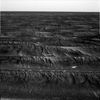
OPP-SOL622-1P183405125EDN63IRP2277L1M1.jpgPostcards from Erebus Crater (6) - Sol 62256 visitenessun commento
|
|

Nereid-CJH.gifNereid56 visiteNereid was discovered in 1949 by astronomer Gerard Kuiper. Nereid is about 340 Km (210 miles) in diameter and is so far from Neptune that it requires 360 days to make one orbit. Voyager's best photos of Nereid were taken from about 4,7 MKM (about 2,9 MMs). The photos show that the moon's surface reflects about 14% of the sunlight that strikes it, making it somewhat more reflective than Earth's Moon and more than twice as reflective as Proteus. Nereid's orbit is the most eccentric in the Solar System. Its distance to Neptune ranges from about 1.353.600 Km (about 841.100 miles) to 9.623.700 Km (such as about 5.980.200 miles).
|
|

Triton-PEI.jpgMoments of Triton...56 visiteThis set of images shows the best views of Neptune's moon Triton taken by Voyager 2 as the spacecraft withdrew from the Neptune system on August 25, 1989. The top four images were constructed from various color image bands as Voyager receded from Triton.
The third image from the left is sharper than the other four, because it was taken with the Narrow Angle Camera, with Triton filling two thirds of the frame. The thin crescent first image, while much closer, spanned about a quarter of the frame. The second image was somewhat smaller, and the last was very small. The first of the four images was composed of Blue, Green, and Orange filter images. The second utilized Violet, Green, and Orange Filtered images. In both composites, the Orange image was of poorer quality. In the fourth image, no orange was available, and the green and blue images were badly smeared, though somewhat salvageable. A clear filtered image (also smeared) was substituted for orange. They were combined and used as a color overlay for a slightly overexposed, but sharp clear filtered view. The third image is composed of a Violet and a Green wide-angle image. Like all the images in the first and second composites, and like the images used to color the fourth composite, these images were underexposed. However, they were very sharp. The orange image came from a poor quality wide angle orange image. The resulting color image was combined with a well exposed clear filter image to provide the detail
The Narrow Angle images used in these mosaics were the first obtained after closest approach, with the exception of a single clear filter image obtained while the disk was about twice as big as what could be framed in the camera's field of view. It is very noisy, and by far the worst underexposure of them all, and could not be processed to the point in which the whole image could be made presentable. However, a few sections were salvaged. The first (lower left) was binned to make up for noisiness and sharpened. It was then merged with the color data from the third image above. A cloud can be seen near the limb. To its right is an image of the cloud that has not been as heavily processed. The cloud itself is better presented, as it was far brighter than the surrounding area and hence more securely detected. Its shadow can be faintly made out to its right.
The next two images are the same, but one to the right was merged with color data. The image is towards the center of the crescent, the brightest area, in which white spots can be seen. Although a few of them may be impact craters, this area, as most of the crescent, is over the south polar cap, and thus frost covered, and the appearance of this area most closely resembles the cantaloupe terrain seen on the other hemisphere before closest approach. The final image (lower right) hints of surface topography near the terminator. It seems it is one of the more rugged parts of Triton. The large, foreshortened circular feature slightly below the center of the image is a dimple similar those found in the cantaloupe terrain. The other features are too ambiguous to determine whether or not they are of the same nature.
|
|

ZJ-Charon.gifCharon (the surface - speculation)56 visiteOriginal caption:"This image shows 4 views of Pluto's moon Charon.
The images are centered in 0° Lat. and 0° (top-left), 90° (top-right), 180° (bottom-left) and 270° (bottom-right) Long.
The images are based on photometric measurements of Marc Bouie/Lowell Observatory".
|
|

Enceladus-PIA07619.jpgEnceladus over the B-Ring56 visiteOriginal caption:"The moon Enceladus seems to hover above the outer reaches of Saturn's B-Ring. Below and to the right of Enceladus, four faint bands lie in the center of the dark Cassini Division.
Recently, scientists have speculated that the particles that make up the dense B and A-Rings might be more like fluffy snowballs than hard ice cubes. The conclusion is based on temperature data obtained by the Cassini spacecraft.
Enceladus' diameter is about 505 Km (such as approx. 314 miles). The icy moon is on the near side of the Rings in this view.
This image was taken in visible light with the Cassini spacecraft narrow-angle camera on Sept. 15, 2005, at a distance of approx. 2,3 MKM (1,4 MMs) from Enceladus.
The image scale is 14 Km (approx. 9 miles) per pixel on Enceladus".
|
|

Saturn-W00011753.jpgSaturn's limb56 visiteOriginal caption:"W00011753.jpg was taken on October 30, 2005 and received on Earth October 30, 2005. The camera was pointing toward SATURN at approximately 345.545 Km away, and the image was taken using the CL1 and BL1 filters. This image has not been validated or calibrated".
|
|
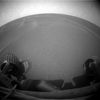
OPP-SOL626-1F183757431EFF63VOP1235L0M1.jpgOpportunity's horizon (2) - Sol 62656 visiteOriginal caption:"Left Front Haz-Cam, Non-linearized Full frame EDR acquired on Sol 626 of Opportunity's mission to Meridiani Planum at approximately 11:40:29 MLT".
|
|

Pandora-N00042203.jpgPandora and...?56 visiteOriginal caption:"N00042203.jpg was taken on October 29, 2005 and received on Earth October 30, 2005. The camera was pointing toward PANDORA at approximately 459.147 Km away, and the image was taken using the CL1 and UV3 filters. This image has not been validated or calibrated".
|
|

Titan-Dunes_and_Ridges-PIA03566.jpgPossible Tectonic fractures on Titan56 visiteOriginal caption:"This synthetic aperture radar image of Titan was taken on Oct. 28, 2005, as the Cassini spacecraft flew by at a distance of 1.350 Km (about 840 miles). This was the first pass dedicated to radar and it was the fourth time Cassini's radar honed in on the smoggy moon.
The bright, curving features are high-standing ridges, poking up above the plains of Titan. Some of the ridges extend for over 100 Km (roughly 60 miles). They are likely to be tectonic in origin, formed by deformation of Titan's icy crust. The low-lying terrain between the ridges is covered in dark streaks, which could be dunes formed by wind. The streaks, spaced 1 to 2 Km apart (0,6 to 1 mile), curve between patches of the bright terrain, which probably act as topographic barriers.
This image is 400 Km (about 250 miles) across and 275 Km-wide (about 170 miles). It is located 8° South Latitude and 215° West Longitude".
|
|
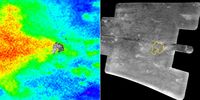
Titan-Huygens_Landing_Site-07-PIA03569.jpgHuygens' Landing Site?56 visiteOriginal caption:"On the left, in color, is a composite of the Imaging Camera and Infrared Data (red areas are brighter and blue darker, as seen in infrared). On the right is the Synthetic Aperture Radar Image. The Huygens descent images are shown inset on the left image and outlined in yellow on the right. The magenta cross in both images shows the best estimate of the actual Huygens Landing Site. This is a preliminary result, based on the best information available at the present time. In the left image, the brighter areas seen by the Huygens camera correspond to the large area depicted in red and yellow. On closer inspection, bright features within the Huygens mosaic seem to correspond to smaller features in the map composed of data from the VIS and Imaging Camera. On the right, the correspondence is less clear. In radar images bright features are usually rougher, so one would not necessarily expect an obvious connection".
|
|
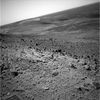
SOL651-2N184161598EFFAIBMP1909R0M1.jpgLandscape (2) - Sol 65156 visitenessun commento
|
|

Helene-N00042585.jpgHelene and Enceladus56 visiteOriginal caption:"N00042585.jpg was taken on November 02, 2005 and received on Earth November 04, 2005. The camera was pointing toward HELENE at approximately 2.186.673 Km away, and the image was taken using the CL1 and CL2 filters.
This image has not been validated or calibrated".
|
|
| 25353 immagini su 2113 pagina(e) |
 |
|
|
|
|
1598 | |
|
|
|
|





