| Piú viste |
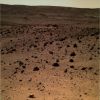
SOL1681-GB.jpgRocky Horizon - Sol 1681 (possible True Colors; credits: Dr G. Barca & Lunexit)57 visitenessun commentoMareKromium
|
|

PSP_005392_0995_RED_abrowse-01~0.jpgImpact Crater on the South Polar Layered Deposits (EDM n.1; MULTISPECTRUM - credits: Lunexit)57 visiteA problem with using craters to determine age on the icy SPLD is that erosion of the icy substrate and relaxation of crater topography (i. e., relief becoming more gentle) is probably more rapid on ice than on harder rocky surfaces.
A detailed study of craters in ice will help better to understand this process of how craters in ice degrade, or deteriorate, with time.
Perhaps then we will know how to use the number and distribution of craters over the icy polar layered deposits in constraining the geologic and climate history of the Mars Polar Regions.MareKromium
|
|
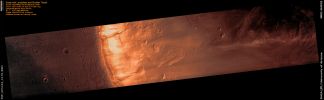
PSP_005343_2170_RED_abrowse-00~0.jpgScarp with Landslides and Boulder Tracks (context frame; natural colors - elab. Lunexit)57 visiteThis observation shows an equatorial scarp (cliff) with possible landslides and boulder tracks.
The cliff has several distinct layers visible near its top. There is a smoother, possibly fine-grained layer on top, underlain by a relatively bright and a dark layer. It is possible that the entire cliff face consists of layers but that erosion has not exposed others yet.
There are two main landslide scars, locations where a landslide has carved into the slope. Both of the scars have boulder tracks, several of which have boulders at their ends as they progress down the slope or reach the end of the slope.MareKromium
|
|
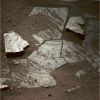
OPP-SOL1764-3-gb.jpgPebbles and Razorblades - Sol 1764 (possible True Colors; credits: Dr G. Barca)57 visitenessun commentoMareKromium
|
|
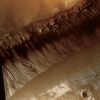
PSP_004071_1425_RED_browse-01.jpgMesas in Gorgonum Chaos (edm - possible True Colors; credits: Lunar Explorer Italia)57 visitePSP_004071_1425 shows mesas that are part of Gorgonum Chaos, a region of chaotic terrain, which is a jumble of mounds and mesas grouped together.
Chaotic terrain is most commonly found in Mars near the sources of the gigantic outflow channels. Gorgonum Chaos is one of the few exceptions.
Some of the troughs between the mesas appear to have V-shaped bottoms; there is no obvious flat floor in between. Others have dunes running down their centers probably indicating flat floors. It is possible that the mesas were once connected and that something caused fractures in the original mesa's surface that were then preferentially eroded.MareKromium
|
|
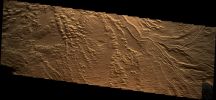
Aeolian_Features-Inverted_Channels-ER-MO.jpgInverted Topography (Natural Colors; credits for the additional process. and color.: Dr Paolo C. Fienga - Lunexit Team)57 visiteCaption NASA:"The system of sinuous ridges seen at the top of the image is the remnants of a channel system. In this case the channel has been filled by a material more resistant to erosion than the surroundings.
As the surround material was eroded away the resistant channel fill was left behind, forming a ridge where the channel had once been. This reversal of topography - from a channel to a ridge - is termed Inversion or Inverted Topography".MareKromium
|
|
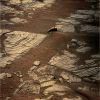
OPP-SOL1765-1.jpgMore Razorblades and Paving - Sol 1765 (possible True Colors; credits: Dr G. Barca)57 visitenessun commentoMareKromium
|
|
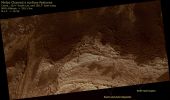
Psp_001443_1695_red~0.jpgFeatures of Melas Chasma (possible True Colors; credits: Lunar Explorer Italia)57 visitenessun commentoMareKromium
|
|
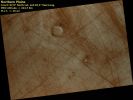
Psp_001477_2470_red.jpgDust Devils' Tracks on the Northern Plains (possible True Colors; credits: Lunar Explorer Italia)57 visitenessun commentoMareKromium
|
|

SOL040-041-GIF-Movie-MF1~0.gifDo You See?!? - Sol 41 (GIF-Movie; credits: Dr M. Faccin)57 visiteQuesto bellissimo GIF-Movie realizzato dal nostro Dr Faccin ha suscitato, in ordine ai suoi contenuti ed a quello che potrebbe mostrare, delle "controversie interpretative" anche all'interno di Lunar Explorer Italia: un fatto, quest'ultimo, che ci ha spinto a considerare ancora una volta il dato per cui, in ipotesi di immagini controverse, la "differenza", spesso, la fanno gli "occhi di chi guarda".
Allora, dato che i deadlocks non servono a nessuno e visto che qui, sulle nostre pagine, vogliamo tutti capire (o almeno vogliamo provare a capire!) ciò che si vede, per questa volta non Vi diremo nulla: nessuna "dritta", nessun "suggerimento", nessuna "informazione circostanziale".
Solo una domanda: Voi...Vedete qualcosa?!?...MareKromium
|
|

OPP-SOL502-1.jpgOpportunity's unusually-looking "Tracks" - Sol 502 (possible True Colors; credits: Dr G. Barca)57 visitenessun commentoMareKromium
|
|
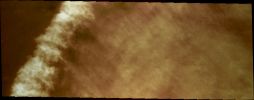
Clouds-Vastitas_Borealis_Region-PCF-LXTT-2.jpgClouds over Vastitas Borealis (Enhanced Natural Colors; credits for the additional process. and color.: Dr Paolo C. Fienga - Lunar Explorer Italia)57 visiteCaption NASA:"Dust Clouds often can obscure the Surface of Mars. When an image captures the edge of a Dust Storm Front, the loss of surface information is more than compensated for by the information that can be gleaned from analysis of the image.
As Dust Storm formation and location are unpredictable, any images of such features are priceless".
Coord.: 66,2° North. Lat. and 248,7° East Long.MareKromium
|
|
| 25353 immagini su 2113 pagina(e) |
 |
|
|
|
|
1594 | |
|
|
|
|





