| Piú viste |

Mimas-N00064753.jpgMimas is "looking down"...57 visiteCaption NASA:"N00064753.jpg was taken on August 16, 2006 and received on Earth August 18, 2006. The camera was pointing toward Mimas that, at the time, was approximately 219.272 Km away.
The image was taken using the P120 and UV3 filters".
|
|

Dione-N00064757.jpgThe "Night" of Dione (1)57 visiteDalla "modesta" distanza di circa 158.000 Km, Cassini fotografa Dione e, sovraesponendone le regioni su cui splende il Sole, è capace di regalarci una incredibile e suggestiva visione dei rilievi Dioniani immersi nella notte e vagamente rischiarati, con ogni probabilità, dal solo "Saturnshine", o "Chiaro di Saturno".
|
|

40-Jacobi Crater.jpgJacobi Crater (HR)57 visiteThis HR image was taken by the advanced Moon Imaging Experiment (AMIE) on 18 March 2006 from a distance of about 578 Km from the Moon's surface, with a ground resolution of 52 mt per pixel. It shows part of crater Jacobi in the Moon's Southern Hemisphere. The western crater rim can be seen on the left edge of the image. The imaged area is centred at a Latitude of 56,5° South and a Longitude of 10,9° East, with a field of view of 27 Km. North is up.
Crater Jacobi itself is much larger than this image - 68 Km in diameter - with the imaged area only showing about 1/5th of the crater floor area. The crater is centred at a Latitude of 56,7° South and a Longitude of 11,4° East. The single prominent crater to the upper left of the image centre is Jacobi "W", with a diameter of only 7 Km.
Peculiar surface structure can be seen in the lower left part of the image, and indicates several heavily eroded big-sized craters.
SMART-1 resolution at high solar elevation angle allows for the detection of eroded structures buried under more recent layers, giving a window on the past evolution of the Moon.
The crater is named after the German mathematician Karl Gustav Jacob Jacobi (1804 - 1851), who worked on elliptic functions and was active in the field of celestial mechanics
|
|

NGC-6397-Graph.jpgNGC 6397 - The "White Dwarfs Hook"57 visiteThis graph schematically plots two populations of stars Hubble has seen in neighboring star cluster NGC 6397. The graph, a simplified version of the original data, plots stellar brightness (vertical axis) against stellar color-temperature. The normal main sequence stars in the cluster are plotted on the right curve.
The cooler a star is, the redder it appears and it diminishes in brightness.
Hubble has identified the very coolest and faintest normal stars in the cluster.
The curve on the left plots the white dwarf population of burned-out sunlike stars. It follows a normal "cooling slope" until the white dwarf begins to look bluer and hook toward the left BUT the dwarfs aren't getting hotter!
Chemical changes in their atmospheres make them look cooler.
This predicted "white dwarfs hook" has never been seen before.
|
|

42-CuvierC-AMI_EAE3_002085_L,1.jpgCuvier "C"57 visiteCaption ESA originale:"This high-resolution image, taken by the Advanced Moon Imaging Experiment (AMIE) on board ESA’s SMART-1 spacecraft, shows the young crater ‘Cuvier C’ on the Moon.
AMIE obtained this sequence on 18 March 2006 from a distance of 591 Km from the surface, with a ground resolution of 53 mt per pixel. The imaged area is centred at a Latitude of 50,1º South and a Longitude of 11,2º East, with a field of view of 27 Km. The North is on the right of the image.
Cuvier "C", a crater about 10 Km across, is visible in the lower right part of the image. Cuvier "C" is located at the edge of the larger old crater Cuvier, a crater 77 Km in diameter. The upper left quadrant of the image contains the smooth floor of Cuvier, only one fourth of which is visible in this image".
|
|
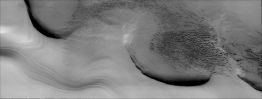
North_Polar_Features-PIA08694-00.jpgNorth Polar Landscape (Original NASA/2001 Mars Odyssey Orbiter b/w Frame)57 visiteImage information: VIS instrument;
Latitude: 83,6° North;
Longitude: 120,3° East;
Resolution: 40 meter/pixel.
|
|

North_Polar_Features-Unconformity-MGS-01.jpgNorth Polar "Unconformity" (Original NASA/MGS/MSSS b/w Frame)57 visiteCaption NASA originale:"This MGS-MOC image shows layered material exposed on a slope in the North Polar Region.
An "unconformity" is visible in the middle/lower left of the image, where layers are abruptly truncated. Unconformities are indicators of drastic change in the Region — the lower layers were deposited first, then eroded, then the upper layers were deposited".
Location near: 81,1° North Lat. and 75,2° West Long.
Image width: ~3 Km (~1,9 mi)
Illumination from: lower left
Season: Northern Spring
|
|

APOLLO 17 AS 17-2444.jpgAS 17-2444 - Mare Imbrium & Copernicus Crater57 visiteThis oblique view across southern Mare Imbrium looks toward Copernicus, the large crater near the horizon. The distance from the lower edge of the picture to the center of Copernicus is 400 km. The mountains at the edge of Mare Imbrium are the Montes Carpatus, and the large crater near the center of the picture is Pytheas, almost 19 km in diameter. Copernicus is one of the youngest of the Moon's large craters. It is visible from Earth, even without the aid of a telescope because of its bright ejecta blanket and its extensive bright rays. The many chains and clusters of small irregular craters and the many bright streaks or rays extending across Mare Imbrium are caused by the secondary impact of debris ejected from Copernicus. The viewing angle accentuates the radial pattern of the secondary impact features. The Sun angle is sufficiently low to show their relief, but high enough to show the contrast between the bright streaks and the normal dark mare surface. As in figure 124, herringbone ridges point toward the primary crater, and the flaring sides of the secondary craters point away from it. The arrow midway between Copernicus and the left edge of the photograph points to a less common pattern of secondary craters; these are concentric to Copernicus.
|
|

APOLLO 16 AS 16-5006 (2).jpgAS 16-5006 - Sketch of the details of King Crater (2)57 visitenessun commento
|
|

North_Polar_Features-Unconformity-02.jpgNorth Polar "Minor Unconformity" (Original NASA/MGS/MSSS b/w Frame)57 visiteCaption NASA originale:"This MGS-MOC image shows Layers exposed in a Trough in the Martian North Polar Region. At the time the picture was acquired, the entire scene was covered by seasonal Carbon Dioxide Frost. By late Spring and into Summer, these Layers would appear darker, once the CO2 Frost sublimes away".
Location near: 84,9° North Lat. and 263,3° West Long.
Image width: ~3 Km (~1,9 mi)
Illumination from: lower left
Season: Northern Spring
|
|

OPP-SOL921-1F209944046EDN758ZP1131L0M1-3.jpgStar-Like Object? (extra detail mgnf) - Sol 92157 visiteNoi non siamo Ufologi, ma l'esame di questo stretch estremo del possibile S.L.O. ci lascia intuire un corpo discoidale in movimento, dai chiari riflessi metallici e - forse - dotato di una leggera protuberanza (o rigonfiamento, visivamente esasperato poichè l'oggetto, al momento della ripresa, era in movimento - presumiamo - piuttosto rapido) sulla sua parte superiore.
Fantasia? Decidetelo Voi...(e comunque complimenti, come sempre, al grande Gianluigi Barca!)
|
|

Saturn-PIA08253.jpgThe "Ring-Masters"57 visiteCaption NASA:"This view looks down onto the unlit side of Saturn's Ringplane. It nicely shows a near-arm/far-arm brightness asymmetry in the B-Ring: The near arm of the B-Ring (in the lower half of the image) is notably darker from this viewing geometry than is the far arm (above).
Imaging scientists believe this to be a manifestation of the reflection of light from the disk of Saturn falling predominantly on the far arm of the Rings. (At the time this image was taken, Cassini was more or less on the dark side of the Planet.) As the B-Ring is the thickest part of Saturn's Rings, it scatters less sunlight from below, and reflects more Saturnshine from above, than either the A or C-Rings, making the effect look more dramatic in the B-Ring. Two small moons appear in this scene as well: Atlas and Pandora (32 and 84 Km across, respectively); between the two moons lie multiple clumps of material in the F-Ring.
The image was taken in visible light with the Cassini spacecraft wide-angle camera on July 25, 2006 at a distance of approximately 1 million kilometers (600,000 miles) from Saturn and at a Sun-Saturn-spacecraft, or phase, angle of 128 degrees. Image scale is 58 kilometers (36 miles) per pixel.
|
|
| 25353 immagini su 2113 pagina(e) |
 |
|
|
|
|
1588 | |
|
|
|
|





