| Piú viste |

NGC-3199.jpgNGC 3199 - Inside the "Carina Constellation"57 visite"...Tu, quamcumque Deus tibi fortunaverit horam,
Grata sume manu neu dubia differ in annum..."
(Orazio)
"Tu, qualunque sia l'ora (propizia) che Giove ti avrà riservato, afferrala e sii riconoscente; e (ricorda) di non posporre (mai) le cose belle che, nel corso degli anni, ti verranno offerte..."
|
|
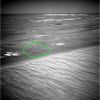
OPP-SOL870-A-1N205424304EFF73Z1P1902R0M1.jpgMore "Martian Sandglasses"? (context image) - Sol 87057 visiteIl dettaglio individuato dal Dr Barca e cerchiato in verde rientra - forse - in quella classe di cedimenti del suolo che sono state battezzati, in omaggio al Dr Alessandro Pullini - che per primo ha fornito una possibile nonchè plausibile spiegazione a questo curioso fenomeno -, "Clessidre Marziane".
Forse, quello che l'occhio attento del Dr Barca ha individuato, è davvero una Clessidra Marziana la quale, nel suo lento ma inarrestabile operare, sta portando alla luce un nuovo tassello di uno dei Pavimenti Marziani che sembrano giacere al di sotto delle sabbie di Meridiani Planum; o forse si tratta di un altro fenomeno, magari anche più sconcertante (poichè non possiamo dimenticare che le Clessidre Marziane, almeno di regola, presuppongono l'occorrere di un evento esterno per mettersi in moto - quale, ad esempio, il passaggio del Rover - e, nella zona ripresa, il Rover NON è transitato. O meglio: non è transitato negli immediatissimi paraggi dell'area interessata dalla potenziale Clessidra).
E allora? Quale potrà mai essere la causa di questo nuovo (e, a nostro parere, del tutto evidente) "cedimento"? Dove va la sabbia che viene inghiottita da Marte e, soprattutto, in casi come questo, che cosa avvìa il processo?
Domande, domande, domande...
|
|

Craters-Unnamed_Craters-Syrtis_Major.jpgUnnamed Craters in Syrtis Major Planum (Original NASA/MGS/MSSS b/w Frame)57 visiteCaption NASA originale:"This MGS-MOC image shows a portion of Syrtis Major Planum, dominated in this area by two Impact Craters of differing age. The large one is about 1,3 Km (approx. 0,8 miles) in diameter, the smaller is about 250 mt (~820 feet) across.
The smaller Unnamed Crater has a well-defined Ejecta Blanket and Rays emanate outward from its center. The larger Unnamed Crater does not exhibit these features. The larger one is older, and its Ejecta Blanket and Rays have been removed and degraded over time".
Location near: 5,4° North; 294,2° West
Image width: ~3 Km (~1,9 mi)
Illumination from: upper left
Season: Northern Spring
|
|
OPP-SOL871-1R205511354EFF730JP1375L0M1-1.jpgStar-Like Object (2 - context image) - Sol 87157 visiteFACCIAMO CHIAREZZA: è innegabile che la vita dell'Uomo, oggi, sia decisamente più COMPLESSA di quello che era centinaia o migliaia di anni fa. Ma una vita complessa non vuol dire più EVOLUTA. Essa significa solo PIU' SPECIALIZZATA (termine che oggi va tanto di moda).
Uno strumento si dice “più specializzato” quando serve molto bene per una cosa sola.
Il massimo della specializzazione è essere capaci di fare, in modo perfetto, solo una cosa.
In pratica essere "specializzati" significa non saper fare assolutamente nulla ad eccezione, per esempio, del grattarsi perfettamente un orecchio.
Questa (Super) SPECIALIZZAZIONE ed (iper) COMPLESSITA' riempie la nostra vita di egocentrismo e presunzione, dandoci l'illusione del Progresso, ma non allontanandoci dall'oscurantismo e dal Medio Evo.
Con il gioco delle SPECIALIZZAZIONI, l'Uomo, tristemente, si è abituato a "dividere" perdendo la visione di insieme.
|
|

OPP-SOL873-1N205688004EFF735TP1902L0M1-2.jpgClosing up on Beagle Crater: the Menhir (detail mgnf) - Sol 87357 visitenessun commento
|
|

SOL872-1152281618_30555-4_Sol872A_P2263_L456atc-A893R1-2.jpgThe Surface of Gusev - Sol 872 (Approx. True Colors; credits: NASA/JPL-Caltech)57 visiteCaption NASA originale:"Zhong Shang is an Antarctic base that the People's Republic of China opened on Feb. 26, 1989, at the Larsemann Hills in Prydz Bay in East Antarctica.
Allan Hills is a location where researchers have found many Martian meteorites, including the controversial ALH84001, which achieved fame in 1996 when NASA scientists suggested that it might contain evidence for fossilized extraterrestrial life. Zhong Shan was the given name of Dr. Sun Yat-sen (1866-1925), known as the "Father of Modern China".
Born to a peasant family in Guangdong, Sun moved to live with his brother in Honolulu at age 13 and later became a medical doctor. He led a series of uprisings against the Qing dynasty that began in 1894 and eventually succeeded in 1911. Sun served as the first provisional president when the Republic of China was founded in 1912".
|
|

SOL872-1152281618_30555-2_Sol872A_P2263_L257F-A893R1-2.jpgThe Surface of Gusev - Sol 872 (False Colors; credits: NASA/JPL-Caltech)57 visitenessun commento
|
|

vo1_020a62.jpgMars: according to Viking 1 Orbiter57 visiteThe results from the Viking experiments give our most complete view of Mars to date. Volcanoes, lava plains, immense canyons, cratered areas, wind-formed features and evidence of surface water are apparent in the Orbiter images. The Planet appears to be divisible into two main regions: Northern Low Plains and Southern Cratered Highlands. Superimposed on these Regions are the Tharsis and Elysium bulges - high-standing volcanic areas - and Valles Marineris, a system of giant canyons near the Equator.
The surface material at both landing sites can best be characterized as iron-rich clay. Measured temperatures at the landing sites ranged from 150 to 250 K, with a variation over a given day of 35 to 50 K. Seasonal dust storms, pressure changes, and transport of atmospheric gases between the polar caps were observed.
The biology experiment produced no evidence of life at either landing site.
|
|
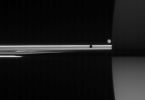
Saturn&Friends-PIA08220.jpgOne in the Shadows, one in the Lights57 visiteCaption NASA originale:"The unlit side of the Rings glows with scattered Sunlight as two moons circle giant Saturn. The light reaching Cassini in this view has traveled many paths before being captured.
At left, Mimas (397 Km, or 247 miles across) presents its "Dark Side". Enceladus (505 Km, or 314 miles across), on the Far Side of the Rings, is lit by "Saturnshine," or reflected sunlight coming from the planet. Saturn, in turn, is faintly lit in the south by light reflecting off the Rings.
Saturn's shadow darkens the Rings, tapering off toward the left side of this view.
The image was taken in visible light with the Cassini spacecraft narrow-angle camera on June 11, 2006 at a distance of approx. 3,9 MKM (about 2,5 MMs) from Mimas, 4,3 MKM (approx. 2,7 MMs) from Enceladus and 4,1 MKM (about 2,6 MMs) from Saturn.
Image scale is roughly 25 Km (approx. 16 miles) per pixel on Saturn".
|
|

Asteroids-Asteroid_2002JF56-PIA09230-00.jpgUnknown Asteroid57 visiteUn'immagine non particolarmente suggestiva, ma comunque importante, molto importante: ci arriva dalla Sonda New Horizons che sta calibrando le proprie fotocamere, in attesa (una LUNGA attesa...) di giungere nello Spazio di Plutone e quindi nella Fascia di Kuiper, tra il 2015 ed il 2020...
|
|

Craters-Unnamed_Crater-Northern_Regions-PIA08611.jpgUnnamed Crater in Vastitas Borealis (Original NASA/2001 Mars Odyssey b/w Frame)57 visiteImage information: VIS instrument;
Latitude: 69,1° North;
Longitude: 273,6° East;
Resolution: 20 mt/pixel.
|
|
OPP-SOL883-1N206575772EFF74G2P0695R0M1.jpgBeagle Crater's Area (5) - Sol 88357 visitenessun commento
|
|
| 25353 immagini su 2113 pagina(e) |
 |
|
|
|
|
1584 | |
|
|
|
|





