| Piú viste |

Psp_002538_1720_red.jpgJust like Thaumasia: more "bright" dunes in Ius Chasma57 visiteIus Chasma is one of several canyons that make up Valles Marineris, the largest canyon system in the Solar System.
The canyons likely formed by extension in association with the development of the Tharsis plateau and volcanoes to the West. Wind and possibly water have modified the canyons after they formed.
This HiRISE image shows the floor of Ius Chasma. The floor is bounded to the North and South by higher standing wallrock, with a few exposures of wallrock seen in the North (Sx) of the picture. Much of the floor is covered by ripples that are oriented approximately North-South, indicating an East to West wind flow, parallel to the orientation of Ius Chasma.
Layered deposits and bright patches of material are also seen along portions of the Ius Chasma floor. The layered deposits appear distinct in morphology from the nearby wallrock. These layered deposits could be lava flows, sediments deposited in a former lake, or fines that settled out from the atmosphere over time, such as dust or volcanic ashes.
The bright outcrops visible further south in the image have been seen elsewhere in Valles Marineris as well as other locations on Mars and tend to have mineral signatures consistent with sulfates. Data from the CRISM instrument (also on Mars Reconnaissance Orbiter) of the composition of these bright patches in Ius Chasma could shed insight into their origin. MareKromium
|
|

as10-27-3906.jpgAS 10-27-3906 - Approaching the Terminator57 visitenessun commentoMareKromium
|
|
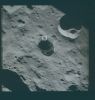
as16-113-18294.jpgAS 16-113-18294 - Casper and the Moon57 visiteCaption NASA:"Pre-landing photo of the CSM (Casper) from the LM (Orion) and, in the background on the Lunar Surface, hilly terrain near the Northwestern rim of Valier".MareKromium
|
|
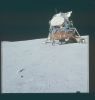
as16-113-18329.jpgAS 16-113-18329 - Orion's Portrait57 visiteCaption NASA:"119:33:46 MT - Charlie Duke's 4 o'clock pan, rightward of 18328, showing John Young on the Rover, preparing to drive around the back of the LM to the MESA".
MareKromium
|
|
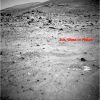
SOL1116-2N225441725EFFASR6P1992L0M1-00.jpgIce, Glass or Metal? (1 - gray scale) - Sol 111657 visiteGrazie ancora una volta al nostro carissimo Amico e Partner, Dr Gianluigi Barca, per questo nuovo Mistero (forse) Marziano.
Il rilievo superficiale controverso lo trovate alla Vostra Dx, indicato dalla freccia. Di che cosa si tratta? Escludiamo, per ovvie ragioni di logica, tecnica ed anche di buon senso, il photoartifact. Cosa resta? Resta una (pseudo)roccia la cui albedo è straordinaria e del tutto incongrua rispetto all'albedo-media del paesaggio che la circonda.
Forse un cristallo gigante, forse un estruso di ghiaccio o forse...forse qualcosa d'altro.
Una nota: il frame originale NASA è di qualità davvero orrenda.
Noi lo abbiamo ripulito al meglio delle nostre capacità e possibilità e la nostra opera di "pulizia digitale", e questo lo diciamo per correttezza ed onestà intellettuale, può avere - sebbene solo minimamente - inciso sulla texture apparente del rilievo anomalo "smussandolo ed arrotondandolo", ma NON HA inciso sulla sua luminosità apparente.
Per il resto, giudicate Voi.MareKromium
|
|

as16-113-18357.jpgAS 16-113-18357 - The "Central Station"57 visiteCaption NASA:"Rightward of 18356, across the Central Station toward Smoky Mountain".MareKromium
|
|
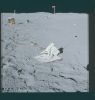
as16-113-18379.jpgAS 16-113-18379 - The "Mortar Package"57 visiteCaption NASA:"122:42:18 MT - John Young's photo from the northeast of the Mortar Package. Charlie Duke offers this description of the scene: "This picture shows the mortar package with the red flag extended and it's facing off parallel to the geophone line. You can't really see the geophone line in the background, but you can see where John walked. That's basically his footprints along the geophone line and it trends off to the northwest. And you can see the spaghetti cable that goes back to the Central Station - not only for the data but also for the power. The magnetometer's in the far background, just over the mortar package. You can see the RTG and Central Station".MareKromium
|
|

as16-114-18439.jpgAS 16-114-18439 - The "UV" Astronomy Camera57 visiteCaption NASA:"Interesting cross-Sun from the south of the UV Astronomy Camera, showing Charlie Duke in the background with the Rover and the Flag to the left".
|
|

Psp_001691_1320_red.jpgGullied Trough in Noachis Terra(False Colors)57 visitePSP_001691_1320 shows gullies in a semi-circular trough in Noachis Terra. The gullies are observed to face all directions.
It is interesting to note that the gully morphology seen here depends on the orientation of the gullies. The morphology differences are most pronounced on the sunlit slope, with the gullies facing South (Dx) being more deeply incised than those facing the West. It is unknown what caused the different gully morphologies, but there are several possibilities.
Gullies are proposed to form at locations determined by the availability of a forming liquid (thought to be water) and/or the amount of insolation the slope receives, among other factors. It is possible that the deeper gullies experienced more erosional events or that their erosional events were more effective for undetermined reasons. It is also possible that the gullies formed at different times such that they did not have the same amount of water — either for an individual flow or total — available to them.
Also, the underlying topography could make the gullies appear relatively more incised without this actually being the case.
|
|

Psp_001691_1320_red~0.jpgGullied Trough in Noachis Terra (extra-detail mgnf - false colors)57 visiteThe majority of the gullies on both sides of the trough appear to originate at a boulder-rich layer seen in this subimage.
The layer appears dark on the sunlit slope because the boulders sticking out from the slopes cast shadows. If these gullies formed by water from the subsurface, then it is possible that this layer is a permeable layer that conducted water to the surface.
The layer is deteriorating and traveling down slope in the form of boulders.
These boulders can clearly be seen in the alcoves of the gullies on both sides of the trough.
Note that the alternating stripes on the lower right (Dx) side of the image are an artifact from camera noise. They are not real features.
|
|

Rhea-PIA08886.jpgDrawing Out Details on Rhea57 visiteRhea displays a marked color contrast from North to South that is particularly easy to see in the extreme color-enhanced Cassini spacecraft view presented here.
A clear filter image is also presented (left) alongside the color composite (right).
To create the false-color view, ultraviolet, green and infrared images were combined into a single picture that isolates and maps regional color differences.
This "color map" was then superimposed over a clear-filter image that preserves the relative brightness across the body.
The combination of color map and brightness image shows how colors vary across the surface of Rhea. The origin of the color differences is not yet understood, but may be caused by subtle differences in the surface composition or the sizes of grains making up the icy surface material.
This view looks toward the Trailing Hemisphere on Rhea. The view shows southerly latitudes on Rhea, down to the South Pole. North is up and rotated 17° to the right.
The image was taken in visible light with the Cassini spacecraft narrow-angle camera on Jan. 17, 2007 at a distance of approx. 457.000 Km (about 284.000 miles) from Rhea.
Image scale is roughly 3 Km (a little less than 2 miles) per pixel.
|
|

Io-022707_Erupt_on_Io.jpgRestless Tvashtar57 visiteThe first images returned to Earth by New Horizons during its close encounter with Jupiter feature the Galilean moon Io, snapped with the Long Range Reconnaissance Imager (LORRI) at 0840 UTC on February 26, while the moon was 2,5 MMs (about 4 MKM) from the spacecraft.
Io is intensely heated by its tidal interaction with Jupiter and is thus extremely volcanically active. That activity is evident in these images, which reveal an enormous dust plume, more than 150 miles high, erupting from the volcano Tvashtar. The plume appears as an umbrella-shaped feature of the edge of Io's disk in the 11 o'clock position in the right image, which is a long-exposure (20-millisecond) frame designed specifically to look for plumes like this. The bright spots at 2 o'clock are high mountains catching the setting sun; beyond them the night side of Io can be seen, faintly illuminated by light reflected from Jupiter itself.
The left image is a shorter exposure — 3 milliseconds — designed to look at surface features. In this frame, the Tvashtar volcano shows as a dark spot, also at 11 o'clock, surrounded by a large dark ring, where an area larger than Texas has been covered by fallout from the giant eruption.
This is the clearest view yet of a plume from Tvashtar, one of Io's most active volcanoes. Ground-based telescopes and the Galileo Jupiter orbiter first spotted volcanic heat radiation from Tvashtar in November 1999, and the Cassini spacecraft saw a large plume when it flew past Jupiter in December 2000. The Keck telescope in Hawaii picked up renewed heat radiation from Tvashtar in spring 2006, and just two weeks ago the Hubble Space Telescope saw the Tvashtar plume in ultraviolet images designed to support the New Horizons flyby.
The New Horizons images of the plume — which show features as small as 20 Km (12 miles), are 12 times sharper than the HST images and about three times sharper than the Cassini images. "This is the best image of a large volcanic plume on Io since the Voyager flybys in 1979" says John Spencer, deputy leader of the New Horizons Jupiter Encounter Science Team from Southwest Research Institute.
"If the Tvashtar plume remains active, the images we take later in the encounter should be even better".
|
|
| 25353 immagini su 2113 pagina(e) |
 |
|
|
|
|
1580 | |
|
|
|
|





