| Piú viste |
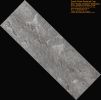
PSP_004739_0935_RED_browse.jpgSouth Pole Residual Cap - Swiss-Cheese Terrain Monitoring (Natural Colors; credits for the additional process. and color.: Dr Paolo C. Fienga - Lunexit Team)57 visitenessun commentoMareKromium
|
|
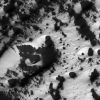
Japetus-PIA08373.jpgThe "Transition Region" of Japetus: Coated Craters57 visiteCaption NASA:"Cassini surveys a bright landscape coated by dark material on Iapetus. This image shows terrain in the Transition Region between the moon's dark Leading Hemisphere and its bright Trailing Hemisphere. The view was acquired during Cassini's only close flyby of the two-toned Saturn moon.
The image was taken on Sept. 10, 2007, with the Cassini spacecraft narrow-angle camera at a distance of approximately 5.260 Km (3.270 miles) from Japetus. Image scale is 32 meters (105 feet) per pixel".MareKromium
|
|

Japetus-PIA08375.jpgThe "Voyager" Mountains57 visiteCaption NASA:"Cassini zooms in, for the first time, on the patchy, bright and dark mountains originally identified in images from the NASA Voyager spacecraft taken more than 25 years earlier. The image was acquired during Cassini's only close flyby of Iapetus, a two-toned moon of Saturn.
The terrain seen here is located on the Equator of Japetus at approximately 199° West Longitude, in the Transition Region between the moon's bright and dark Hemispheres. North is up.
The image was taken on Sept. 10, 2007, with the Cassini spacecraft narrow-angle camera at a distance of approximately 9.240 Km (5.740 miles) from Japetus. Image scale is 55 meters (180 feet) per pixel".MareKromium
|
|
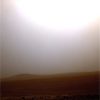
SOL1313-2P242923915EFFAV00P2629L6M1.jpgLate morning fogs over Gusev - Sol 131357 visitenessun commentoMareKromium
|
|
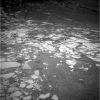
OPP-SOL1293-1N242973887EFF86JZP1909R0M1.jpgVictoria's Paving - Sol 129357 visitenessun commentoMareKromium
|
|

as04-01-221.JPGAS 04-01-0221 - Crescent Mother Earth57 visitenessun commentoMareKromium
|
|

as17-134-20386.JPGAS 17-134-20386 - Saluting the Flag57 visiteCaption NASA:"118:26:32 MT - EVA-1 at the LM. Gene is holding a corner of the Flag and saluting. We see the LRV (Lunar Roving Vehicle) in the background and, on his chest, the "Red Apple" purge valve actuator. He has the geology hammer in his right shin pocket. Ken Glover notes that Gene's face can be seen thru the gold visor in this picture and, more clearly, in 20387".MareKromium
|
|

PSP_004778_0945_RED_browse.jpgSouth Pole Residual Cap - Swiss-Cheese Terrain Monitoring (Natural Colors; credits for the additional process. and color.: Dr Paolo C. Fienga - Lunexit Team)57 visitenessun commentoMareKromium
|
|

PSP_005155_1030_RED_browse.jpgExposure of South Polar Layered Deposits57 visiteA complex geologic history is on display in this image of the South Polar Layered Deposits. These layered deposits are a mixture of dust and water-ice. Each layer is thought to record information about the state of the Martian climate at the time of its deposition.
The original stack of layered ice has eroded to produce a scarp that exposes the internal layers. Smooth material was then deposited to cover this scarp before being in turn eroded. Deposition on top of an eroded surface like this produces what geologists call an "unconformity in the stratigraphic record". Remnants of this smooth material can be seen on the left of the image and draping the layered scarp near the image center.
Although it looks, at first glance, like this material has flowed down the scarp, that is unlikely to have happened. The extremely cold temperatures at the Martian Poles mean that ice in general does not flow like we see it do here on Earth. There are also no indications of some of the geomorphologic features that flowing ice typically acquires (such as crevasses, compressional ridges or moraines).
MareKromium
|
|

PSP_005194_1070_RED_browse.jpgFaulting in the South Polar Layered Deposits57 visiteThe scarp shown in this image marks the edge of the Polar Layered Deposits. These layered deposits are a mixture of dust and water-ice. Each layer is thought to record information about the state of the Martian climate at the time of its deposition.
The polar layered deposits were once more extensive, but have been eroded back to their current size. Most of this erosion takes places at inclined scarps (such as this one) which retreat as icy material is ablated away.
Other processes are also operating on these deposits as exemplified by the fault that is visible on the left of the image. Layers appear offset from one side of the fault to another indicating that the layered deposits have been fractured into large blocks that have moved relative to each other. The source of the stress that caused this fracturing is unknown; some possible examples are subsidence of the underlying terrain or perhaps melting of a portion of the base of the ice-sheet.
This particular Region of the Layered Deposits (Ultimi Lingula) contains many examples of this brittle fracture (which is otherwise rare in these Deposits). Another less obvious fault lies near the center of the image at the base of the scarp. This fault does not break through, or even deform, the upper layers which may indicate that the fault occurred when only half the layered deposits had accumulated. These observations point to a history of faulting in this region that at least spans the age range of these Layered Deposits. MareKromium
|
|

Saturn-PIA09734.jpgTurbulences57 visiteCaption NASA:"The Cassini Spacecraft has a peek beneath the hazes in Saturn's Upper Atmosphere at the swirling vortices that lurk below.
Many vortices can be seen in this image, varying in size from small to large.
The largest one in this image exhibits a collar of bright clouds surrounding the central dark core.
The view is centered on a region about 46° South of the Planet's Equator.
The image was taken with the Cassini spacecraft narrow-angle camera on Aug. 12, 2007 using a spectral filter sensitive to wavelengths of infrared light centered at 750 nanometers. The view was acquired at a distance of approx. 4,1 MKM (such as about 2,5 MMs) from Saturn.
Image scale is roughly 24 Km (about 15 miles) per pixel".MareKromium
|
|
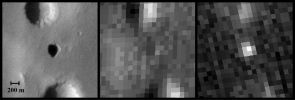
Volcanic_Features-Caverns-PIA09929-01.jpgOn the Northern Slope of Arsia Mons: candidate Cavern Entrance (Annie)57 visiteCaption NASA:"Each of the 3 images in this set covers the same patch of Martian Ground, centered on a possible cave skylight informally called "Annie" which has a diameter about double the length of a football field. The THEMIS camera on NASA's Mars Odyssey orbiter took all 3, gathering information that the hole is cooler than surrounding surface in the afternoon and warmer than the surrounding surface at night. This is thermal behavior that would be expected from an opening into an underground space.
The left image was taken in visible-wavelength light (fig. 1). The other 2 were taken in Thermal Infrared Wavelengths, indicating the relative temperatures of features in the image. The center image is from mid-afternoon. The hole is warmer than the shadows of nearby pits to the North and South, while cooler than sunlit surfaces. The thermal image at right was taken in the pre-dawn morning, about 4 M.L.T. .
At that hour, the hole is warmer than all nearby surfaces".
Nota Lunexit: ovviamente non era necessario nè uno scienziato nè un veggente per anticipare le mosse (di buon senso) della NASA, ma il fatto che i Tecnici di Pasadena abbiano effettivamente operato non solo delle riprese notturne di questa interessante Surface Feature, ma anche dei rilievi IR - come da noi suggerito ed anticipato, sebbene a proposito di un'altra (e forse più famosa) Candidate Cavern Entrance - ci ha dato, onestamente, una notevole soddisfazione!MareKromium
|
|
| 25353 immagini su 2113 pagina(e) |
 |
|
|
|
|
1579 | |
|
|
|
|





