| Piú viste |

Saturnian_Sky.gifIn the Sky of Saturn (GIF-Movie; credits: Dr M. Faccin)58 visitenessun commentoMareKromium
|
|

ZZ-Mercury-Craters-Rembrandt_Crater-PIA12395.jpgLow Sun over Rembrandt Crater (possible Natural Colors; credits: Dr Paolo C. Fienga - Lunexit Team)58 visiteThis NAC image acquired during MESSENGER's third Fly-By of Mercury shows a view of the interior of Rembrandt Basin that emphasizes landforms. Rembrandt was discovered during the Mission's second Fly-By, in October 2008. Its large size (approx. 715 Km, or about 444 miles, in diameter), its relatively young age (as implied by the low number of superposed impact craters), and the radiating extensional and contractional fractures on its Floor, have made it a topic of special interest to the MESSENGER Science Team.
Earlier this year, an article devoted to the first study of the geology of Rembrandt was published in the Science magazine. During Mercury's Fly-By 3, Rembrandt was closer to the Terminator - such as the line between the sunlit dayside and dark nightside of the Planet - and the different viewing geometries between Fly-Bys 2 and 3 enabled a three-dimensional view of this unusual basin. The grazing angle of the light from the setting Sun in this particular NAC image accentuates the topography of the features on the Rembrandt's Floor, including the set of unusual Radiating Fractures.
Date Acquired: September 29, 2009
Image Mission Elapsed Time (MET): 162744327
Instrument: Narrow Angle Camera (NAC) of the Mercury Dual Imaging System (MDIS)
Resolution: 390 meters/pixel (0,24 miles/pixel)
Scale: The prominent crater at center left is about 44 Km (approx. 27 miles) in diameter
Spacecraft Altitude (distance from target): approx. 15.100 Km (about 9400 miles)
MareKromium
|
|

Prometheus-N00148968-N00148985-GB.gifPrometheus adrift... (GIF-Movie; credits: Dr G. Barca)58 visitenessun commentoMareKromium
|
|

Prometheus-091227-N00148969-EB.jpgPrometheus adrift... (possible Natural Colors; credits: Elisabetta Bonora - Lunexit Team)58 visiteNulla di artefatto o manipolato digitalmente, in questo frame prodotto dalla nostra Elisabetta Bonora!
La colorazione rosacea di Prometheus, infatti, potrebbe e dovrebbe dipendere, a nostro modo di vedere, dal Saturnshine (o "Chiaro di Saturno").
E non è neppure inutile rammentare che Prometheus non è la sola Luna Saturniana ad avere un colore simile!
Esso, infatti, forma uno splendido "Space Duo" con Hyperion la cui Superficie, sempre secondo la NASA (e ad eccezione di quanto contenuto nei bizzarri crateri che lo ricoprono quasi per intero), sarebbe di color rosa pallido, con sfumature grigie e bianco/verdastre.MareKromium
|
|

The_Rings-EB.jpgUp-Sun in the Space of Saturn (Natural Colors; credits: Elisabetta Bonora - Lunexit Team)58 visitenessun commentoMareKromium
|
|

Rhea-4229274308_c987cf73d9_o.jpgLarge Crater on Rhea (possible True Colors; credits: Dr M. Faccin - Lunexit Team)58 visitenessun commentoMareKromium
|
|

FIGURA_01.jpgCommemorative stamp about the "San Marco Project"58 visiteFrancobollo commemorativo del Progetto San Marco - 1975.MareKromium
|
|
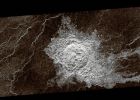
Craters-Unnamed_Crater-PIA00468.jpgUnnamed (and heavily degraded) Crater (possible Natural Colors; credits: Dr Paolo C. Fienga - Lunexit Team)58 visiteDuring orbits 423 through 424 on 22 September 1990, Magellan imaged this Impact Crater that is located at Latitude 10,7° North and Longitude 340,7° East.
This Crater is shown as a representative of Venusian Craters that are of the proper diameter (about 15 Km) to be 'transitional' in their morphology between 'complex' and irregular'.
Complex Craters account for about 96% of all craters on Venus with diameters larger than about 15 Km; they are thought to have been formed by the impact of a large, more or less intact, mass of asteroidal material that has not been excessively effected during its passage through the dense Venusian Atmosphere.
Complex Craters are characterized by circular Rims, terraced Inner Wall Slopes, well developed Ejecta Deposits, and flat Floors with a Central Peak or Peak Ring.
Irregular Craters make up about 60% of the Craters with diameters less than about 15 Km. Irregular Craters are thought to form as the result of the impact of asteroidal projectiles that have been aerodynamically crushed and fragmented during their passage through the Atmosphere.
Irregular craters are characterized by irregular and/or discontinuous Rims and hummocky or multiple Floors.
The 'Transitional' Crater shown here has a somewhat circular Rim like larger Complex Craters, but has the hummocky Floor and asymmetric Ejecta characteristic of smaller Irregular Craters. MareKromium
|
|
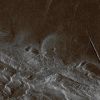
Lakshmi_Planum-PIA00249.jpgDanu Montes and Lakshmi Planum (possible Natural Colors; credits: Dr Paolo C. Fienga - Lunexit Team)58 visiteSouthwest Lakshmi Planum is bounded on the South by the Danu Montes.
Lakshmi Planum is an elevated plateau plain that is bounded on all sides by mountain chains. Here, the Danu Mountains have an angular fractured appearance. Chasms slice diagonally across the mountains in the lower left (South-West) corner of the image. Because of the steep slopes and the local relief of the mountains of several kilometers (2-3 miles, these fault-bounded troughs appear to zig-zag through the mountains when, in fact, they are probably straight if viewed from above.
The radar view provides a perspective that would place the viewer's eye to the right, 27° above the Horizon. Thus, slopes facing to the right can be seen completely, though dark, and slopes facing away to the left appear shortened, often seen only as thin bright lines. In the center of the image is a low volcanic dome (approx. 20 Km - about 12 miles - in diameter).
This type of volcanic feature frequently occurs on the low plains. This dome on the edge of Lakshmi is deformed and faulted where it has been affected by the forces that created the Danu mountains.
The image is approx. 75 Km (about 46 miles) on a side. The center is at 60° North Latitude and 324,5° East Longitude.MareKromium
|
|

PSP_001916_2220_RED_abrowse.jpgKnobs and Mounds on the Northern Plains (Natural Colors; credits: Dr Paolo C. Fienga - Lunexit Team)58 visiteLight-toned Mounds occur across the image.
The northern part of the image is dominated by small Knobs or Patches, while there are features hundreds of meters across to the South. The larger features frequently have one or more craters and an irregular shape; it has been proposed that these features are Mud Volcanoes, which erupt mud instead of lava.
On Earth, Mud Volcanoes usually form in conditions of tectonic pressurization or rapid burial of sediments.
At high resolution, the Knobs show some fine lineations which may be wind-blown material, but are otherwise very smooth. In between the Mounds, the Surface is rough and rich in Boulders. The few Boulders on the Mounds were likely ejected from nearby Impact Craters.
Information like this from HiRISE images provides useful constraints on the formation and material of these Knobs and Cones.MareKromium
|
|

FIGURA_06B.jpgThe "San Marco 3" Satellite58 visitenessun commentoMareKromium
|
|

Enceladus-PIA12517.jpgA "Pearl of Ice", in the Night of Saturn (possible Natural Colors; credits: Dr Paolo C. Fienga - Lunexit Team)58 visiteCaption NASA:"The Cassini Spacecraft looks toward the South Pole of Enceladus, with a glimpse of Saturns Rings in the distance, during the Spacecraft's close Fly-By of Nov. 2, 2009.
(see PIA08386 to learn more about the active South Pole of Enceladus)
This view looks toward the anti-Saturn side of Enceladus. The Rings have been brightened relative to Enceladus to increase visibility.
The image was taken in Visible Light with the Cassini Spacecraft wide-angle camera on Nov. 2, 2009. The view was acquired at a distance of approx. 10.400 Km (aout 6500 miles) from Enceladus and at a Sun-Enceladus-Spacecraft, or Phase, Angle of 6°.
Image scale is roughly 630 meters (2100 feet) per pixel".MareKromium
|
|
| 25353 immagini su 2113 pagina(e) |
 |
|
|
|
|
1577 | |
|
|
|
|





