| Piú viste |

Enceladus-PIA07800-br500.jpgEnceladus (1)57 visiteA masterpiece of deep time and wrenching gravity, the tortured surface of Saturn's moon Enceladus and its fascinating ongoing geologic activity tell the story of the ancient and present struggles of one tiny world. This is a story that is recounted by imaging scientists in a paper published in the journal Science on March 10, 2006.
The enhanced color view of Enceladus seen here is largely of the Southern Hemisphere and includes the South Polar terrain at the bottom of the image.
Ancient craters remain somewhat pristine in some locales, but have clearly relaxed in others. Northward-trending fractures, likely caused by a change in the moon's rate of rotation and the consequent flattening of the moon's shape, rip across the southern hemisphere. The South Polar terrain is marked by a striking set of 'blue' fractures and encircled by a conspicuous and continuous chain of folds and ridges, testament to the forces within Enceladus that have yet to be silenced.
|
|

Enceladus-PIA07800f-1~0.jpgEnceladus (2) - detail mgnf and HR57 visiteThe global mosaic of Enceladus was created from 21 false-color frames taken during the Cassini spacecraft's close approaches to Enceladus on March 9 and July 14, 2005. Images taken using filters sensitive to ultraviolet, visible and infrared light (spanning wavelengths from 338 to 930 nnmts) were combined to create the individual frames.
The mosaic is an orthographic projection centered at 46,8° South Lat. and 188° West Long. and has an image scale of 67 mt (about 220 feet) per pixel. The original images ranged in resolution from 67 mt per pixel to 350 mt were taken at distances ranging from 11.100 to 6.300 Km from Enceladus.
|
|

OPP-SOL753-1N195035118EFF64__P0686R0M1.jpgLike an island, in a Sea of Dust... (1) - Sol 75357 visitenessun commento
|
|

Enceladus&Rhea-PIA08133.jpgEnceladus and Rhea, divided by the Rings57 visiteCaption originale:"Rhea and Enceladus hover in the distance beyond Saturn's Ring-Plane. Enceladus (left, 505 Km - about 314 miles - wide), bathed in icy particles from Saturn's E-Ring, appears noticeably brighter than Rhea (right, 1528 Km - about 949 miles - wide).
The image was taken in visible light with the Cassini spacecraft narrow-angle camera on Feb. 8, 2006, at a distance of approx. 4,3 MKM (such as about 2,7 MMs) from Enceladus and 4,6 MKM (about 2,9 MMs) from Rhea.
The image scale is approx. 26 Km (roughly 16 miles) per pixel on Enceladus and about 28 Km (roughly 17 miles) per pixel on Rhea.
|
|
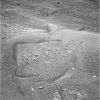
OPP-SOL757-1P195388930EFF65C3P2364L7M1.jpgNatural or artificial? - Sol 75757 visiteCaption Originale:"Left PanCam Non-linearized Full frame EDR acquired on Sol 757 of Opportunity's mission to Meridiani Planum at approximately 12:35:24 MLT.
Camera commanded to use Filter 7 (432 nm)".
Difficile da commentare: la porzione di "Martian Paving" che vediamo in questo frame sembra - indiscutibilmente - squadrata...
E questa sensazione devono averla avuta anche i Signori di Pasadena poichè questo dettaglio, nei Soles seguenti - come vedremo - verrà ripreso più e più volte.
|
|
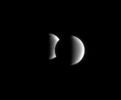
Tethys&Dione-PIA08134.jpgCrossing Spheres57 visiteCaption originale:"Dione steps in front of Tethys for a few minutes in an occultation - or "mutual event". These events occur frequently for the Cassini spacecraft when it is orbiting close to the Ring-Plane.
The image was taken in visible red light with the Cassini spacecraft narrow-angle camera on Feb. 10, 2006, at a distance of approx. 3,7 MKM(such as about 2,3 MMs) from Dione and approx. 4 MKM (about 2,5 MMs) from Tethys. Resolution in the original image was about 22 Km (approx. 14 miles) per pixel on Dione and about 24 Km (approx. 15 miles) per pixel on Tethys.
The image has been magnified by a factor of two.
|
|

Mimas-PIA08135.jpgOverlapping Planets57 visiteCaption originale:"Mimas briefly slipped in front of Tethys while the Cassini spacecraft looked on and captured the event in this series of images.
The images were taken in visible light with the Cassini spacecraft narrow-angle camera on Feb. 11, 2006, at a distance of approx. 3,7 MKM (such as about 2,3 MMs) from Mimas and 4,1 MKM (such as about 2,5 MMs) from Tethys. Resolution in the original images was approx. 22 Km (about 14 miles) per pixel on Mimas and approx. 25 Km (about 16 miles) per pixel on Tethys.
The images have been magnified by a factor of two".
|
|
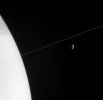
Rhea&Saturn-PIA08132.jpgCrescent Rhea57 visiteCaption NASA originale:"Shadow-striped Saturn and its exquisitely thin Rings occupy the near-field view in this Cassini image, while a crescent moon Rhea hangs in the distance.
A couple of bright pixels at the center of the image mark the location of the tiny moon Pan (only 26 Km, or 16 miles across).
The image was taken in visible light with the Cassini spacecraft narrow-angle camera on Feb. 3, 2006, at a distance of approx. 4,1 MKM (2,5 MMs) from Saturn and 4,6 MKM (2,9 MMs) from Rhea. The image scale is 28 Km (approx. 17 miles) per pixel on Rhea".
|
|

OPP-SOL762-1N195836080EFF65RXP0695R0M1.jpgSide-Winders (2) - Sol 76257 visitenessun commento
|
|
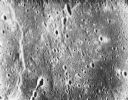
B-A-Mercury-PIA02961.jpgMercury, in HR57 visiteCaption NASA originale:"Taken only minutes after Mariner 10 made its closest approach to the planet Mercury on March 29, 1974, this is one of the highest resolution pictures obtained during the Mission. Craters as small as 150 mt (roughly 500 feet) across can be seen. The picture, taken from a distance of about 5900 Km (such as approx. 3700 miles), measures 50 by 40 Km (such as approx. 931 by 25 miles). The relativity level surface contrasts with the abundant relief seen in some close-up views on the opposite side of the planet. The long, narrow area of hills and scarps to the left resembles ridges in the mare of Earth's Moon. Abundant craters in various stages of degradation dot the surface".
|
|

B-B-Mercury-PIA02947.jpgIntercrater Plain near Caloris Basin57 visiteCaption NASA originale:"Intercrater Plains and heavily cratered terrain typical of much of Mercury outside the area affected by the formation of the Caloris Basin are shown in this image (FDS 166738) taken during the spacecraft's second encounter with Mercury. Abundant shallow elongate craters and crater chains are present on the intercrater plains.
North is to the top of this image, centered at 56° South, 128° West and measuring about 400 Km across".
Note: The Mariner 10 mission, managed by the Jet Propulsion Laboratory for NASA's Office of Space Science, explored Venus in February 1974 on the way to 3 encounters with Mercury (March and September 1974 and March 1975). The spacecraft took more than 7000 photos of Mercury, Venus, the Earth and the Moon.
|
|

Craters-PIA02429.jpgRayed Craters on Mercury57 visiteCaption NASA originale:"These two prominent rayed craters are located at 40° North and 124° West. Bright halos extend as far as 2 crater diameters beyond crater rims. Individual rays extend from halo. Bright streak extending from middle top to lower is unrelated to the two craters. Craters are 40 Km in diameter. This image (FDS 275) was taken during the spacecraft's first encounter with Mercury".
|
|
| 25353 immagini su 2113 pagina(e) |
 |
|
|
|
|
1576 | |
|
|
|
|





