| |
| Piú viste |

20000217b.jpgOver Eros' horizon (natural colors; credits: Lunexit)57 visiteThis incredible picture of Eros, taken on February 14, 2000, shows the view looking from one end of the asteroid across the gouge on its underside and toward the opposite end. In this mosaic, constructed from two images taken after the NEAR Spacecraft was inserted into orbit, features as small as 120 feet (35 meters) across can be seen.
House-sized boulders are present in several places; one lies on the edge of the giant crater separating the two ends of the asteroid. A bright patch is visible on the asteroid in the top left-hand part of this image, and shallow troughs can be see just below this patch.
The troughs run parallel to the asteroid's long dimension.
(Mosaic of images 0125971425, 0125971487)MareKromium
|
|

Titan-Channels-Unnamed_Channels-PIA10956.jpgXanadu's Channels (false colors; credits: Lunexit)57 visiteOn the final flyby of Cassini's original 4-year tour, its radar mapper captured these unusual channels on Titan at the edge of Xanadu, the widest seen in this area (For a radar image of Xanadu, see PIA08428). These might be active rivers carrying methane or debris, or they might be dry riverbeds similar to earthly "arroyos".
Past Cassini radar images have revealed different types of channels on Titan's surface (see PIA03565 and PIA07366). They vary from bright to dark in radar (rough to smooth), and from fan-shaped to braided to meandering.
Some, drain into lakes; others disappear. Some of these channels may be several hundred meters, or feet, deep.
This image, taken from the flyby on May 28, 2008, shows the border of Xanadu as the bright-dark boundary running from the upper left to lower right. Southward from that boundary is an unusual set of channels. While these are brighter (more roughly textured) than the surrounding terrain, some are only slightly brighter, and some are as wide as 5 Km (about 3 miles) — about the size of the River Thames at its mouth east of London.
They appear to flow out of the rough Region of Xanadu.
Careful inspection reveals smaller tributaries that wind through the brighter and apparently rougher terrain to the north. A close-up of one of the widest channels is shown at the lower left.
Scientists think that many of the channels on Titan are carved by methane deposited on the surface from strong but infrequent rainstorms. A bright channel may be dry, with the rough riverbed of icy particles (like those seen at the Huygens Landing Site) producing the radar brightness. The darker channels in this image resemble the dry lakes seen in the North Polar area of Titan, so they may be dry as well, with their smoother (radar-dark) surfaces caused by finer-grained sediment deposits on the channel floors.
This image shows an area located at 15° South Latitude and 121° West Longitude. It is about 450 Km (about 280 miles) across, and has approximately 1 Km (0,62-mile) resolution.
North is up.MareKromium
|
|

PHOE-SOL060-PIA11004.jpgPhoenix's Workspace - Sol 60 (True Colors; credits: NASA)57 visiteCaption NASA:"This image taken by NASA's PHoenix Mars Lander's Surface Stereo Imager shows the current trenches, labeled Dodo-Goldilocks and Snow White, and the areas identified for future digging, labeled Cupboard and Neverland".MareKromium
|
|
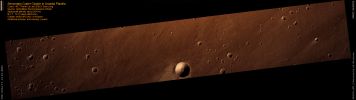
PSP_006271_2210_RED_abrowse.jpgPrimary and Secondary Craters in Arcadia Planitia (MULTISPECTRUM; credits: Lunexit)57 visiteThese unusual craters were spotted in Arcadia Planitia, which is part of an extensive region of Mars blanketed by a thick layer of bright dust.
Light southeasterly winds during southern spring and summer blow the dust towards the northwest (top left of the picture in the cutout above). The dust is trapped temporarily in the lee of crater rims, both inside the craters and along the outside rims where they form streamers that resemble St. Nick’s beard.
MareKromium
|
|

20000410.jpgDifferent Lights, Different Visions57 visiteDuring the 28 days the NEAR Shoemaker Spacecraft circled Eros in a 200-Km (such as approx. 124-mile) altitude orbit, it imaged parts of the surface under a variety of lighting and viewing conditions.
The different views of the surface allow study of small-scale morphology, analysis of albedo and color variations, and construction of topographic models from stereo images.
This image, taken April 2, 2000, from a range of 199 Km (about 123 miles), shows the effects of lighting changes. At the bottom of the frame, sunlight illuminates the surface at a grazing angle. The strong shadows bring out subtle landforms like the gentle undulations in the surface, visible at the lower center.
At the top of the frame, sunlight strikes the surface at a high angle and shadows become subdued, bringing out brightness variations like those on the wall of the large, 5,5-Km (3,4-mile) diameter crater at left.
(Image 0130112939)MareKromium
|
|
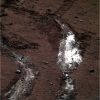
SOL1187-1.jpgRover Tracks, Colourful Dust and White Sulphates - Sol 1187 (True Colors; credits: Dr G. Barca)57 visitenessun commentoMareKromium
|
|
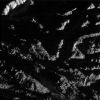
Enceladus-N00118361.jpgThe Unbelievable Surface of Enceladus, from ONLY 545 Km!57 visiteCaption NASA:"Caption NASA:"N00118365.jpg was taken on August 11, 2008 and received on Earth August 12, 2008. The camera was pointing toward ENCELADUS that, at the time, was approximately 545 Km away.
The image was taken using the CL1 and CL2 filters and it has not been validated or calibrated".
Note Lunexit: tutta la Regione ripresa pare essere - letteralmente - un "groviglio" di crepacci e di canali che si intersecano e che evidenziano, sulle loro estremità, l'esistenza di rilievi davvero singolari (alcuni a forma sferoidale, ed altri, molto irregolari, che ci ricordano i "rami contorti" di una sorta di foresta pietrificata). Comune a tutti i rilievi visibili è l'abedo: elevatissima (si tratta forse di grandi "blocchi di ghiaccio"? Probabilmente si).
Un numero elevato di boulders è chiaramente distinguibile sull'intera scena e, in particolare, sul versante illuminato del crepaccio situato nell'angolo superiore Sx del frame (un crepaccio che, a nostro parere, lascia altresì intuire - se si osserva con estrema attenzione - la presenza di "chiazzature" le quali possono ricordare i "seeps" Marziani).
Un grandissimo frame, reso ancora più straordinario dal fatto che il panorama ripreso giace a ridosso del Terminatore!MareKromium
|
|

Enceladus-W00048467.jpgThe Unbelievable Surface of Enceladus, from ONLY 545 Km: the bright (and icy) walls of a Canyon57 visiteCaption NASA:"W00048467.jpg was taken on August 11, 2008 and received on Earth August 12, 2008. The camera was pointing toward ENCELADUS that, at the time, was approximately 545 kilometers away.
The image was taken using the CL1 and CL2 filters and it has not been validated or calibrated". MareKromium
|
|
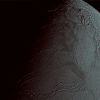
Enceladus-W00048468.jpgApproaching Enceladus (natural colors; credits: Lunexit)57 visiteCaption NASA:"W00048468.jpg was taken on August 11, 2008 and received on Earth August 12, 2008. The camera was pointing toward ENCELADUS that, at the time, was approximately 4748 kilometers away.
The image was taken using the CL1 and CL2 filters and it has not been validated or calibrated".MareKromium
|
|

SOL1198-1.jpgRover Tracks and Sulphates - Sol 1198 (True Colors; credits: Dr G. Barca)57 visitenessun commentoMareKromium
|
|

The_Rings-PIA10446.jpgIn the Sunlight... (natural colors; credits: NASA)57 visiteCaption NASA:"Saturn's icy Rings shine in scattered sunlight in this view, which looks toward the unilluminated northern side of the Rings from about 15° above the Ring-Plane. The Sun currently illuminates the Rings from the South. Some of the sunlight not reflected from the Rings' southern face is scattered through the countless particles, setting the Rings aglow. The inner F-Ring shepherd moon Prometheus (86 Km, or about 53 miles across at its widest point) appears at lower left.
Images taken using red, green and blue spectral filters were combined to create this natural color view. Bright clumps of material in the narrow F-Ring moved in their orbits between each of the color exposures, creating a chromatic misalignment in several places that provides some sense of the continuous motion within the Ring System.
The images were obtained with the Spacecraft wide-angle camera on July 4, 2008 at a distance of approx. 1,2 MKM (about 770.000 miles) from Saturn. The Phase Angle was 28°.
Image scale is roughly 70 Km per pixel".MareKromium
|
|

Enceladus-PIA11112.jpgThe (possible) True Colors of Enceladus (credits: Lunexit)57 visiteQuesta colorizzazione in possibili Colori Veri è la risposta ad un quesito postoci dal nostro Amico "Alby56", il quale ci domanda - appunto - quali sìano (possano essere) i colori di Encelado.
Come ovvio, una risposta che abbia valore assoluto non possiamo darla, però possiamo provare a ragionarci sopra e vedere che cosa si riesce a stabilire...Dunque:
1) Encelado, a quanto pare, è completamente ricoperto da uno (spesso) strato di ghiaccio d'acqua ed esso - per motivi ancora non noti, ma che potremmo rinvenire, ad esempio, in un "riscaldamento periodico" dell'intero globo causato da "frizionamento mareale" con Saturno, si rinnova, nel tempo, rimuovendo i segni classici che dimostrano l'invecchiamento di un Corpo Celeste (su tutti: i crateri da impatto, i quali vengono - letteralmente - "cancellati", se sono piccoli, oppure "riempiti e parzialmente nascosti", se di medio-grandi dimensioni);
2) il ghiaccio d'acqua, allorchè illuminato dal Sole, risplende di color bianco, con riflessi azzurri;
3) il Sole, visto da Encelado, dovrebbe apparire non molto più grande di una qualsiasi delle altre stelle visibili dalla sua superficie e questo ci spinge a ritenere che la sua capacità di illuminare questo piccolo mondo sia trascurabile;
4) su Encelado, non esistendo un'atmosfera e dunque non sussistendo le condizioni per la diffusione della luce solare (anche se ci è possibile ipotizzare una diffusione minima e meramente stagionale - grazie alle particelle di ghiaccio e di vapore acqueo che restano, per un certo tempo, in sospensione nello spazio circum-Enceladiano), riteniamo che il panorama visibile ad occhi umani risulti, globalmente, piuttosto buio.
Ma attenzione: potrebbe essere ragionevole ipotizzare una dominante bianca (provocata dal Sole e dal ghiaccio) durante il "Giorno" di Encelado - ed a cielo sgombro - oppure, allorchè Saturno splende nel cielo di Encelado in tutta la sua pienezza, si potrebbe ipotizzare, sempre per una visione "umana", un paesaggio illuminato da una colorazione dominante giallo-arancio, la quale - al suolo - potrebbe tradursi in un colorito giallo pallido dei rilievi maggiori, con riflessi bianchi, azzurri e, forse - in alcune zone - anche verdastri.
Conclusioni: da una certa distanza (supponiamo tra i 500 ed i 25000 Km), Encelado - ad occhi umani - dovrebbe apparire, allorchè illuminato congiuntamente dal Sole e da Saturno (come in questo frame), di color giallo pallido, con riflessi bianchi ed azzurri (e quindi, in alcune regioni ed in determinate ore del giorno, non è assurdo ipotizzare la visione/percezione di delicate sfumature di color grigio e rosa).
Oltre i 25000/30000 Km di distanza, infine, Encelado dovrebbe apparire, ad un Osservatore che lo scrutasse "ad occhio nudo", di color bianco brillante, con debolissime (diremmo quasi impercettibili) sfumature di colore giallo e rosa.MareKromium
|
|
| 25353 immagini su 2113 pagina(e) |
 |
|
|
|
|
1571 | |
|
|
|
|
|
|





