| Piú viste |
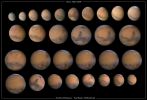
MARS-002.jpgMars in Time58 visiteCaption NASA, da "NASA - Picture of the Day" del 14 Luglio 2008:"Does Mars always appear the same? No.
As both Earth and Mars orbit the Sun, the apparent angular size of Mars changes as viewed from the Earth. Pictured above from Enschede, Holland, Mars was captured in 2007 and 2008 with 30 separate images, all taken with the same magnification.
When Earth and Mars are on opposite sides of the Sun, Mars appears relatively small. Conversely, when Earth and Mars are near each other, Mars looms large and bright. The largest Mars has appeared in recent history was the opposition of August 2003.
Since Mars is always more distant from the Earth from the Sun, Mars never shows a crescent phase to Earthlings. Visible also in the above images are the North Polar Cap of Mars, dark and light soil, clouds, and, in the early images, a Global Dust Storm.
The next opposition, when Earth again passes near to Mars, will occur in early 2010".MareKromium
|
|

SOL658-1~0.jpgSomething's wrong with that boulder... - Sol 658 (natural colors + MULTISPECTRUM; credits: Dr M. Faccin & Lunexit)58 visiteUna elaborazione ulteriore del frame relativo al "boulder impossibile", realizzata dal nostro Marco Faccin, ci lascia intuire meglio alcuni dettagli (la porzione sottile ed arcuata della pseudo-roccia potrebbe essere, in realtà, una mera componente della porzione Dx del macigno - Sx dell'Osservatore -, la cui configurazione ingannevole è determinata da un fenomeno di "schiacciamento" del panorama ripreso), ma non ci può dare risposte definitive.
Giudicate Voi stessi...MareKromium
|
|

OPP-SOL661-2.jpgOpportunity's perfectly CLEAN Solar Panels - Sol 661 (natural colors; credits: Dr G. Barca)58 visiteDue splendide elaborazioni del bravissimo Dr Gianluigi Barca che ci mostrano, mentre il Sole splende quasi a picco sulla Piana di Meridiani, i Pannelli Solari - splendidamente immacolati! - di Opportunity.
Tutto questo per riflettere - ancora una volta... - a proposito di quello che Marte, in accordo al nostro Lavoro, "è", in relazione a quello che Marte, invece ed in accordo al Lavoro NASA, "sembra".MareKromium
|
|

PSP_007493_2650_RED_abrowse~0.jpgNorth Polar Layered Deposits covered by Seasonal Frost (MULTISPECTRUM; credits: Lunexit)58 visiteThis image shows an exposure of the North Polar Layered Deposits (NPLD). The layering visible here might have been formed by recent climate variations on Mars, similar to ice ages on Earth.
While the Polar Layered Deposits are mostly water ice, exposures such as this are typically covered by a layer of reddish dust, protecting the underlying ice from evaporation during the Summer. This dusty layer hides the internal composition of the Polar Layered Deposits from view, but variations in the slopes of the surfaces of the layers are still visible.
The slope of each layer is probably affected by the internal composition, so the topography of exposures like this is of interest to scientists. When this image was taken (Northern Spring), the surface was mostly covered by seasonal CO2 frost.
This white frost layer helps to highlight the surface slopes because the visible brightness variations are mainly caused by topographic variations. Therefore, this image will be useful for photoclinometric, or "shape from shading" analyses that can yield topographic maps limited only by the resolution of the image.
MareKromium
|
|
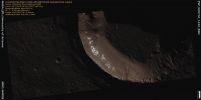
PSP_008792_1410_RED_abrowse.jpgLight-Toned Layers in Crater Wall (MULTISPECTRUM; credits: Lunexit)58 visiteThis approximately 8 Kilometer-diameter Impact Crater is interesting because of the light-toned band visible in the upper slopes of the Inner Crater Wall.
Because the light-toned materials are confined to a distinct elevation within the Crater, it is possible that it represents a well-defined Layer exposed in the Crater Walls.MareKromium
|
|
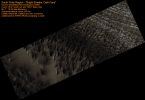
PIA10144-DarkFans~0.jpgBright Streaks and Dark Fans (MULTISPECTRUM; credits: Lunexit)58 visiteThe South Polar Region of Mars is covered every year by a layer of Carbon Dioxide (CO2) ice. In a Region called the "cryptic terrain", the ice is translucent and sunlight can penetrate through the ice to warm the surface below.
The ice layer sublimates (evaporates) from the bottom. The Dark Fans of dust seen in this image come from the surface below the layer of ice, carried to the top by gas venting from below. The translucent ice is "visible" by virtue of the effect it has on the tone of the surface below, which would otherwise have the same color and reflectivity as the Fans.
Bright streaks in this image are fresh frost. The CRISM team has identified the composition of these streaks to be Carbon Dioxide.
Nota Lunexit: questa è la surface feature che ha "stimolato" l'immaginazione di Joseph Skipper e Richard Hoagland. Secondo costoro, le "dark features" sarebbero alberi simili ai "pioppi" terrestri... Ogni ulteriore commento ci sembra davvero inutile.MareKromium
|
|

PIA10141-AraneiformTerrain~0.jpgAraneiform and Lace Terrains (MULTISPECTRUM; credits: Lunexit)58 visiteThe South Polar Terrain on Mars contains landforms unlike any that we see on Earth, so much that a new vocabulary is required to describe them. The word "araneiform" means "spider-like".
There are radially organized channels on Mars that look spider-like, but we don't want to confuse anyone by talking about "spiders" when we really mean "channels", not "bugs."
This picture shows an example of "connected araneiform topography", such as terrain that is filled with spider-like channels whose arms branch and connect to each other. Gas flows through these channels until it encounters a vent, where is escapes out to the atmosphere, carrying dust along with it. The dark dust is blown around by the prevailing wind.
This image also shows a different Region where the channels are not radially organized. In this Region they form a dense tangled network of tortuous strands. We refer to this as "lace". MareKromium
|
|
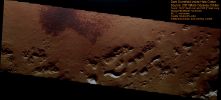
Craters-Hale_Crater-Dunes-20071210a-PCF-LXTT.jpgFeatures of Hale Crater (Darkened Absolute Natural Colors; credits for the additional process. and color: Dr Paolo C. Fienga - Lunexit Team)58 visitenessun commentoMareKromium
|
|
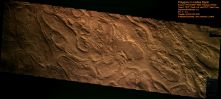
Polygons-Hellas_Basin-20080328a.jpgPolygons in Hellas Basin (Enhanced Natural Colors; credits for the additional process. and color.: Dr Paolo C. Fienga - Lunexit Team)58 visiteCaption NASA:"This interesting image shows a small portion of the Western Floor of Hellas Basin. The curved, broad ridges are separated by lower elevations filled with smaller, linear ridges". MareKromium
|
|

Aeolian_Features-Yardangs-20080104a-PCF-LXTT.jpgPeri-Equatorial Yardangs (MULTISPECTRUM; credits: Lunexit)58 visiteCaption NASA:"The power of the wind to reshape the surface is readily exposed in the Equatorial Region of Mars, South and East of Olympus Mons. The materials here have been sculpted and resculpted by thousands, if not hundreds of thousand, years of exposure to the wind". MareKromium
|
|
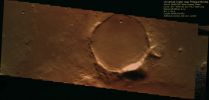
Craters-Unnamed_Crater-20080721a-PCF-LXTT.jpgUnnamed Crater near Phlegra Montes (Darkened and Enhanced Natural Colors; credits for the additional process. and color.: Dr Paolo C. Fienga - Lunexit Team)58 visitenessun commentoMareKromium
|
|
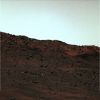
SOL716-1.jpgGusev's Skyline - Sol 716 (natural colors + MULTISPECTRUM; credits: Dr G. Barca & Lunexit)58 visitenessun commentoMareKromium
|
|
| 25353 immagini su 2113 pagina(e) |
 |
|
|
|
|
1569 | |
|
|
|
|





