| Piú viste |

OPP-SOL1055-1P221842215ESF7802P2564R3M1.jpgInteresting rock and spherules around Victoria Crater (2)57 visiteForma convenientemente smussata, caratteristiche superficiali tipicamente "non locali"; colore, "diverso" rispetto al resto del paesaggio.
Conclusione (interlocutoria): nuovo "meteorite" Marziano?!?
|
|

OPP-SOL1055-1P221842215ESF7802P2564L3M1.jpgInteresting rock and spherules around Victoria Crater (1)57 visiteForma convenientemente smussata, caratteristiche superficiali tipicamente "non locali"; colore, "diverso" rispetto al resto del paesaggio.
Conclusione (interlocutoria): nuovo "meteorite" Marziano?!?
|
|

McNaught-01.jpgComet McNaught (2)57 visiteCaption NASA:"The brightest comet in decades is unexpectedly now visible. The most optimistic predictions have Comet McNaught (C/2006 P1) shortly becoming one of the brightest comets of the past century. For the next few days, its short tail and bright coma can be spotted with the unaided eye close to the Sun and near the horizon in both evening and morning skies. This dramatic picture of the comet shining through cloudy skies was taken near sunset on January 7, 2007, from Bad Mergentheim, Germany".
|
|
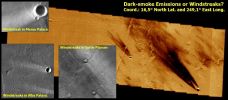
Aeolian_Features-Windstreaks-Comparison.jpgWindstreaks inside Becquerel Crater (CTX Frame: False Colors - insets: Original NASA/MGS/MSSS and NASA/JPL/ASU b/w Frames)57 visiteUn piccolo mosaico, tanto per evidenziare la notevole (sempre e solo a nostro avviso, naturalmente) diversità esistente fra alcuni Windstreaks.
Tanto per prevenire possibili malintesi, ribadiamo che il Windstreak, tecnicamente, è (o forse sarebbe meglio dire "dovrebbe essere") l'espressione visibile di un'area superficiale "protetta" da un rilievo la quale, di conseguenza ed a differenza delle aree ad essa latistanti, NON viene spazzata dal vento (diciamo che è "risparmiata").
Ma alcuni Windstreaks, a differenza di quanto detto qui di sopra, esprimono invece il risultato visibile di quanto il vento ha DIRETTAMENTE trasportato su una specifica area superficiale (il che vuol dire che essi non rappresentano un'area "coperta", bensì un'area "battuta").
Questa distinzione costituisce una mera "finezza/sottigliezza" interpretativa, forse? Secondo noi no. No perchè una cosa è guardare cosa accade ad un'area su cui il vento non arriva a battere direttamente (a causa della presenza di un ostacolo) ed un'altra osservare che cosa il vento ha trasportato su una certa superficie, battendo direttamente su di essa.
Osservate l'omogeneità iniziale del tre Windstreaks presenti nei frames in b/n (si tratta dunque di Windstreaks che evidentemente esprimono delle aree "protette") e la forma a "V" dei Windstreaks individuati nelle prossimità di Ascraeus (i quali, ora ed altrettanto evidentemente, esprimono aree "battute").
Le implicazioni derivanti da questa (sommaria, ma non insignificante) classificazione dei Windstreaks ci paiono talmente evidenti da non necessitare, in questa sede, di ulteriori spiegazioni.MareKromium
|
|

McNaught-07.jpgComet McNaught (8)57 visiteCaption NASA:"Comets grow bright when they're close to the Sun, basking in the intense solar radiation. Of course, they're also usually impossible to see against the overwhelming scattered Sunlight. But surprising Comet McNaught - whose January 12, 2007, closest approach to the Sun (perihelion passage) was well inside the orbit of Mercury - gave an enjoyable performance in bright blue daytime skies. In fact, comet expert David Levy captured this remarkable inset (upper left) telescopic view of McNaught within an hour of perihelion, with the comet in broad daylight only about 7° away from the Sun's position.
Stefan Seip's wider daytime view of the comet and fluffy clouds was recorded approximately a day later. Seip used a polarizing filter and a telescope/camera set up near Stuttgart, Germany.
No longer visible in broad daylight, Comet McNaught is now touring twilight Southern Skies".
|
|

McNaught-05.jpgComet McNaught (6)57 visiteCaption NASA:"After a remarkable performance in the Northern Hemisphere, the brightest comet in decades is now showing off in the South. Recorded during evening twilight on January 17, 2007, this view features the bright coma and gorgeous, sweeping tail of Comet McNaught (c/2006 P1) over Lake Horowhenua in Levin, a small town on New Zealand's North Island.
Astronomer Noel Munford reports that the five second long digital camera exposure comes close to capturing the visual appearance of the comet in a sky coloured by smoke from distant brush fires in Australia. Discovered last summer by R. H. McNaught (Siding Spring Survey), the comet grew impressively bright in early January and has even been sighted in full daylight.
In the coming days Comet McNaught will continue to move south, for now a spectacle in Southern Skies as it heads for the outer Solar System".
|
|

Rhea-N00075318.jpgRhea (natural colors)57 visitenessun commentoMareKromium
|
|

Saturn-PIA08858.jpgInfrared Saturn (elab. NASA)57 visiteCaption NASA:"This psychedelic view of Saturn and its Rings is a composite made from images taken with the Cassini spacecraft wide-angle camera using spectral filters sensitive to wavelengths of infrared light centered at 728, 752 and 890 nanometers.
Cassini acquired the view on Dec. 13, 2006 at a distance of approx. 822.000 Km(such as about 511.000 miles) from Saturn. Image scale is roughly 46 Km (approx. 28 miles) per pixel". MareKromium
|
|

McNaught-08.jpgComet McNaught (9)57 visiteCaption NASA originale:"Comet McNaught, the Great Comet of 2007, has grown a long and filamentary tail. The spectacular tail spreads across the sky and is visible to Southern Hemisphere observers just after sunset. The head of the comet remains quite bright and easily visible to even city observers without any optical aide. The amazing tail is visible on long exposures and even to the unaided eye from a dark location. Reports even have the tail visible just above the horizon after sunset for many Northern observers as well. Comet McNaught, estimated at magnitude - 2 (minus two), was caught by the comet's discoverer in the above image just after sunset last Friday from Siding Spring Observatory in Australia.
Comet McNaught, the brightest comet in decades, is now fading as it moves further into Southern Skies and away from the Sun and Earth".MareKromium
|
|

OPP-SOL1060-PIA09116.jpgGoing around Victoria...from MRO57 visiteCaption NASA originale:"Three years after embarking on a historic exploration of the red planet and six miles away from its landing site, NASA's Mars Exploration Rover Opportunity is traversing "Victoria Crater" ridge by ridge, peering at layered cliffs in the interior. To identify various alcoves and cliffs along the way, science team members are using names of places visited by the 16th-century Earth explorer Ferdinand Magellan and his crew aboard the ship Victoria, who proved the Earth is round. (All names are unofficial unless approved by the International Astronomical Union.)
This orbital view of "Victoria Crater" was taken by NASA's Mars Reconnaissance Orbiter".
|
|
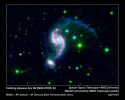
NGC-2535-PIA09106.jpgNGC 2535 and NGC 2536 (alias Arp 82)57 visiteA pair of interacting galaxies might be experiencing the galactic equivalent of a mid-life crisis. For some reason, the pair, called Arp 82, didn't make their stars early on as is typical of most galaxies. Instead, they got a second wind later in life -- about 2 billion years ago -- and started pumping out waves of new stars as if they were young again.
Arp 82 is an interacting pair of galaxies with a strong bridge and a long tail. NGC 2535 is the big galaxy and NGC 2536 is its smaller companion. The disk of the main galaxy looks like an eye, with a bright "pupil" in the center and oval-shaped "eyelids." Dramatic "beads on a string" features are visible as chains of evenly spaced star-formation complexes along the eyelids. These are presumably the result of large-scale gaseous shocks from a grazing encounter. The colors of this galaxy indicate that the observed stars are young to intermediate in age, around 2 million to 2 billion years old, much less than the age of the universe (13.7 billion years).
The puzzle is: why didn't Arp 82 form many stars earlier, like most galaxies of that mass range? Scientifically, it is an oddball and provides a relatively nearby lab for studying the age of intermediate-mass galaxies.
This picture is a composite captured by Spitzer's infrared array camera with light at wavelength 8 microns shown in red, NASA's Galaxy Evolution Explorer combined 1530 and 2310 Angstroms shown in blue, and the Southeastern Association for Research in Astronomy Observatory light at 6940 Angstroms shown in green.
|
|
Orion_s_Region.jpgOrion's Region57 visite"...For the Lord gives Wisdom; from His mouth come knowledge and understanding..."
- Proverbs 2:6
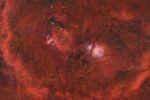
Caption NASA:"Cradled in glowing Hydrogen, stellar nurseries in Orion lie at the edge of a giant molecular cloud some 1500 Light-Years (LY) away. This breath-taking view spans about 13° across the center of the well-known constellation with the Great Orion Nebula, the closest large Star Forming Region, just right of center. The deep mosaic also includes (left of center), the Horsehead Nebula, the Flame Nebula, and Orion's Belt stars. Image data acquired with a Hydrogen Alpha filter adds other remarkable features to this wide angle cosmic vista -- pervasive tendrils of energized atomic hydrogen gas and portions of the surrounding Barnard's Loop.
While the Orion Nebula and belt stars are easy to see with the unaided eye, emission from the extensive interstellar gas is faint and much harder to record, even in telescopic views of the nebula-rich complex".
|
|
| 25353 immagini su 2113 pagina(e) |
 |
|
|
|
|
1568 | |
|
|
|
|





