| Piú viste |
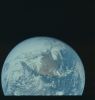
as16-118-18879.jpgAS 16-118-18879 - The Earth during Trans-Lunar Coast (USA and Mexico)57 visitenessun commentoMareKromium
|
|

OPP-SOL1437-1N255746064EDN8884P1585L0M1.jpgThe Inner Rim of Victoria and the dark&dusty Sky above - Sol 1437 (MULTISPECTRUM; credits: Lunexit)57 visitenessun commentoMareKromium
|
|
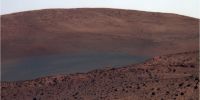
SOL1448-A_P2436_1_False_L257_pos_2.jpgView from Spirit's Overwintering Position (False Color; credits: NASA/JPL-Caltech/Cornell University)57 visiteCaption NASA:"NASA's Mars Exploration Rover Spirit has this view northward from the position at the north edge of the "Home Plate" plateau where the Rover will spend its third Martian Winter.
Husband Hill is on the horizon. The dark area in the middle distance is "El Dorado" sand dune field.
Spirit used its Panoramic Camera (PanCam) to capture this image during the Rover's 1448th Martian day, of Sol (Jan. 29, 2008).
This view combines separate images taken through the PanCam filters centered on wavelengths of 753, 535 and 432 nanometers.
It is presented in a false-color stretch to bring out subtle color differences in the scene".MareKromium
|
|
OPP-SOL1443-1N256291340EFF88AFP1977L0M1.jpgLooking "Down"... - Sol 1443 (2 - MULTISPECTRUM; credits: Lunexit)57 visitenessun commentoMareKromium
|
|

as16-113-18310.jpgAS 16-113-18310 - Orion's Shadow57 visiteCaption NASA:"Charlie (Duke) aimed the camera down to get this picture of the surface under his window".MareKromium
|
|

APOLLO_16_LS-MAP.jpgAS 16-114-18427 - The Map: where's Plum Crater?57 visiteI legittimi interrogativi suscitati dal "riflesso" nel Visore di Charlie Duke, uniti alle possibili chiavi di lettura del fenomeno, ci hanno spinto a fare questo piccolo passo in avanti sulla strada della migliore interpretazione di quanto proposto dai frames originali e non compressi (e dunque i frames "più vicini" alla Realtà dell'Esplorazione Lunare realizzata durante gli Apollo Days).
E la strada è stata (relativamente) semplice, partendo dalla domanda originale: i riflessi color oro e fucsia possono derivare dal Lunar Module?
Risposta: no.
No perchè Plum Crater (la zona che Young e Duke stanno visitando ora) è a circa 800 metri di distanza dal Landing Site di Orion (il Lunar Module).
Dunque scartiamo il LM.
Potrebbe trattarsi dei riflessi del Lunar Rover, quindi?
Risposta: no.
No perchè il Lunar Rover è parcheggiato a circa 70/80 metri dalla posizione attuale di Charlie Duke e del Com.te Young.
Forse anche qualcosa in più (su questo dato non possiamo essere certi al 100%).
Settanta/ottanta metri (o più) che, tradotti in "soldoni", significano che il LR (viste anche le sue modestissime dimensioni - specie in rapporto al LM) non può essere "catturato" dal visore di Duke.
E allora? E allora ritorniamo al punto di partenza: che cosa può essere quel riflesso?
Grazie a tutti coloro che ci hanno già aiutato e che vorranno ancora aiutarci in questa ricerca!MareKromium
|
|

Once_upon_a_Time.jpgOnce Upon A Time... (by Roberto Tremolada)57 visite"...Fortuna immoderata est: in bono, atque in malo..."
(Laberio)
"...La Buona Sorte (al pari della Cattiva Sorte) non conosce misura: nè nel bene, nè nel male..."MareKromium
|
|

as08-14-2450.JPGAS 08-14-2450 - Tsiolkovsky57 visiteImage Collection: 70mm Hasselblad
Mission: 8
Magazine: 14
Magazine Letter: B
Latitude: approx. 21° South
Longitude: approx. 128° East
Lens Focal Length: 250 mm
Description: Tsiolkovsky Crater (FARSIDE)
Film Type: SO-368
Film Width: 70 mm
Film Color: colorMareKromium
|
|
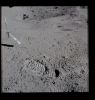
as15-86-11642.jpgAS 15-86-11642 - Gnomon & Bootprint (2)57 visiteCaption NASA:"Dave (Scott) stepped to his right to get this stereo companion to 11641".MareKromium
|
|

PSP_006891_1970_RED_abrowse-01.jpgAt the base of the Olympus... (EDM - Saturated Natural Colors; credits for the additional process. and color.: Dr Paolo C. Fienga - Lunexit Team)57 visiteThe bottom right part of the cutout has a much flatter and smoother surface. These are younger lava flows that have buried the lower part of the volcano. When lava flows form vast smooth sheets, they are called "flood" lavas.
In the bottom of the cutout, the flood lavas have odd, wiggly looking plateaus. These are parts of the lava crust that were lifted up when more liquid lava was injected into the middle of the slowly solidifying lava flow.
This process is called "inflation" and is seen on many lava flows on Earth. These younger lava flows are cut by two different sets of faults. One makes the branching valley in the flood lavas and the other creates the sinuous ridge and valley along the edge of the Olympus Mons lava flows.
Lower resolution images that cover a broader area suggest that the sinuous fault is an old buried structure that has been more recently reactivated.MareKromium
|
|
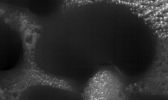
PSP_006952_1870_RED_abrowse-01.jpgDunefield in West Arabia Terra Unnamed Crater (extra-detail mgnf - RAW Frame; credits: NASA/JPL/Univ. of Arizona)57 visiteBarchan dunes are commonly found on Earth, and are generally crescent-shaped with a steep slip face bordered by horns oriented in the downwind direction (see here).
Barchan dunes form by unidirectional winds and are good indicators of the dominant wind direction. In this case, the strongest winds blew approximately North to South.
These dunes are most likely composed of basaltic sand that has collected on the bottom of the crater. Superimposed on their surface are smaller secondary dunes which are commonly seen on terrestrial dunes of this size.
Many smaller and brighter bed forms — most likely small dunes or granule ripples — also cover the substrate between the larger dark dunes.
The dark dunes overlie the small bright bed forms indicating that the darker dunes formed more recently.MareKromium
|
|

Venus-South_Pole-02.jpgThe South Pole of Venus (Natural Colors; credits for the additional process. and color.: Dr Paolo C. Fienga - Lunexit Team)57 visitenessun commentoMareKromium
|
|
| 25353 immagini su 2113 pagina(e) |
 |
|
|
|
|
1562 | |
|
|
|
|





