| Piú viste |
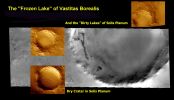
Martian_Lakes_in_Vastitas_Borealis_and_Solis_Planum.jpgWet Craters and Dry Craters: a Visual Comparison57 visitenessun commento
|
|

Collinder-399.jpgThe "Asterism" known as "Collinder 399"57 visite"...Volgarità...Tu pensi che la Volgarità esista in una "parolaccia", o in un gesto - in sè - volgare, o magari in un vestito, in un modo di truccarsi; o forse in un atteggiamento od in una azione i quali, viste le circostanze di luogo e di tempo in cui hanno luogo, sono qualificabili come "volgari".
Si, certo, questa può essere Volgarità. Anche questa è Volgarità.
Ma se mi chiedi che cosa io ritengo essere volgare, allora ti dico che, a mio parere, sono volgari ed offensive del Pudore, dell'Onestà Intellettuale, del Buon Senso, della Giustizia e di quant'altro è ancora considerabile come "Sacro", tutte le parole che vengono proferite dai Capi di Stato in occasione degli Auguri di fine anno, come in occasione del verificarsi di calamità, di crimini efferati, di ingiustizie e di funerali di stato; sono volgari le dichiarazioni sulle piaghe del mondo, dalla fame alla guerra civile, le quali - umide di lacrime di coccodrillo - arrivano da professionisti del jet-set, da attori, da atleti, o da personaggi dello spettacolo che, nel corso della loro vita da privilegiati oltre ragione ed oltre misura, ritengono di avere il diritto di dire le loro squallide ovvietà su un mondo che vedono solo in televisione oppure quando, protetti, serviti e riveriti, visitano gli zoo umani del Terzo Mondo. (...)
La vera e l'unica - autentica - Volgarità che puoi ormai trovare in ogni angolo di questa Terra, Amico mio, è nella menzogna.
Nell'ipocrisia.
Nella negazione della Verità.
La Volgarità è la sconfitta della Ragione..."
P.C. Floegers - "Conversations for Tomorrow"
|
|

OPP-SOL1055-1P221848961EFF78AZP2449L2M1.jpgVictoria's Panorama (4) - Sol 105557 visitenessun commento
|
|

OPP-SOL1055-1N221847636EFF78AZP0645R0M1.jpgVictoria's Panorama (2) - Sol 105557 visitenessun commento
|
|

OPP-SOL1055-1P221842215ESF7802P2564R3M1.jpgInteresting rock and spherules around Victoria Crater (2)57 visiteForma convenientemente smussata, caratteristiche superficiali tipicamente "non locali"; colore, "diverso" rispetto al resto del paesaggio.
Conclusione (interlocutoria): nuovo "meteorite" Marziano?!?
|
|

OPP-SOL1055-1P221842215ESF7802P2564L3M1.jpgInteresting rock and spherules around Victoria Crater (1)57 visiteForma convenientemente smussata, caratteristiche superficiali tipicamente "non locali"; colore, "diverso" rispetto al resto del paesaggio.
Conclusione (interlocutoria): nuovo "meteorite" Marziano?!?
|
|

McNaught-01.jpgComet McNaught (2)57 visiteCaption NASA:"The brightest comet in decades is unexpectedly now visible. The most optimistic predictions have Comet McNaught (C/2006 P1) shortly becoming one of the brightest comets of the past century. For the next few days, its short tail and bright coma can be spotted with the unaided eye close to the Sun and near the horizon in both evening and morning skies. This dramatic picture of the comet shining through cloudy skies was taken near sunset on January 7, 2007, from Bad Mergentheim, Germany".
|
|
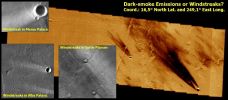
Aeolian_Features-Windstreaks-Comparison.jpgWindstreaks inside Becquerel Crater (CTX Frame: False Colors - insets: Original NASA/MGS/MSSS and NASA/JPL/ASU b/w Frames)57 visiteUn piccolo mosaico, tanto per evidenziare la notevole (sempre e solo a nostro avviso, naturalmente) diversità esistente fra alcuni Windstreaks.
Tanto per prevenire possibili malintesi, ribadiamo che il Windstreak, tecnicamente, è (o forse sarebbe meglio dire "dovrebbe essere") l'espressione visibile di un'area superficiale "protetta" da un rilievo la quale, di conseguenza ed a differenza delle aree ad essa latistanti, NON viene spazzata dal vento (diciamo che è "risparmiata").
Ma alcuni Windstreaks, a differenza di quanto detto qui di sopra, esprimono invece il risultato visibile di quanto il vento ha DIRETTAMENTE trasportato su una specifica area superficiale (il che vuol dire che essi non rappresentano un'area "coperta", bensì un'area "battuta").
Questa distinzione costituisce una mera "finezza/sottigliezza" interpretativa, forse? Secondo noi no. No perchè una cosa è guardare cosa accade ad un'area su cui il vento non arriva a battere direttamente (a causa della presenza di un ostacolo) ed un'altra osservare che cosa il vento ha trasportato su una certa superficie, battendo direttamente su di essa.
Osservate l'omogeneità iniziale del tre Windstreaks presenti nei frames in b/n (si tratta dunque di Windstreaks che evidentemente esprimono delle aree "protette") e la forma a "V" dei Windstreaks individuati nelle prossimità di Ascraeus (i quali, ora ed altrettanto evidentemente, esprimono aree "battute").
Le implicazioni derivanti da questa (sommaria, ma non insignificante) classificazione dei Windstreaks ci paiono talmente evidenti da non necessitare, in questa sede, di ulteriori spiegazioni.MareKromium
|
|

McNaught-07.jpgComet McNaught (8)57 visiteCaption NASA:"Comets grow bright when they're close to the Sun, basking in the intense solar radiation. Of course, they're also usually impossible to see against the overwhelming scattered Sunlight. But surprising Comet McNaught - whose January 12, 2007, closest approach to the Sun (perihelion passage) was well inside the orbit of Mercury - gave an enjoyable performance in bright blue daytime skies. In fact, comet expert David Levy captured this remarkable inset (upper left) telescopic view of McNaught within an hour of perihelion, with the comet in broad daylight only about 7° away from the Sun's position.
Stefan Seip's wider daytime view of the comet and fluffy clouds was recorded approximately a day later. Seip used a polarizing filter and a telescope/camera set up near Stuttgart, Germany.
No longer visible in broad daylight, Comet McNaught is now touring twilight Southern Skies".
|
|

McNaught-05.jpgComet McNaught (6)57 visiteCaption NASA:"After a remarkable performance in the Northern Hemisphere, the brightest comet in decades is now showing off in the South. Recorded during evening twilight on January 17, 2007, this view features the bright coma and gorgeous, sweeping tail of Comet McNaught (c/2006 P1) over Lake Horowhenua in Levin, a small town on New Zealand's North Island.
Astronomer Noel Munford reports that the five second long digital camera exposure comes close to capturing the visual appearance of the comet in a sky coloured by smoke from distant brush fires in Australia. Discovered last summer by R. H. McNaught (Siding Spring Survey), the comet grew impressively bright in early January and has even been sighted in full daylight.
In the coming days Comet McNaught will continue to move south, for now a spectacle in Southern Skies as it heads for the outer Solar System".
|
|

Rhea-N00075318.jpgRhea (natural colors)57 visitenessun commentoMareKromium
|
|

Saturn-PIA08858.jpgInfrared Saturn (elab. NASA)57 visiteCaption NASA:"This psychedelic view of Saturn and its Rings is a composite made from images taken with the Cassini spacecraft wide-angle camera using spectral filters sensitive to wavelengths of infrared light centered at 728, 752 and 890 nanometers.
Cassini acquired the view on Dec. 13, 2006 at a distance of approx. 822.000 Km(such as about 511.000 miles) from Saturn. Image scale is roughly 46 Km (approx. 28 miles) per pixel". MareKromium
|
|
| 25353 immagini su 2113 pagina(e) |
 |
|
|
|
|
1561 | |
|
|
|
|





