| Piú viste |
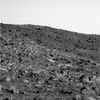
SOL519-2P172446295EFFABAKP2291L2M1.jpgRocks, boulders and dust on the way to the Summit (6) - Sol 51957 visitenessun commento
|
|

Terra_Meridiani-E0200373-00.jpgBizarre-looking Features in Terra Meridiani (Original NASA/MGS/MSSS b/w M0705535 CTX Frame)57 visiteUn'altra immagine spettacolare e difficilissima da interpretare. In questo primo frame, che riprende un'ampia area all'interno della Regione di Terra Meridiani, la curiosità è data dalla forma anomala e dall'elevata albedo di un modesto dettaglio - situato nella parte alta dell'immagine, poco al di sopra di un cratere piuttosto grande e scuro - il quale sembra essere, a prima vista, un 'grappolo di crateri ravvicinati' (un Crater Cluster dunque) posizionati in maniera tale da far assomigliare il rilievo in questione ad una sorta di 'lisca'.
|
|
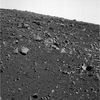
SOL523-2P172798615EFFABGZP2437L7M1.jpgLooking around on Sol 523 (5)57 visitenessun commento
|
|
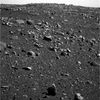
SOL523-2P172799154EFFABGZP2437R1M1.jpgLooking around on Sol 523 (8)57 visitenessun commento
|
|
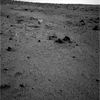
SOL524-2N172890513EFFAC00P0715R0M1.jpgPanorama - Sol 524 (2)57 visiteE' molto interessante notare, in questi frames panoramici, la presenza, ad una modesta distanza dal Rover (25/30 mt), di grossi macigni di color chiaro, la cui morfologia (e, supponiamo, composizione) sembra essere molto diversa da quella della maggior parte delle rocce che abbiamo visto sino ad ora.
Anche gli outcrops (in questo frame ne vediamo uno molto interessante che ci ricorda - vagamente - un altro outcrop che avevamo chiamato "The Nest") sembrano avere una colorazione ed una morfologia diverse, a mano a mano che ci avviamo al summit di Husband Hill.
Potrebbe trattarsi di una circostanza curiosa e scientificamente difficile da spiegare e giustificare, siamo tuttavia perfettamente consapevoli del fatto che queste - apparenti - diversità potrebbero essere il frutto di semplici illusioni ottiche determinate, come al solito, dal cambio dei filtri/colore utilizzati.
|
|

Pandora-PIA07530.jpgPandora: the closest view so far!57 visiteCaption NASA originale:"This is one of Cassini's closest views to date of Saturn's F-Ring shepherd moon Pandora. At least one crater is visible on the surface of this moon, which is thought to be an icy rubble pile, loosely bound together by gravity. Pandora is 84 Km across.
Several of Saturn's Ring moons, including Pandora, show elongated, oval-like shapes with their long axes oriented along the moon-Saturn line. In this view, Cassini is looking at the side of Pandora facing away from Saturn. The image shows the moon's leading hemisphere (although, as mentioned, Pandora is not actually round). To the right, much of the moon's surface is in shadow. The image was taken in visible light with the Cassini spacecraft narrow-angle camera on May 20, 2005, at a distance of approx. 346.000 Km from Pandora and at a Sun-Pandora-spacecraft, or phase, angle of 21°".
|
|

Epimetheus-PIA07531.jpgEpimetheus57 visiteCaption NASA originale:"Cassini continues to survey the small worlds that orbit near Saturn's Rings, capturing this view of Epimetheus.
The moon's lumpy, irregular topography can be seen here, along with several impact craters. The image was taken in visible light with the Cassini spacecraft narrow-angle camera on May 20, 2005, at a distance of about 345.000 Km from Epimetheus and at a phase angle of 26°.
Resolution in the original image was 2 Km per pixel.
The view was also magnified by a factor of two and contrast-enhanced to aid visibility of the moon's surface".
|
|
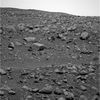
SOL529-2P173328962EFFACAQP2442R1M1.jpgThe rocks and boulders around Spirit (7) - Sol 52957 visitenessun commento
|
|
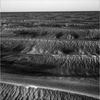
OPP-SOL512-1P173638000EFF55XKP2430R2M1.jpgThe Side-Winders ahead (2) - Sol 51257 visitenessun commento
|
|

Titan-IR-PIA07542.jpgInfrared Titan (from approx. 1,2 MKM)57 visiteCaption NASA originale:"Southeast of Xanadu (and above the center in this view) is a peculiar semi-circular feature informally referred to by imaging scientists as "The Smile". This surface feature is the brightest spot on Titan's surface, not only to the Imaging Science Subsystem Cameras, but also to the Visual and Infrared Mapping Spectrometer (VIMS), which sees the surface at even longer wavelengths. "The Smile" is about 560 Km (345 miles) wide.
At the landing site of the successful Huygens probe mission, brighter regions correspond to icy upland areas, while the darker regions are lowlands that possess a higher proportion of the organic byproducts of Titan's atmospheric photochemistry. Those results seem to confirm the long-standing hypothesis that Xanadu is a relatively high region of less contaminated ice. However, the cause of the even brighter Smile is a mystery that is still under study. Farther South, a field of bright clouds arcs around the Pole, moving at a few meters per second".
|
|

Enceladus-N00037000.jpgEnceladus fly-by (9) - from approx. 38.000 Km57 visitenessun commento
|
|

Enceladus-N00037015.jpgEnceladus fly-by (12) - from approx. 29.000 Km57 visitenessun commento
|
|
| 25353 immagini su 2113 pagina(e) |
 |
|
|
|
|
1560 | |
|
|
|
|





