| Piú viste |

McNaught-08.jpgComet McNaught (9)57 visiteCaption NASA originale:"Comet McNaught, the Great Comet of 2007, has grown a long and filamentary tail. The spectacular tail spreads across the sky and is visible to Southern Hemisphere observers just after sunset. The head of the comet remains quite bright and easily visible to even city observers without any optical aide. The amazing tail is visible on long exposures and even to the unaided eye from a dark location. Reports even have the tail visible just above the horizon after sunset for many Northern observers as well. Comet McNaught, estimated at magnitude - 2 (minus two), was caught by the comet's discoverer in the above image just after sunset last Friday from Siding Spring Observatory in Australia.
Comet McNaught, the brightest comet in decades, is now fading as it moves further into Southern Skies and away from the Sun and Earth".MareKromium
|
|

OPP-SOL1060-PIA09116.jpgGoing around Victoria...from MRO57 visiteCaption NASA originale:"Three years after embarking on a historic exploration of the red planet and six miles away from its landing site, NASA's Mars Exploration Rover Opportunity is traversing "Victoria Crater" ridge by ridge, peering at layered cliffs in the interior. To identify various alcoves and cliffs along the way, science team members are using names of places visited by the 16th-century Earth explorer Ferdinand Magellan and his crew aboard the ship Victoria, who proved the Earth is round. (All names are unofficial unless approved by the International Astronomical Union.)
This orbital view of "Victoria Crater" was taken by NASA's Mars Reconnaissance Orbiter".
|
|
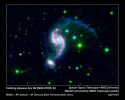
NGC-2535-PIA09106.jpgNGC 2535 and NGC 2536 (alias Arp 82)57 visiteA pair of interacting galaxies might be experiencing the galactic equivalent of a mid-life crisis. For some reason, the pair, called Arp 82, didn't make their stars early on as is typical of most galaxies. Instead, they got a second wind later in life -- about 2 billion years ago -- and started pumping out waves of new stars as if they were young again.
Arp 82 is an interacting pair of galaxies with a strong bridge and a long tail. NGC 2535 is the big galaxy and NGC 2536 is its smaller companion. The disk of the main galaxy looks like an eye, with a bright "pupil" in the center and oval-shaped "eyelids." Dramatic "beads on a string" features are visible as chains of evenly spaced star-formation complexes along the eyelids. These are presumably the result of large-scale gaseous shocks from a grazing encounter. The colors of this galaxy indicate that the observed stars are young to intermediate in age, around 2 million to 2 billion years old, much less than the age of the universe (13.7 billion years).
The puzzle is: why didn't Arp 82 form many stars earlier, like most galaxies of that mass range? Scientifically, it is an oddball and provides a relatively nearby lab for studying the age of intermediate-mass galaxies.
This picture is a composite captured by Spitzer's infrared array camera with light at wavelength 8 microns shown in red, NASA's Galaxy Evolution Explorer combined 1530 and 2310 Angstroms shown in blue, and the Southeastern Association for Research in Astronomy Observatory light at 6940 Angstroms shown in green.
|
|
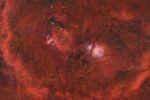
Orion_s_Region.jpgOrion's Region57 visite"...For the Lord gives Wisdom; from His mouth come knowledge and understanding..."
- Proverbs 2:6
Caption NASA:"Cradled in glowing Hydrogen, stellar nurseries in Orion lie at the edge of a giant molecular cloud some 1500 Light-Years (LY) away. This breath-taking view spans about 13° across the center of the well-known constellation with the Great Orion Nebula, the closest large Star Forming Region, just right of center. The deep mosaic also includes (left of center), the Horsehead Nebula, the Flame Nebula, and Orion's Belt stars. Image data acquired with a Hydrogen Alpha filter adds other remarkable features to this wide angle cosmic vista -- pervasive tendrils of energized atomic hydrogen gas and portions of the surrounding Barnard's Loop.
While the Orion Nebula and belt stars are easy to see with the unaided eye, emission from the extensive interstellar gas is faint and much harder to record, even in telescopic views of the nebula-rich complex".
|
|

Saturn-PIA08864.jpgTurbulences... (False Colors; credits: Lunexit)57 visiteCaption NASA:"The Cassini spacecraft captures the ripples, loops and storms that swirl in Saturn's East-West flowing cloud bands.
The image was taken with the Cassini spacecraft wide-angle camera using a spectral filter sensitive to wavelengths of infrared light centered at 728 nanometers. The view was obtained on Dec. 13, 2006 at a distance of approx. 775.000 Km (about 482.000 miles) from Saturn. Image scale is roughly 43 Km (about 27 miles) per pixel".
|
|
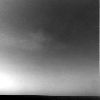
OPP-SOL956-PIA09170-1.gifClouds over Meridiani - Sol 956 (GIF-Movie)57 visiteNASA's MER Opportunity captured a view of wispy afternoon clouds, not unlike fair weather clouds on Earth, passing overhead on the Rover's 956th Sol (such as Oct. 2, 2006). With Opportunity facing North-East, the clouds appear to drift gently toward the West in this movie taken with the Rover's NavCam.
The 10 frames, taken 32" apart, show the formation and evolution of what are likely mid-level, convective water clouds. Such clouds are common near Mars' Equator at this time of the Martian year. They have been observed by both of NASA's MER, by satellites orbiting Mars and by the HST. In this case, the clouds appear to develop at a fixed location, in the center of the frame about 25° above the horizon. This style of origin suggests that a thermal plume is rising over a surface feature. In spite of apparent winds aloft, the thermal plume appears to remain stationary for the whole duration of the movie.
Though scientists have determined from the images that the wind bearing is East/North-East, approximately 80°, it is not possible on the basis of the movie to unambiguously determine the height and speed of the clouds. Scientists estimate, based on models of atmospheric wind profiles and the apparent displacement of the clouds, that all of the clouds in the movie are at about the same height somewhere between 5 and 25 Km (about 3 to 20 miles) above the surface. The clouds are estimated to be moving at 2,5 mt per second, if they are low, to 12,5 mt per second, if they are high (8 to 41 feet per second).
|
|

OPP-SOL1065-1P222748165EFF78ESP2666R1M1.jpgHorizon (2) - Sol 106557 visitenessun commento
|
|

McNaught-9.jpgComet McNaught (10)57 visiteCaption NASA:"By January 19/20, 2007, Comet McNaught's magnificent dust tail stretched for about 150 MKM (~1 AU), requiring images from both Southern and Northern Hemispheres of planet Earth to take it all in. Two such views - from Cerro Paranal in Chile (left) and the Carnic Alps in Italy - are combined in this unique graphic that also outlines a perspective view of the Comet's orbit (dotted line) and relative position of the Sun. Driven by solar radiation pressure the dust tail initially points away from the Sun, but also trails outside the comet's orbit. Astronomers try to account for the complex structure along the tail, including the pronounced striations, by considering forces acting on the dust (e.g. gravity, solar wind and radiation) as well as the release time and size of the dust grains. In the diagram, the modeled location of dust grains released at approximately the same time relative to perihelion passage, synchrones, are shown as dashed lines. The location of grains of similar size, syndynes, are shown as solid lines".
|
|

OPP-SOL1062-1P222466688EFF78DYP2664L4M1-02.jpgThe "Twin-Peaks" of Meridiani Planum during a foggy Sol (2 - detail mgnf)57 visitenessun commento
|
|

OPP-SOL1062-1P222466688EFF78DYP2664L4M1-01.jpgThe "Twin-Peaks" of Meridiani Planum during a foggy Sol (1 - context image)57 visitenessun commento
|
|

Titan-PIA08868.jpgTitanian "Bands"57 visiteCaption NASA:"Titan bears a distinct East-West banded pattern in this Cassini spacecraft image taken in the ultraviolet.
The ultraviolet wavelength allows Cassini to see Titan's stratosphere, where superrotation -- in which the atmosphere moves around the moon faster than Titan rotates -- is strong. The recent appearance of this feature may be a harbinger of seasonal change on Titan.
The moon's halo -- its detached, high-altitude global haze layer -- is visible here as well, and is often its most prominent feature in such ultraviolet views. North on Titan is up and rotated 6° to the right in this image.
The view was obtained by the Cassini spacecraft narrow-angle camera using a spectral filter sensitive to wavelengths of polarized ultraviolet light.
The view was acquired on Dec. 25, 2006 at a distance of approx. 1,3 MKM (about 800.000 miles) from Titan and at a Sun-Titan-spacecraft, or phase, angle of 123°.
Image scale is roughly 8 Km per pixel".
|
|

as10-29-4254.jpgAS 10-29-4254 - What's at the bottom?!?57 visitenessun commento
|
|
| 25353 immagini su 2113 pagina(e) |
 |
|
|
|
|
1558 | |
|
|
|
|





