| Piú viste |

PSP_005346_1755_RED_abrowse-01.jpgLow-Order Inverted Streams near Juventae Chasma (extra-detail mgnf)57 visiteThis subimage (approx. 1120 meters across) shows a juncture of 2 of the "Inverted Channels".
It is likely that the water flowed from the left to the right of the scene, because channels usually join rather than divert unless there is an obvious obstacle in the way.
No such obstacle is seen here, but one might have been present when the stream originally flowed.
However, there is no way of knowing this.MareKromium
|
|

PSP_005346_1755_RED_abrowse-00.jpgLow-Order Inverted Streams near Juventae Chasma (context frame - elab. Lunexit)57 visiteThis image shows plains North-West of Juventae Chasma, one of the Martian canyons that are part of the equatorial Valles Marineris System. The two most noticeable features in this scene are craters on mesas (plateaux) and raised, winding ridges. The raised ridges are "Inverted Channels". It is likely that liquid water, either pure or salt water, flowed through these channels. The channels are raised because streams transport sediment as they flow, deposit the heavier sediment on the stream floor, and, eventually fill in once their water supply dwindles. Over time, wind erosion modifies a landscape, and this has played an important role on these plains. It eroded the land around the channels leaving the remnant channels exposed and standing high. The channels did not erode as much since they were more resistant, possibly because the deposited sediment had cemented together.
The craters on mesas are also evidence of active wind erosion: when craters form, they eject material out onto the surrounding landscape.
It appears that several of the craters’ ejecta visible here cemented, making the ejecta more resistant to erosion and leaving them standing high as craters on plateaux.MareKromium
|
|

LLO-Itokawa-ST_2539423137_v.jpgThe unbelievable surface of 25143-Itokawa (HR3 - possible natural colors; elab. Lunexit)57 visitenessun commentoMareKromium
|
|

Comets-Comet_Holmes-TView.jpgTelescopic View of the Comet Holmes57 visiteCaption NASA, da "NASA - Picture of the Day" del 29 Ottobre 2007:"What's happened to Comet Holmes? A normally docile comet discovered over 100 years ago, Comet 17P/Holmes suddenly became nearly one million times brighter last week, possibly over just a few hours. In astronomical terms, the comet brightened from magnitude 17, only visible through a good telescope, to magnitude 3, becoming visible with the unaided eye. Comet Holmes had already passed its closest to the Sun in 2007 May outside the orbit of Mars and was heading back out near Jupiter's orbit when the outburst occurred. The comet's sudden brightening is likely due to some sort of sunlight-reflecting outgassing event, possibly related to ice melting over a gas-filled cavern, or possibly even a partial breakup of the comet's nucleus. Pictured above through a small telescope, Comet Holmes appeared as a fuzzy yellow spot, significantly larger in angular size than Earth-atmosphere blurred distant stars. Although Comet Holmes' orbit will place it in northern hemisphere skies for the next two years, whether it will best be viewed through a telescope or sunglasses remains unknown".MareKromium
|
|
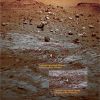
SOL1352-2P246395581EFFAVPBP2407R1M1-3.jpgExtremely "High-Albedo" Surface Feature (possible Surface Anomaly; comparison ctx-fr 1 and 2)57 visiteShift Prospettico? O il dettaglio si è "mosso"?
E se fosse davvero una "lamina sottile"? Un qualcosa di leggero che "rotola", spinto dal vento...MareKromium
|
|

ISD_highres_AS13_AS13-62-8898.jpgAS 13-62-8898 - Reflections?57 visiteCaption L&PI:"Small narrow Red Bar; probably part of interior of the Spacecraft".
MareKromium
|
|

ISD_highres_AS13_AS13-62-8895-1.jpgAS 13-62-8895 (1) - Space debris?57 visiteUn nuovo frame relativo alla sfortunata (ma comunque gloriosa) Missione "Apollo 13" ed un nuovo (piccolo) "mistero.
Il frame è stato - ancora una volta - individuato dal bravissimo Dr Gianluigi Barca il quale ci ha suggerito di prestare attenzione al dettaglio che si vede in basso, sulla Dx del frame: di che si tratta?
Il L&PI non si esprime al riguardo e si limita a rilasciare questa caption:"FAINT IMAGE OF MOON CRESCENT". Immagine che ritrae una debole falce di Luna.
Ok, perfetto.
Preso atto della reticenza (o, forse, della mera distrazione) degli Amici del L&PI, proviamo noi a fornire una spiegazione del particolare (una idea sulla sua natura che, speriamo, Vi risulti chiara e credibile).
Guardate il detail-mgnf che segue...MareKromium
|
|

Comets-Comet_Holmes-UX.jpgComet 17-P-Holmes and its - now - Green Coma57 visiteCaption NASA:"This gorgeous skyscape spans some 10° across the Constellation of Perseus, about the size of a generous binocular field of view.
The deep exposure includes bright stars, emission nebulae, star clusters, and, of course, the famous Comet Holmes.
The brightest star in view, Alpha Persei, is itself surrounded by a loose cluster of stars - the Alpha Per Moving Cluster - at a distance of about 600 LY.
But, at a distance of a mere 14 Light-Minutes (LM), bright Comet 17-P-Holmes still dominates the scene with its fluorescing greenish coma and foreshortened blue tail".MareKromium
|
|
OPP-SOL1329-1P246169340EFF8754P2379R1M1-2.jpgThe True Colors of Victoria - sample n. 2 (Sol 1329)57 visitenessun commentoMareKromium
|
|

SOL491-2P169942343EFFAAEEP2423L5M1.jpgVolcanic rocks in a NON-Volcanic environment? - Sol 491 (natural colors; elab. Lunexit)57 visitenessun commentoMareKromium
|
|

SOL1360-2P247097114EFFAW00P2456R7M1-2.jpgSulphurous emissions? (detail; elab. Dr Marco Faccin) - Sol 136057 visiteIn questo dettaglio, sempre realizzato dal Dr Faccin, la diversa colorazione del suolo che mostra una netta "lobate shape" - tipica delle emissioni di gas e vapori, proprio in direzione del presunto sfogo (o "camino") - si mostra a noi con inequivocabile chiarezza.
Come scritto non una, ma centinaia di volte, le immagini "da sole" (quasi sempre) non bastano per "fare Scienza", ma è pur vero che eccellenti immagini, una volta analizzate e processate in maniera accurata e professionale, POSSONO diventare un eccellente mezzo di prova. Una prova non decisiva (anzi: mai decisiva, purtroppo), ma pur sempre una prova.
L'ipotesi avanzata dal Dr Faccin, corroborata dall'immagine da lui stesso individuata e processata (e che Vi proponiamo), a nostro avviso, è un'Ipotesi ACCETTABILE, RAGIONEVOLE e COERENTE con quanto vediamo qui.
Tutto questo Lavoro, ovviamente, non riesce (per quanto bello ed accurato) da solo a formare una "Prova Piena" ma, di certo, è un ECCELLENTE INDIZIO che su Marte, Regione di Gusev Crater, qualcosa "sta ancora accadendo", nel sottosuolo; qualcosa che "produce emissioni" di un qualche tipo (gas? Fumi? Vapori?...chissà...).
Un grandissimo complimento ed un profondo ringraziamento al Dr Faccin, ancora una volta; per il resto...possiamo solo aspettare e continuare a guardare e studiare.MareKromium
|
|
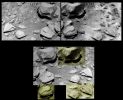
SOL1360-3.jpgLight & Filter Tricks? (1)57 visiteAllora: il possibile "sfogo" di gas, fumi e polveri è solo uno scherzo dei filtri/colore di cui le camere del MER Spirit sono dotati? Paradossale, come suggerisce l'ottimo Dr Marco Faccin, che ci propone questo fotomosaico, ma possibile.
Ma lasciamo parlare il Dr Faccin:"...quindi possiamo intepretare la realtà a seconda dei filtri? Se vedo in un modo, cado nel buco e nell'altro ci passo sopra xchè è solida roccia?..."
Paradossale ma, al momento, sembra proprio che la risposta sia "Si: la realtà di Marte, ad occhi e per occhi terrestri, dipende dai filtri usati per ottenere le immagini".
Le immagini sono chiare: il rilievo superficiale controverso, in un frame pare che si risolva in un "foro", mentre in un altro frame si tratta solo di una roccia - bizzarra sinchè si vuole - ma senza "sfoghi" di sorta sulla sua superficie.
Un nuovo esempio di QUANTO sia difficile il Lavoro dell'Anomaly Hunter e QUANTO sia facile, mutatis mutandis, "speculare" sui rilievi curiosi sino a scriverci sopra dei libelli.
Ogni riferimento alle speculazioni di Hoagland & C., in questo caso, è assolutamente intenzionale e cercato.
E si, perchè se non siamo in condizione neppure di poter dire con sicurezza CHE COSA stiamo guardando quando ci troviamo a circa mezzo metro di distanza dal particolare controverso, come facciamo poi a scrivere libri e libelli su (presuntissimi) manufatti (ivi: "monumenti") che vengono inquadrati - male - da centinaia di Km di altezza?
Eppure c'è chi fa queste operazioni e riesce anche a rendersi credibile...Che dire? Complimenti! Noi preferiamo restare delusi, ma offrire spunti meditati e razionali.
Ottimo il fotomosaico del Dr Faccin, che ringraziamo di cuore, come sempre.MareKromium
|
|
| 25353 immagini su 2113 pagina(e) |
 |
|
|
|
|
1554 | |
|
|
|
|





