| Piú viste |

SOL455-2P166771091EFFA9DWP2406L7M1.jpgHorizon - Sol 455 (6)57 visitenessun commento
|
|

SOL455-2P166771248EFFA9DWP2406L7M1.jpgHorizon - Sol 455 (7)57 visitenessun commento
|
|
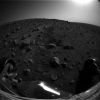
SOL456-2F166854146EFFA9EEP1201L0M1.jpgFront-View - Sol 45657 visitenessun commento
|
|

Dione&Tethys-PIA06629.jpgDione and Tethys57 visiteCaption NASA originale:"Cassini offers this lovely comparison between two of Saturn's satellites, Dione and Tethys, which are similar in size but have very different surfaces.
Extensive systems of bright fractures carve the surface of Dione. The double-pronged feature Carthage Linea points toward the crater Turnus at the nine o'clock position near the terminator and Palatine Linea runs toward the moon's bottom limb near the five o'clock position.
In contrast, the surface of Tethys appears brighter and more heavily cratered. The large crater Penelope is near the eastern limb. The huge rift zone Ithaca Chasma, which is 3 to 5 Km deep and extends for about 2.000 Km from north to south across Tethys, is hidden in shadow just beyond the terminator. For comparison, the Grand Canyon in Arizona is about 1,5 Km deep and about 450 Km long.
The image was taken in visible light from a distance of approx. 1,5 MKM from Tethys and 1,6 MKM from Dione. The image scale is 9 Km/pixel on Tethys and 10 Km/pixel on Dione".
|
|

Rhea-PIA06630.jpgRhea, from 1,8 MKM57 visiteCaption NASA originale:"The ancient and battered surface of Saturn's moon Rhea shows a notable dark swath of territory near the eastern limb in this image from Cassini.
This view shows principally the Saturn-facing hemisphere on Rhea (1.528 Km across). North is up and tilted 40° to the right.
The image was taken with the Cassini spacecraft narrow-angle camera on March 7, 2005, through a filter sensitive to wavelengths of ultraviolet light centered at 338 nnmts. The view was acquired at a distance of approx. 1,8 MKM (approx. 1,1 MMs) from Rhea and at a phase angle of 30°. Resolution in the original image was 10 Km per pixel.
The image has been contrast-enhanced and magnified by a factor of two to aid visibility".
|
|

Tethys-PIA06632.jpgTethys (infrared vision) from approx. 1,4 MKM57 visiteCaption NASA originale:"In this infrared view, Saturn's cratered moon Tethys shows a faint, dark band across its equatorial region. North is up in this view.
The image was taken with the Cassini spacecraft narrow-angle camera on March 11, 2005, through a filter sensitive to wavelengths of infrared light centered at 930 nnmts. The view was acquired at a distance of approximately 1,4 MKM from Tethys and at a phase angle of 80°. Resolution in the original image was 8 Km per pixel.
The image has been contrast-enhanced and magnified by a factor of two to aid visibility".
|
|

OPP-SOL442-1P167424812EDN55B0P2297R2M1.jpgVery unusual terrain around Opportunity (2)57 visitenessun commento
|
|
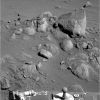
SOL465-2P167649543EFFA9HEP2281L7M1.jpgStones around Spirit (Sol 464) - 457 visiteUn solo commento, a chiusura di questo piccolo panorama in 4 frames: le immagini ottenute con la PanCam (scusateci ma non ricordiamo se questo commento è già stato fatto in passato), a prescindersi dal filtro/colore utilizzato, sembrano non avere nè spessore, nè profondità.
E' una scelta deliberata del NASA-Team oppure una semplice (ed inevitabile) caratteristica dei frames PanCam?
Noi non ne abbiamo idea. E Voi?!?
|
|

Epimetheus-PIA06226.jpgEpimetheus up close (from about 74.600 Km) but in false colors57 visiteCaption NASA originale:"The color of Epimetheus in this view appears to vary in a non-uniform way across the different facets of the moon's irregular surface. Usually, color differences among planetary terrains identify regional variations in the chemical composition of surface materials. However, surface color variations can also be caused by wavelength-dependent differences in the way a particular material reflects light at different lighting angles. The color variation in this false-color view suggests such "photometric effects" because the surface appears to have a more bluish cast in areas where sunlight strikes the surface at greater angles. The slightly reddish feature in the lower left is a crater named Pollux. The large crater just below center is Hilairea, which has a diameter of about 33 Km. At 116 Km across, Epimetheus is slightly smaller than its companion moon, Janus (181 Km across), which orbits at essentially the same distance from Saturn".
|
|

Tempel 1-PIA07879.jpgComet "Tempel 1"57 visiteCaption NASA originale:"Sixty-nine days before it gets up-close-and-personal with a comet, NASA's Deep Impact spacecraft successfully photographed its quarry, comet Tempel 1, at a distance of 39,7 MMs. The image, taken on April 25, 2005, is the first of many comet portraits Deep Impact will take leading up to its historic comet encounter on July 4, 2005".
|
|
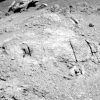
SOL468-2P167913877ESFA9I4P2560R2M1.jpgParallel cracks on a flat rock (2)57 visiteIl cambio di filtro/colore (per il primo frame, era stato usato il n. 3, ora è il n. 2) non cambia di molto la sostanza dell'immagine: le crepe confermano le caratteristiche che avevamo già evidenziato. Forse la sensazione che la roccia sia internamente "cava" viene leggermente rinforzata da questa nuova ripresa: guardate bene il bordo della crepa posta alla Vostra Sx il quale è opposto al punto di osservazione per rendervene conto.
|
|
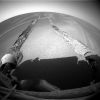
OPP-SOL449-1F168048686EFF55DIP1214L0M1.jpgDeep down in the sand! (1)57 visiteGuai seri per Opportunity e la notizia sembra proprio che abbia il crisma dell'ufficialità: il Rover si è "insabbiato".
No, non è un gioco di parole, nè - come Voi stessi potrete vedere in queste due immagini - uno scherzo: almeno 4 ruote del Rover sono letteralmente affondate in una duna particolarmente alta e soffice. Il rischio che un evento simile si verificasse c'era ed è innegabile, ma che il rischio diventasse realtà...Forse nessuno se lo aspettava.
E adesso?
Adesso la parola d'ordine è "to keep cool": stare calmi e non fare manovre azzardate che potrebbero compromettere in maniera definitiva le chances di recupero del Rover. Ci vorranno molti giorni e tantissime simulazioni (operate usando le repliche dei Rover), prima di tentare qualcosa per 'liberare' Opportunity.
|
|
| 25353 immagini su 2113 pagina(e) |
 |
|
|
|
|
1551 | |
|
|
|
|





