| Piú viste |

PHOE-SOL002-lg_542.jpgTwilights over Vastitas Borealis... - Sol 2 (MULTISPECTRUM; credits: Lunexit)57 visitenessun commentoMareKromium
|
|

PHOE-SOL002-lg_501.jpgDistant Mountains... - Sol 2 (MULTISPECTRUM; credits: Lunexit)57 visitenessun commentoMareKromium
|
|

PHOE-SOL002-lg_436-437-2.jpgThe soil of Vastitas Borealis - Sol 2 (Natural Colors + MULTISPECTRUM; credits: Dr Gianluigi Barca & Lunexit)57 visitenessun commentoMareKromium
|
|

PSP_008591_2485_cut_a.jpgPhoenix Lander "Hardware" (Day-Time Frame)57 visiteCaption NASA:"MRO’s HiRISE camera acquired this image of the Phoenix Landing Site 22 hours after landing. The image shows three unusual features which were not present in a pre-landing HiRISE image.
We expect to find three main pieces of hardware: the parachute attached to the backshell, the heat shield, and the lander itself.
The Parachute (bottom) is easy to identify because it is especially bright, and this image also clearly shows the Back-Shell. We can even see the stripes on the Parachute.
The dark marking (middle right) appears most consistent with disturbance of the ground from impact and bouncing of the Heat-Shield, which fell from a height of about 13 kilometers.
The last object (top) is the Lander, and we can clearly see the solar arrays on each side. The solar arrays were relatively dark in the image acquired 11 hours after landing, but are brighter than the Mars surface in this daytime image acquired with the HiRISE blue-green filter.
There are dark halos around all three locations, perhaps due to disturbing a thin dust coating.
North is about 7°to the right of straight up in this image and illumination is from the lower left".MareKromium
|
|
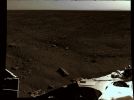
PHOE-SOL002-lg_542-543-3.jpgLandscape... Sol 2 (Natural Colors + MULTISPECTRUM; credits: Dr G. Barca & Lunexit)57 visitenessun commentoMareKromium
|
|

PHOE-SOL002-lg_542-543-2.jpgLandscape... Sol 2 (Natural Colors; credits: Dr G. Barca)57 visitenessun commentoMareKromium
|
|

Pan-PIA09911.jpgAlmost invisible...57 visiteCaption NASA:"Pan coasts down its private highway within the Encke Gap.
The process by which Pan (about 28 Km, or 17 miles across) maintains the gap, clearing the neighborhood around its orbit, is believed to be similar to the way that planets clear gaps in debris disks around young stars. This view looks toward the unilluminated side of the Rings from about 11° above the Ring-Plane.
The limb of Saturn is seen through the Rings, at the upper left.
The image was taken in visible light with the Cassini Spacecraft narrow-angle camera on April 24, 2008. The view was obtained at a distance of approx. 1,3 MKM (such as about 784.000 miles) from Pan.
Image scale is roughly 8 Km (approx. 5 miles) per pixel".MareKromium
|
|
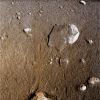
PHOE-SOL005-233919main_SS005EFF896647257_11708RBM1-2-3.jpgSmall Rocks in a Greenish/Reddish Soil - Sol 5 (Superdefinition; credits: Dr G. Barca)57 visitenessun commentoMareKromium
|
|

PHOE-SOL004-PIA10726.jpgDark Arctic Panorama (MULTISPECTRUM; credits: Lunexit)57 visiteNotizia dell'ultima ora: malfunzionamento di alcuni circuiti del Phoenix Lander. Il Sito NASA dedicato è, al momento, non raggiungibile.
Ricerca di "Interesse e Pathos" o "Problema Reale Grave"? Pubblicheremo le novità non appena possibile.
Caption NASA:"Typical view if you were standing on Mars and slowly turned around for a look. Starting at the North, SSI sees its shadow and turns its head viewing Solar Arrays, the Lander Deck and landscape. Note very few rocks on the hummocky terrain and network of troughs, typical of Polar Surfaces here on Earth".MareKromium
|
|

PHOE-SOL004-PIA10739.jpgIce under Phoenix?!? - Sol 457 visiteCaption NASA:"This contrast-enhanced image was acquired at the Phoenix Landing Site on Sol 4 by Phoenix's Robotic Arm Camera (RAC). As seen in the top center, the exhaust from the descent engine has blown soil off to reveal either rock or ice, which has not yet been determined".MareKromium
|
|
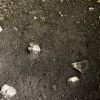
PHOE-SOL006-234593main_SS005ESF896648917_10F20R2M1-2-3.jpgThe soil of Vastitas Borealis - Sol 6 (Natural Colors; credits: Dr Gianluigi Barca)57 visiteUna splendida immagine (sembra insignificante, ma NON lo è...) ed una meravigliosa interpretazione in Colori Naturali del suolo di Vastitas Borealis, realizzata dall'eccezionale Dr Gianluigi Barca.
MareKromium
|
|
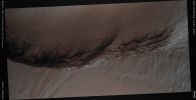
PSP_008244_2645_RED_abrowse.jpgNorth Polar Layered Deposits (MULTISPECTRUM; credits: Lunexit)57 visiteThe North Polar Layered Deposits of Mars form a layered stack of dusty ice up to 3 Km (about 2 miles) thick. The differences from layer to layer are thought to reflect differences in the climate of Mars that existed when the layers were formed.
We can see these internal layers exposed on the faces of the many troughs and scarps that cut through these deposits.
One of these scarp faces is shown here; it is situated at the head of a large canyon (named Chasma Boreale) that cuts through these Polar Layered Deposits.
The terrain on the upper side of the picture is higher and consists of the upper surface of the icy layered deposits in this area while the terrain on the lower side of the frame consists of the rocky ground that underlies the layered deposits. The cliff that separates these two areas runs down the center of the image with a relief of about 700 meters (about 2300 feet).
The section of the Layered Deposits that is exposed on this cliff face is unusual in that, as well layers of dusty ice, there are also layers of sand present. Small structures, called cross-beds, visible in the sandy layers indicate that each layer was originally a dune field that only later became covered with ice. Some of this sandy material is being removed from the cliff face and is forming new dunes at the foot of the cliff.MareKromium
|
|
| 25353 immagini su 2113 pagina(e) |
 |
|
|
|
|
1544 | |
|
|
|
|





