| Piú viste |

PSP_006952_1870_RED_abrowse-01.jpgDunefield in West Arabia Terra Unnamed Crater (extra-detail mgnf - RAW Frame; credits: NASA/JPL/Univ. of Arizona)57 visiteBarchan dunes are commonly found on Earth, and are generally crescent-shaped with a steep slip face bordered by horns oriented in the downwind direction (see here).
Barchan dunes form by unidirectional winds and are good indicators of the dominant wind direction. In this case, the strongest winds blew approximately North to South.
These dunes are most likely composed of basaltic sand that has collected on the bottom of the crater. Superimposed on their surface are smaller secondary dunes which are commonly seen on terrestrial dunes of this size.
Many smaller and brighter bed forms — most likely small dunes or granule ripples — also cover the substrate between the larger dark dunes.
The dark dunes overlie the small bright bed forms indicating that the darker dunes formed more recently.MareKromium
|
|
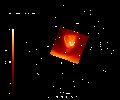
Venus-South_Polar_Vortex-13_VIRTIS_vortex_movie_H.gifThe restless South Pole of Venus (GIF-Movie - credits: ESA)57 visiteCaption ESA:"This video is composed of a set of images acquired by the Visible and Infrared Thermal Imaging Spectrometer (VIRTIS) on board ESA’s Venus Express, during two observations slots in August 2007. The spacecraft was flying at a distance of about 65.000 Km from the Planet.
The video was obtained at 3.8-micrometre wavelength, allowing the instrument to see the cloud top thermal emission at an altitude of about 60-65 Km.
The South Polar "Dipole", a complex atmospheric vortex-like feature situated over the South Pole of the Planet, can be clearly seen".MareKromium
|
|

Venusian_Clouds-29_VM_Pericentre_mosaic_H.jpgChaotic "Cloud Patterns" at Venus57 visiteCaption ESA:"This mosaic of Venus’ cloud tops was put together with several images obtained by the Venus Monitoring Camera (VMC) on board ESA’s Venus Express. The images where taken in the ultraviolet (365-nanometre wavelength) on 15 August 2006 at distances from 5000 to 1000 Km from the Planet.
The picture clearly shows streaks, wave trains and convection cells. The elongated orbit of Venus Express allows one to zoom into the cloud features as the Spacecraft approaches the Planet. This mosaic shows that mottled and chaotic cloud patterns at low latitudes give way to oriented streaks at about 15° South.
This behaviour indicates transition between two different cloud motion regimes – a ‘dynamic’ regime dominated by local convection where the Sun light hits the Planet perpendicularly (so-called "Sub-Solar Point") - and a more regular, quasi-laminar-flow regime".
MareKromium
|
|

Venus-South_Pole-02.jpgThe South Pole of Venus (Natural Colors; credits for the additional process. and color.: Dr Paolo C. Fienga - Lunexit Team)57 visitenessun commentoMareKromium
|
|

LunarEclipses.jpgEclipses...57 visiteCaption NASA, da "NASA - Picture of the Day", del 29 Febbraio 2008:"Welcome to the extra day in the Gregorian Calendar's leap year 2008! To celebrate, consider this grid of lunar eclipse pictures - starting in leap year 1996 and ending with February's eclipse - with the date in numerical year/month/day format beneath each image. Mostly based on visibility from a site in Turkey, the 3x4 matrix includes 11 of the 13 total lunar eclipses during that period, and fills out the grid with the partial lunar eclipse of September 2006. Still, as the pictures are at the same scale, they illustrate a noticeable variation in the apparent size of the eclipsed Moon caused by the real change in Earth-Moon distance around the Moon's elliptical orbit. The total phases are also seen to differ in color and darkness. Those effects are due to changes in cloud cover and dust content in the atmosphere reddening and refracting sunlight into Earth's shadow. Of course, the next chance to add a total lunar eclipse to this grid will come at the very end of the decade".MareKromium
|
|

PSP_007043_2650-BLUE-MarsPolarDunes2_hirise_big-01.jpgSand Dunes Thawing on Mars (Natural Colors; credits: Lunexit)57 visitenessun commentoMareKromium
|
|

PSP_006969_1725_RED_abrowse-01.jpgThe Floor of Noctis Labyrinthus (extra-detail mgnf - MULTISPECTRUM; credits: Lunexit)57 visiteThe most striking feature of many of these knobs is a thin, bright band which often wraps around the edges near the bottom, as in this extra-detail mgnf. This image was acquired in order to investigate whether this is an exposed layer of rock or the shoreline of a former body of water.
HiRISE resolves details of the bright band that indicate that this is an unusual layer of rock, rather than an old shoreline. In several places, the band is broken up along cracks, sometimes forming boulders. This indicates that the band is solid rock, while material left on a shoreline should be loose sediments. It is now exposed as rings and arcs where erosion has cut deeply enough to expose the layer.
This band must indicate some unusual event in the geologic history of the region when a different type of rock was deposited; it is strikingly different in color from the other rocks. Although it is not a shoreline, it could be material that was deposited on the floor of a much older lake or sea and then buried by other rock; it could also have been laid down by other sedimentary processes or as volcanic ash.
MareKromium
|
|
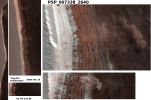
PSP_007338_2640_hires.jpgCaught in Action: Avalanches on North Polar Scarps (false colors; credits: NASA)57 visiteAmazingly, this image has captured at least four Martian avalanches, or debris falls, in action. It was taken on February 19, 2008, by the High Resolution Imaging Science Experiment (HiRISE) camera on NASA's Mars Reconnaissance Orbiter.
The image to the left shows the context of where these avalanches occurred, with white boxes indicating the locations of the more detailed image portions shown to the right. All images are false color. Material, likely including fine-grained ice and dust and possibly including large blocks, has detached from a towering cliff and cascaded to the gentler slopes below. The occurrence of the avalanches is spectacularly revealed by the accompanying clouds of fine material that continue to settle out of the air. The largest cloud (upper images) traces the path of the debris as it fell down the slope, hit the lower slope, and continues downhill, forming a billowing cloud front. This cloud is about 180 meters (590 feet) across and extends about 190 meters (625 feet) from the base of the steep cliff. Shadows to the lower left of each cloud illustrate further that these are three dimensional features hanging in the air in front of the cliff face, and not markings on the ground. Sunlight is from the upper right.
Cameras orbiting Mars have taken thousands of images that have enabled scientists to put together pieces of Mars' geologic history. However, most of them reveal landscapes that haven't changed much in millions of years. Some images taken at different times of year do show seasonal changes from one image to the next, however, it is extremely rare to catch such a dramatic event in action. (Another, unrelated, active process that has been captured by Mars cameras are dust devils.) Observing currently active processes is often a useful tool in unlocking puzzles of the past for scientists studying the Earth. Working from primarily still images, it is harder for scientists studying Mars to rely on this tool. The HiRISE image of avalanching debris is a very rare opportunity to directly do so.
The scarp in this image is on the edge of the dome of layered deposits centered on Mars' north pole. From top to bottom this impressive cliff is over 700 meters (2300 feet) tall and reaches slopes over 60 degrees. The top part of the scarp, to the left of the images, is still covered with bright (white) carbon dioxide frost which is disappearing from the polar regions as spring progresses. The upper mid-toned (pinkish-brownish) section is composed of layers (difficult to see here) that are mostly ice with varying amounts of dust. The darkest deposits below form more gentle slopes, less than 20 degrees, and are mainly composed of two materials: mid-toned layers, possibly ice-rich, that form small shelves, and more mobile, wide-spread, sand-sized dark material. The wavy forms on the flatter areas to the right are dunes.
The upper, steepest section, which appears highly fractured due to blocks pulling away from the wall, is the likely source zone for the falls. The precise trigger mechanism is not yet known, although the disappearance of the carbon dioxide frost, the expansion and contraction of the ice in response to temperature differences, a nearby Mars-quake or meteorite impact, and vibrations caused by the first fall in the area, are all possible contributors.
By comparing images taken before the fall (such as HiRISE image PSP_007140_2640) and after the fall, we may be able to see where material has disappeared from the steep scarp and where it has appeared on the gentler slopes below, possibly as larger blocks, diffuse streaks, or other debris deposits. By imaging this scarp throughout the polar summer, we may be able to determine how much material falls over a given time period. These observations would help determine how much, and at what rate, ice is being eroded from the cliff. Understanding the processes and rates of erosion will help determine how the polar landscape has evolved, and help reveal how volatiles, such as water and carbon dioxide ices and gases, move around Mars.
The precise composition of the ice-dust mixture making up layers in the upper, steepest section of scarp is not known. However, detailed measurements of the volume of material removed, the configuration of the source area, and the steepness of the slope can be used to estimate physical properties of the material that may relate to composition.
The complete image, HiRISE PSP_007338_2640, is centered at 83.7 degrees latitude, 235.8 degrees east longitude. The image was taken at a local Mars time of 1:05 PM and the scene is illuminated from the west with a solar incidence angle of 70 degrees, thus the sun was about 20 degrees above the horizon. At a solar longitude of 34.0 degrees, the season on Mars is northern spring.
NASA's Jet Propulsion Laboratory, a division of the California Institute of Technology in Pasadena, manages the Mars Reconnaissance Orbiter for NASA's Science Mission Directorate, Washington. Lockheed Martin Space Systems, Denver, is the prime contractor for the project and built the spacecraft. The High Resolution Imaging Science Experiment is operated by the University of Arizona, Tucson, and the instrument was built by Ball Aerospace and Technology Corp., Boulder, Colo.
MareKromium
|
|
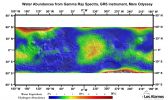
023-Mars_Water-2.jpgWhere is the "Water" of Mars? (Equatorial and Middle Latitude Regions)57 visiteA Neutron Spectrometer on the Mars Odyssey Spacecraft measures the abundances of neutrons of various energies emitted from Mars' Surface.
The ratio of low- to high-energy neutrons is a sensitive test of water abundances within a meter of Mars' surface.
There is LOTS of water. No one had expected any where near this much water near the Martian Surface.
All this is BETTER described in a press release from the Los Alamos National Laboratory, home of the Neutron Spectrometer and the scientists who run it (http://www.lanl.gov/news/releases/archive/03-101.shtml). MareKromium
|
|
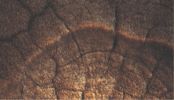
PSP_007173_2245_RED_abrowse-01.jpgScallops and Polygons in the Utopia Planitia Region (extra-detail mgnf - MULTISPECTRUM; credits: Lunexit)57 visiteSeveral cracks cut through the side of the scallops suggesting that they must be at least as deep as the scallops. The polygons may have been present previous to the erosion of the mantle.
The landforms we observe here most likely show that ice-rich permafrost is present or has been present geologically recently. At this latitude on Mars, the conditions of pressure and temperature allow water ice within the ground to sublime.
The disappearance of the ice component of the ground probably leads to the formation of the depressions, a process that may still be active today.MareKromium
|
|

Enceladus-5-CASSINI-big.jpgOver and Above... (natural colors; credits: Lunexit)57 visiteCaption NASA:"What does the surface of Saturn's ice-spewing moon Enceladus look like? To help find out, the robotic Cassini Spacecraft now orbiting Saturn was sent soaring past the cryovolcanic moon and even right through one of Enceladus' ice plumes.
Cassini closed to about 52 Km during its closest encounter to date. The above unprocessed image was taken looking down from the North, from about 30.000 Km away. Visible are at least two types of terrain.
The first type of terrain has more craters than occur near Enceladus' South Pole.
The other type of terrain has few craters but many ridges and grooves that may have been created by surface-shifting tectonic activity.
Exogeologists are currently poring over this and other Cassini images from last Wednesday's flyby to better understand the moon's patch-work surface, its unusual ice-geysers, and its potential to support life. Cassini is scheduled to fly by Enceladus at least 9 more times, including an even closer pass of just 25 Km in October 2008".MareKromium
|
|

PSP_006673_1600_RED_abrowse.jpgBright Material on the Floor of an Unnamed Crater (natural colors; credits: Lunexit)57 visiteThis image shows part of a crater wall and floor, where the floor is covered by dunes and distinct regions of bright material. The bright material stands higher than the rest of the floor suggesting that it is more resistant to erosion than surrounding materials.
It is possible that more and more bright material will be exposed over time; why the material is bright is unknown.
The material might be evaporites, that form when salt water dries up and leaves behind salt deposits (the evaporites).
Also in this scene is a crater with a ridge running up to its west (left) side. The ridge is lighter and might be evidence that water flowed through it, bleaching the rocks as it went. The water might have cemented the soil, causing it to be more resistant to erosion and high standing as seen today.MareKromium
|
|
| 25353 immagini su 2113 pagina(e) |
 |
|
|
|
|
1540 | |
|
|
|
|





