| Piú viste |

M-031~2.jpgM 31 - The "Great Andromeda Galaxy"211 visite"...Ethos anthropoi daimon..."
Eraclito
"...Il destino (di ognuno di noi) è nella (propria) personalità (nel proprio carattere)..." (trad. libera)MareKromium
|
|

OPP-SOL2695-1N367432357ESFBMLVP1961L0M1-PCF-LXTT.jpgLooking inside Endeavour Crater - Sol 2695 (Absolute Natural Colors; credits for the additional process. and color: Dr Paolo C. Fienga - Lunexit Team)211 visitenessun commentoMareKromium
|
|

Chaotic_Terrain-Eos_Chaos-04.jpgFeatures of Eos Chaos: High Slope (Natural Colors; credits for the additional process. and color.: Dr Paolo C. Fienga - Lunexit Team)211 visiteLocation near: 12,9° South Lat. and 49,5° West Long.
Image width: ~3 Km (~1,9 mi)
Illumination from: lower left
Season: Southern SummerMareKromium
|
|

ESP_023304_1995_RED_abrowse.jpgFeatures of Chrise Planitia: Cones, Shield-like Features and small round Mounds (Absolute Natural Colors; credits for the additional process. and color.: Dr Paolo C. Fienga - Lunexit Team) 211 visiteMars Local Time: 13:59 (Early Afternoon)
Coord. (centered): 19,1° North Lat. and 322,9° East Long.
Spacecraft altitude: 289,9 Km (such as about 181,2 miles)
Original image scale range: 29,0 cm/pixel (with 1 x 1 binning) so objects ~ 87 cm across are resolved
Map projected scale: 25 cm/pixel
Map projection: EQUIRECTANGULAR
Emission Angle: 12,6°
Sun-Mars-Spacecraft (or "Phase") Angle: 53,7°
Solar Incidence Angle: 43° (meaning that the Sun is about 47° above the Local Horizon)
Solar Longitude: 329,5° (Northern Winter)
Credits: NASA/JPL/University of Arizona
Additional process. and coloring: Dr Paolo C. Fienga - Lunar Explorer ItaliaMareKromium
|
|
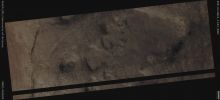
ESP_023803_1345_RED_abrowse.jpgClay-bearing Layered Deposit located within an Unnamed Crater, North of Proctor Crater (Absolute Natural Colors; credits for the additoonal process. and color.: Dr Paolo C. Fienga - Lunexit Team)211 visiteMars Local Time: 14:19 (Early Afternoon)
Coord. (centered): 45,4° South Lat. and 28,0° East Long.
Spacecraft altitude: 253,0 Km (such as about 158,1 miles)
Original image scale range: 25,3 cm/pixel (with 1 x 1 binning) so objects ~ 76 cm across are resolved
Map projected scale: 25 cm/pixel
Map projection: EQUIRECTANGULAR
Emission Angle: 6,5°
Sun-Mars-Spacecraft (or "Phase") Angle: 55,9°
Solar Incidence Angle: 51° (meaning that the Sun is about 39° above the Local Horizon)
Solar Longitude: 350,2° (Northern Winter)
Credits: NASA/JPL/University of Arizona
Additional process. and coloring: Dr Paolo C. Fienga - Lunar Explorer ItaliaMareKromium
|
|

Volcanoes-Olympus_Mons.jpgImage n. 641A52 - Olympus (Enhanced Absolute Natural Colors; credits for the additional process. and color.: Dr Paolo C. Fienga - Lunexit Team) 211 visiteThis image shows the Volcano Olympus Mons. With a diameter of more than 600 Km (approx. the size of Arizona) and a height of nearly 25 Km above the surrounding Plains, Olympus it is the tallest volcano known to exist in the Solar System. When clouds are present, it is sometimes even visible above the clouds.
The relative ages of the Surface in various parts of Mars can be estimated from the number of Impact Craters present in a given area, with young regions having fewer craters than old regions. Only two Craters are visible here, indicating that Olympus Mons is young, probably the youngest Volcanic Feature on Mars. By some estimates, the most recent large volcanic eruption at Olympus Mons occurred only 25 million years ago. The oldest activity at Olympus Mons could be much older than this and would have been buried by younger Lava Flows.
The Caldera of Olympus Mons is the depression near the top center of the image. The Caldera is about 65 × 80 Km across (approx. the size of Rhode Island) and occurs near the maximum elevation of the Volcano. It formed when the Magma within the Volcano either erupted out of Vents located on the side, or temporarily drained deeper into the Planet. In either case, the removal of this Magma allowed part of the overlying Surface to collapse, producing a topographic depression that is termed as "Caldera". The overlapping series of structures in the Olympus Mons Caldera demonstrates that this Magma withdrawal occurred a number of different times.
Similar Calderas are seen on other Volcanos, both on Mars and on Earth.MareKromium
|
|

OPP-SOL179-1N144073610EFF3336P1950L0M1.jpgThe Rim of Endurance Crater at Sunset - Sol 179 (Absolute Natural Colors; credits for the additional process. and color.: Dr Paolo C. Fienga - Lunexit Team)211 visitenessun commentoMareKromium
|
|

PSP_007547_1895_RED_abrowse-02.jpgFeatures of Shalbatana Vallis (EDM n.1 - Absolute Natural Colors; credits for the additional process. and color.: Dr Paolo C. Fienga - Lunexit Team)211 visiteThis image covers an area where the Southern Branch of Shalbatana Vallis opens into Chryse Planitia, showing a variety of boulders that have moved down slope leaving tracks on the surface.
These boulders may have been thrown out from low-energy secondary craters, or simply eroded out of the above rocky cliff.
MareKromium
|
|
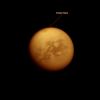
Titan-Seas-Kraken_Mare-PIA14584-PCF-LXTT.jpgKraken Mare (Enhanced Absolute Natural Colors; credits for the additional process. and color.: Dr Paolo C. Fienga - Lunexit Team)211 visiteCaption NASA:"The Cassini Spacecraft looks toward Saturn's largest moon, Titan, and spies the huge, Northern Kraken Mare. Kraken Mare, a large sea of liquid hydrocarbons and is visible as a dark area near the top of the image. This view looks toward the Saturn-facing Side of Titan. North on Titan is up and rotated 29° to the left.
The image was taken with the Cassini Spacecraft narrow-angle camera on Sept. 14, 2011 using a spectral filter sensitive to wavelengths of Near-InfraRed Light centered at 938 nanometers. The view was acquired at a distance of approx. 1,2 MMs (such as about 1,9 MKM) from Titan and at a Sun-Titan-Spacecraft, or Phase, Angle of 26°.
Image scale is roughly 7 miles (approx. 12 Km) per pixel".MareKromium
|
|
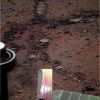
OPP-SOL2789-GB-LXTT-00.jpgRover Tracks - Sol 2789 (Enhanced Natural Colors; credits for the additional process. and color.: Dr Gianluigi Barca - Lunar Explorer Italia)211 visitenessun commentoMareKromium
|
|

Channels-Shalbatana_Vallis-PIA15184-PCF-LXTT.jpgFeatures of Shalbatana Vallis (Absolute Natural Colors; credits for the additional process. and color.: Dr Paolo C. Fienga - Lunexit Team)211 visiteOrbit Number: 44005
Latitude: 13,834° North
Longitude: 317,526° East
Instrument: VIS
Captured: November, 15th, 2011
Mars Local Time (M.L.T.): 16:10 (Middle Afternoon)
MareKromium
|
|

APOLLO 11 AS11-40-5847 ritoccata.jpgAS 11-40-5847 - Moonscape with crater (1)210 visiteL'annotazione "ritoccata" che vedete, accanto al frame number, ci è sembrata, ancora una volta, doverosa.
L'immagine è ad Alta Definizione (HR) e va bene, però la linea dell'orizzonte sembra davvero "tagliata con il rasoio" per quanto è precisa.
In quasi tutte le foto della Serie Apollo 11, anche quelle HR, l'orizzonte non è mai perfettamente netto e definito.
C'è sempre una leggera (ed alcuni Ricercatori dicono "inspiegabile") sfuocatura.
Qui e nel frame successivo, no.
|
|
| 25353 immagini su 2113 pagina(e) |
 |
|
|
|
|
154 | |
|
|
|
|





