| Piú viste |
OPP-SOL101-CLOUDS-1N137172962EFF2019P1559L0M1.jpgMorning Clouds - Sol 101 (Natural Colors; credits for the additional process. and color.: Dr Paolo C. Fienga - Lunexit Team)57 visitenessun commentoMareKromium
|
|

Craters-Unnamed_Craters_in_Vastitas_Borealis.jpgTwin-Craters?57 visitenessun commentoMareKromium
|
|
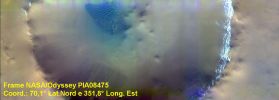
Craters-Unnamed_Crater-Vastitas_Borealis-PIA08475-00.jpgUnnamed Crater with frosted Rim... (False Colors; credits: NASA/JPL-ASU)57 visitenessun commentoMareKromium
|
|
NGC_7000.jpgNGC 700057 visite"...Salvo che questa supernova sembra insolitamente luminosa", esclamò Tom Cook.
"Lo è stata ancor di più" annunciò Bill Gaynor, che era appena arrivato.
"Non mi sono coricato. Sono stato sveglio sino a quando non è sorta - ad Est, circa un'ora fa".
"Quanto è adesso?"
"Direi circa meno 8" (25 volte più luminosa di Venere)
Nella sala comune si udì un fischio.
"Più simile ad una dannata quasar che ad una supernova!..." mormorò qualcuno.
A questa osservazione seguì un lungo silenzio, interrotto da Almond.
"Il che spiegherebbe qualcosa che mi stava preoccupando maledettamente".
"Di che si tratta, Dr Almond?" chiese Gaynor, gli occhi arrossati dalla mancanza di sonno.
"Il fatto è che la posizione di quella cosa è esattamente la stessa del Centro Galattico.
E' del tutto ovvio, no? Il centro della Galassia è esploso".
Mentre Almond faceva questa affermazione la sua profonda voce aveva un tono grave...".
"The Inferno" di Fred e Geoffrey Hoyle
|
|

Gullies-Hale_Crater-R07-02277_R13-01791_S16-01780_fig.jpgGullies in Hale Crater (False Colors; credits for the additional process. and color.: Dr Paolo C. Fienga - Lunar Explorer Italia)57 visiteThe MGS-MOC captured 2 examples of gullies on crater walls in which a change occurred between 1999 and 2005.
In each case, one in Terra Sirenum, the other in the Centauri Montes, new light-toned material was deposited during the MGS Mission. These new light-toned deposits may be indicators that water flowed at these two gully sites during the past few years. Naturally, a question arises: are there other gullies at which similar light-toned deposits have formed?
To answer the question, the MOC Team at MSSS reviewed every MOC image ever taken of a Martian Gully. Most of the gullies occur at middle latitudes in both the Northern and Southern Hemispheres. This re-examination turned up several good examples of other light-toned materials deposited in gullies. However, in none of these cases is there a “before” image, with no light-toned material, followed by an “after” image in which new light-toned material had appeared. Thus, one cannot know how long ago these other light-toned deposits formed.
However, these are excellent candidates for future monitoring with orbiter cameras that have sufficient spatial resolution to look for new light-toned deposits, should they form during the coming years.
|
|

as17-147-22469.jpgAS 17-147-22469 - Family Mountain and Geophone57 visitePre-EVA-1 LM window pan. LM Shadow, Geophone Rock, (West) Family Mountain.
MareKromium
|
|

as17-147-22512.jpgAS 17-147-22512 - Up-Sun57 visiteEVA-1 at the LM. 4 o'clock pan. Gap between the Sculptured Hills and the East Massif.
|
|

Titan-Clouds-PIA09033.jpgClouds and Surface57 visiteCaption NASA originale:"This image set was taken at a distance of 15.000 Km (9.300 miles) from Titan and shows two views of an area riddled by mountain ranges that were probably produced by tectonic forces.
Near the bottom of the right image, a band of bright clouds is seen.
These clouds are probably produced when gaseous methane in Titan's atmosphere cools and condenses into methane fog as Titan's winds drive air over the mountains. It was once thought that these recurring clouds were produced by volcanic activity on Titan, but this image calls that idea into question.
These views were obtained during an Oct. 25 flyby designed to obtain the highest-resolution infrared views of Titan yet. Cassini's VIMS resolved surface features as small as 400 mt (1300 feet). The images were taken at wavelengths of 1,3 microns shown in blue, 2 microns shown in green and 5 microns shown in red".MareKromium
|
|
SOL1041-2R218777640EFFAS64P1301R0M1-02.jpgFrom the "b&w raw material" to a "decent color-frame": step 2 (digital clean-up)57 visitenessun commento
|
|

OPP-SOL1027-1N219361542EFF77HRP1986L0M1.jpgVictoria Crater (2) - Sol 102757 visitenessun commento
|
|
as12-46-6729~0.jpgAS 12-46-6729 - Alan Bean on the Lunar Surface57 visiteCaption NASA originale:"At about 115:51:59 MT, Pete Conrad asked Alan Bean to pose as he stepped off the LM footpad for the first time. Note the porch rails at the top of the ladder and the curve of Surveyor Crater beyond Al".MareKromium
|
|
as13-58-8465.jpgAS 13-58-8465 - Farewell "Odyssey"...57 visiteMareKromium
|
|
| 25353 immagini su 2113 pagina(e) |
 |
|
|
|
|
1536 | |
|
|
|
|





